
Pierce v. Society of Sisters:The 100th Anniversary-Parents’ Rights Children’s Rights & Social Rights
PANEL 3
A central doctrinal legacy of Pierce is the recognition of parental rights in directing the education of their children. This legacy implicates children’s rights in the context of their education, as well as the right of society to use education for the replication of social values. The scope and meaning of these rights have changed over the past century. This panel will explore the meaning of these different rights, then and now, considering what parents’ rights are vis-à-vis the state and their children’s interests, including their right to direct religious education and homeschooling, as well as current issues of parents’ rights to control public school education around race, political content, and information related to gender-affirming care.
Moderator: Judge Daniel A. Bress, U.S. Court of Appeals for the Ninth Circuit
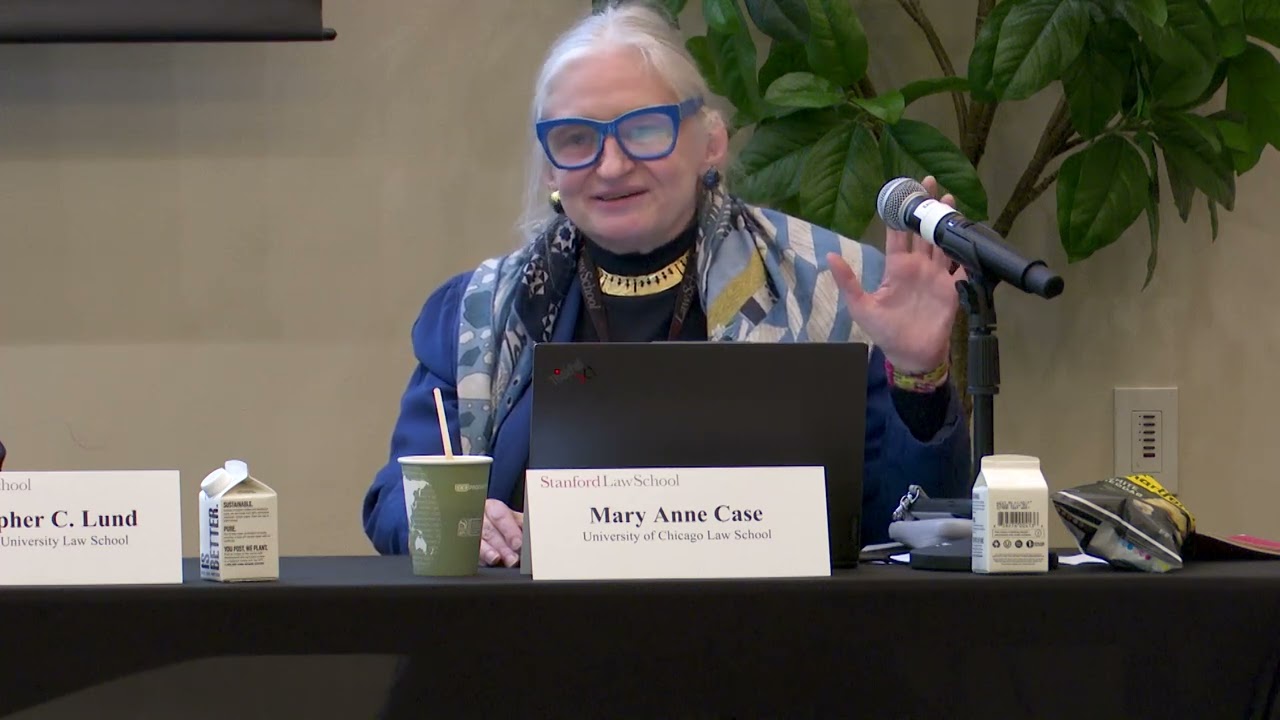
Okay, we are here at the three 30 afternoon session. My name is Dan Bress. I wanna thank Michael McConnell and the constitutional Law Center for putting on this wonderful discussion and for including me. It’s great to be back at Stanford. Pierce talks about parents directing the destiny of their children.
It was my father’s destiny for us that we would, all of his sons would be undergraduates here at Stanford and become doctors. And nobody fulfilled the destiny, but it’s great to be it’s great to be here with all of you. The panel we have is entitled Par Parents’ Rights, children’s Rights and Social Rights, and the panel, I think at least by the description, which perhaps is more advisory.
Is, I think, a good continuation of the discussion that we just heard from the prior panel raising questions about whose rights we’re really talking about parents versus children, the role of religion in conceptualizing and thinking about these rights and some of the issues that can come up in terms of indoctrination versus exposure and what Pierce has to say about all these issues, especially as we travel forward in time to Mahmud, which which Michael referenced and which I hope is part of our discussion in this last panel.
So I wanna introduce briefly our panel members professor Mary Anne Case from the University of Chicago Law School, who she was previously at the University of Virginia Law School, a place near and dear to my heart, which has written broadly in the areas of constitutional law, feminist jurisprudence in the regulation of sexuality and family law.
And Mark Storslee directly to my left is an associate professor at Emory University School of Law. And you may remember Mark, because he prior to that time was the executive director here at the Constitutional Law Center and can’t be can’t not be mentioned. He was also a law clerk to judge diarmuid o’scannlain, my colleague who’s here with us, and of course, justice Gorsuch on the Supreme Court and Chris in the middle.
Chris Lund is a professor of law at Wayne State University Law School. And Chris has written in areas of contracts, constitutional law and religious liberty. And along with Michael McConnell is a author of a church state case book entitled Religion in the Constitution. So I wanna welcome each of our panelists here.
We heard a little bit about standardization or lack thereof in pea, and our panel will slightly adjust the structure of this. My direction. In addition to deciding cases and controversies, I’m a professional moderator of panels and so I’ve asked the panel members to each first speak one to two minutes on a quick hit overview.
And then we are gonna hear in greater depth from each of them. And Professor Case. I’m gonna use my overview to tell people who don’t know where I’m coming from, this parents’ rights, children’s rights, social rights. I’m here on behalf of social rights. I am neither a parent, nor, have been a child and not incidentally, a child with 13 years of Catholic education.
I come here to talk about my interests and my rights as a citizen, as a taxpayer for having fellow citizens, fellow taxpayers, neighbors who are at least educated in and. I hope will have learned to share the values that I think are foundational to this country. The particular value that is my hobby horse is something I’ve been calling for decades, feminist fundamentalism, by which I mean a deep of commitment to the equality of the sexist that is at my fun, my root, my base, that I’m not prepared to compromise, and that I also, at least until recently from the 1970s to the present thought were foundational fundamental to the Constitution of the United States.
And its interpretation. And I play with analogies to religion. When I work out feminist fundamentalism there are sectarian views of what the equality and liberty of the sexes are. I happen to share my sectarian views with what. Up until now have been those of the Constitution of the United States.
That is, there should be, quote, no fixed notions concerning the roles and abilities of males and females. Thank you, mark. I. Okay. Hey everybody. I’m so grateful to be here. Thanks for to Michael for inviting me and to get to talk with you about some of these problems. So as we heard in the last panel, the legacy of Pierce and sort of its meaning for thinking about parental rights in education is front and center at the Supreme Court this term in Mahmud versus Taylor, the court is gonna consider whether the free exercise clause provides a right to opt children out of.
Public school instruction using targeted L-G-B-T-Q storybooks at odds with the parents’ Faith. We talked last time the case raises some fundamental issues about the free exercise clause, but given the topic of our panel I wanted to focus on another set of questions that the case presents questions about the relationship between parents’ rights and public schools.
And most, basically I wanna propose the idea that the historic doctrine of in local parentes, the idea that schools exercise some kind of delegated parental authority. I. Might provide the appropriate starting place for thinking about these issues. And maybe more specifically and a little more provocatively.
I wanna suggest that rightly understood this doctrine of In Loco Parentes ought to yield a highly protective understanding of the constitutional rights of both parents and children in public schools. And that last part, I think, is pretty controversial or at least controversial in some circles because on several occasions in local parentis has been used by the court and by some of the more originalist justices to severely limit constitutional rights in public schools, especially the rights of students.
And meanwhile, progressives sometimes deploy the doctrine or gesture towards it as a way to curtail parental rights. And I really wanna push back on both of those approaches. I think correctly conceived in local parentis provides. A reason to affirmatively protect constitutional rights of all kinds in the public school setting students’ rights and parents’ rights, with only the narrowest of exceptions.
And with a lot of fear and trembling. What I wanna propose to you and try to convince you of is that, getting back to that sort of getting back and clarifying that key idea is really the key to understanding some of the constitutional law in this area. Okay, great, Chris. I’m pleased to, I’m pleased to be here with this great group of popes.
I dunno if this mic’s working, but that’s fine. I wanna take the idea of social rights in a slightly different direction when I talk about. Groups and group rights and interests in the context of parents and children. I don’t know if we talk about groups enough. Obviously these cases are all about groups, right?
Pierce is about not just the Catholic parents, but about Catholicism and the Society of Sisters. Yoder doesn’t just involve Amish parents, it involves the Amish as a group. And maybe the first cut is that groups don’t have rights in this space. All these legal doctrines are really about parental rights, right?
That’s the way most people think of Pearson, Meyer and Yoder and Troxel. And that makes sense because, when we’re talking about kids any rights, the group has really come through the parents, right? If two Catholic parents decide against Catholic schools for their kids, there’s really nothing the Catholic Church can do, right?
If an Amish family decides to leave the Amish and send their kids to a public school, there’s nothing the Amish can do. Groups have the power given to them by their, by the parents. I think it’s true as a legal matter and as a practical matter. I think it’s also true as a constitutional matter, right?
Troxel versus Granville. Hells hold that state law can’t give grandparents visitation over the objections of fit parents. I think that’s true for groups too, right? State law couldn’t give the Catholic church or the Amish visitation rights over a fit parents’ objection. I think the establishment prop clause probably comes in here too.
It really is a triangle states, parents and kids, and it’s not a quadrilateral groups don’t have rights in this space except there is one place where groups have rights or may have rights or historically claimed rights. And I’m not gonna tell you what it is ’cause this is a teaser. And I’m going last and I don’t want you to leave.
Okay. All right. I wanna thank you to the panelists for wetting your appetites, and I wanna turn it back over to Professor Case. Okay. The, I am in many respects repeating things that I said in 2009 in a Utah Law Review article. It unfortunately isn’t 2009 anymore. So I’ll talk about the things that have changed since then.
But one of the things I said then is that, we’ve got this constitutional orthodoxy with respect to sex. And the moment that it became clear that it was orthodoxy was when Quist, who had opposed the ERA because it would destroy the family, wrote the Hibs opinion. Now, if you remember Renquist, you remember he states rights guy.
He said there was Section four power to enforce against the states Ruth Bader Ginsburg’s vision of sex equality that is to say. Not just equality, but no governmentally enforced role differentiation even when it came to the family. And the cases from and I, worked this out in 2009, looking at situations when the state necessarily intervened in the family.
For example divorce cases between presumptively equally fit divorcing parents. And what I found was that a religious parent, whatever, the religion was preferred. And very often a parent who said girls should have all the opportunities boys did was not, no thumb on the scales was put.
For them. And I think that is a violation of the constitutional obligations of the state to carry through on its commitment to the equality of the sexes. But another thing I considered at the time were cases that are newly relevant. You heard echoes of them in the oral argument of Mahmud in which parents sought to be exempted from portions of the public school curriculum.
That for example, taught that it was perfectly okay to go for women to go out and work a parent suit and said, I don’t think that should be taught because I think girls should stay at home. There were, litigation about shop for Girls and Home Ec for boys. And again, all of these parents lost regrettably from my perspective, they lost without there being a robust discussion of why sex equality as something the schools ought to be teaching was a reason why.
There should be no optout. But here we are again and I am worried. And so I wanna run through a series of bits in constitutional cases that stand up for my perspective. And I wonder how many of these would be called into question by the current court or. And again, it’s not the details of the cases, it’s the principles here.
I said to Michael at the break this notion that there is no fixed notion, no orthodoxy I think is never understood that quoted as an unsustainable proposition. But I give you, for example the Bob Jones, the Prince. Neither rights parent rights of parent are not beyond limitation, acting to guard the general interests.
Hang on a second. In youth’s wellbeing, the state is parents’s. Padre may restrict the parents’ control. Zelman, the Simmons Harris. Yes, it was a descent, but I think s suitor was exactly right. Not every secular taxpayer will be content to support Muslim views, und differential treatment of the sexes or for that matter, to fund the fund.
The espousal of a wife’s obligation of obedience to her husband, presumably taught in any schools adopting the articles of faith of the Southern Baptist Convention. At the very least, those schools should not be public schools. Then Bob Jones where the example was played with of Fagan School for educating English boys in the art of picking pockets.
And then a terrorist school for the intensive training of subversive, something that’s much less hypothetical. Now I would add to that I. So if it’s, Osama Bin Laden school for terrorists, it could also be Warren Jeff’s school for Wifely obedience. Warren Jeffs, the head of the FLDS did run a school for all of the members of the Ffl DS.
And so it does seem to me that there are things beyond the pale for not only to be funded, but be to permitted as a substitute for instruction. And it troubles me massively that it’s not just the left but the right. Not that’s the right, but the left that has embraced full throated parents’ rights with, which it seems to me no historical memory the brief that, made this clear to me is the Amicus fil by bill Esri Steven Calabresi, Naomi Khan, June, carbon and others full throated, embracing not only parents’ rights, but Blackstone for this committee case. Blackstone’s view of domestic relations is one I as, again, a self-described feminist fundamentalist.
I’m not gonna endorse not just for wives, but also for daughters and sons for the matter of that. But if you’re going to embrace Blackstone. You gotta be clear on what else Blackstone says. And the current Supreme Court is obsessed with the grievances done to Catholics by the history of American education regulation Blackstone says about education.
Yeah, sure. Parents have control over education, except that if they put their kid into any pop college or to be instructed, persuaded, or strengthened in the Pope religion to enter into, be resident in, trained up in any Abbey Nni, nunnery, Pope University, or in any private pop family, in order to be influenced, instructed, persuaded, or confirmed in the pop religion, that person shall be disabled to, to sue in law and equity, to be an executor administrator shall forfeit all his goods and chats and all his real estate for life.
Okay. And what I wanna say somewhat controversially is what has changed is not our view of the acceptability of that as a penalty for people who did what the 17th and 18th century English people reasonably thought. Was a risk from Catholics. We would say the same. I think about a parent who sent his kid to be educated in the doctrines of the Islamic state, sent them abroad to the Islamic state here.
We have changed our view because Catholics have changed. I think about this every time I hear the term witch hunt used as a scare word. We don’t hunt witches anymore because we don’t believe that they have, even if they self-identify as witches, that they had the power. If we really thought there were people out there who could ca could indeed cast an evil eye on your children or your crops and kill them we’d be hunting them.
We would wanna give them due process, but we would be hunting them. And similarly, with respect to Catholics, there. And again, the left and the right. In 2009 were also uniting to defend the FLDS against the raid on the yearning for Zion Ranch in Texas. And I think it’s really interesting that both sides saw yeah, had reason to fear that if the fl DS was in fact interfered with they in their differently situated divergences from ordinary family life would be persecuted.
But I think the facts of the Ffl DS which are that. The overwhelming majority of teenagers in that community were pregnant or had children. And what the judge, again, the, in that case it was not possible to meet the standards Texas sent for immediate withdrawal. But I think if we are talking about freedom of education and limits on freedom of education, we need to figure out a time and place and manner to step into what the judge described as a culture of belief that young girls should be married at puberty and intervene before.
What you have to do is erase the father of the young girl’s child, arrest the father of the young girl’s child for statutory rape. Let me in the, let me turn completely to the other side. In the final thing I will say and ask a question that is definitely against my interests to ask, but it is something that has wondered me.
It caused me wonder. And this crowd is the one to raise it in with. And this is the conference to raise it in. I teach first Amendment religion, and I always pair Jefferson to the Danbury Baptists Jeffersons to the Ursuline nuns. And I have not understood why people like the conservatives in this room have not had more uptake for Jefferson to the Ursuline nuns to whom he wrote.
I have received Holy Sisters, the letters you have written me wherein you express anxiety for the property vested in your institution by the former governments of Louisiana. The principles of the Constitution and government of the United States are sure guarantee to you that it will be preserved to you sacred and in Violet, and that your institution will be permitted to govern itself according to its own voluntary rules without interference from the civil authority.
Whatever diversity of shade may appear in the religious opinions of our fellow citizens, the charitable objects of your institution cannot be indifferent to any, and its furtherance of the wholesome purposes of society. By training up its young members in the way they should go, cannot fail to ensure it.
The patronage of the government it is under be assured, it will meet all the protection, which my office can give it. I salute you. Again, I’m happy that’s not more of a part of the conversation. I am puzzled why it’s not more a part of the conversation. Thank you. Okay, mark. Okay. I am gonna talk about some Blackstone Marianne, so if you do hunt me, gimme due process, would you, okay, so wait. So as I mentioned this question about parental rights is front and center in Mahmud. It’s being litigated as a free exercise case, but Mahmud in a lot of ways really is about the legacy of cases like Meyer and Pierce. What does it mean when we talk about a general right of parents to direct the education of their children?
That right was previously recognized in these early cases as a substantive due process, right? We saw that in some of the earlier panels. Maybe today the court probably thinks about it as a right under the privileges or immunities clause of the 14th Amendment. I can’t defend that. But I just, want to acknowledge it starting forward as just a thing to set aside.
The question I really want to explore is, what exactly the right guarantees or how could we start to conceptualize, think about what the right might guarantee, and to address that, as I said in my opening, I think one place historically that we might look is this doctrine of In Loco Parentis, the idea that parents and teachers share a relationship of delegated and retained authority.
And I wanna suggest that I think rightly understood, the doctrine is actually much more protective of constitutional rights in public schools than folks on either the left or the right have assumed. So over the next few minutes, I wanna do three things to unpack that a little.
First I wanna just talk about some basic history about that doctrine. Second, I wanna. Talk about why I think a kind of sensible understanding of in Loco Parentes today can help us think a little bit more clearly about the constitutional rights of both parents and students. And then third, I wanna say a brief word about constitutional interpretation generally, and the puzzle that this area raises.
Okay, so first, a little bit of the history here necessarily highly simplified. In the period preceding and following the founding writers on both sides of the Atlantic regularly recognized the duty as well as the right of parents to direct the education of their children. To take just one example, James Kent’s famous commentaries on law observe that non quoting the rights of parents result from their duties.
So as parents are bound to maintain and educate their children, that’s the duty part. The law has given them a right to such authority as maybe requisite for the discharge of their sacred trust. So that’s the first thing to notice Parents possess a right to direct a child’s education because they have a corresponding duty to undertake what James Wilson called a zealous regard for their children’s usefulness, their respectability, and their happiness.
The right and the duty go together. But of course parents don’t act alone in exercising this duty and right. Legal commentators recognize that parents can also assign a portion of that right to someone else. As Blackstone explained, a parent could quote, delegate part of his parental authority to the tutor or school master of his child, who is then in local parentis.
And has such a portion of the power of the parent committed to his charge. And that’s part of the idea of in local parentes, this idea that there’s a delegation from the stu, from the parent to the school master. But there’s also an important caveat here. According to Blackstone and others, this delegation extended only to forms of discipline that in his words, were necessary to answer the purposes for which the school master is employed.
The delegation, in other words, was circumscribed by parental design. And presumably whatever parents don’t delegate in terms of their rights, they continue to retain. Now here, let me pause just briefly. So even from that very minimal description. It should be obvious that in one sense, in local parentis empower schools in terms of their authority and sometimes majorities of the court and various originalist justices have latched on to that aspect of the doctrine, contending that it severely limits the constitutional rights of children in public schools.
As I read him, justice Thomas has even gone so far as to suggest that public school students may have no constitutional rights at all other than the right to be free from excessive physical punishment because of the doctrine of in loco parentis. So that’s one side of things. But I think there’s another side which is progressive advocates have sometimes implicitly relied on the doctrine of in Loco Parentes in a different way, not to curtail the rights of students.
But to curtail the rights of parents. In Mahmud, for instance, the county argued that parents are not cognizable coerced by virtue of their students’ exposure to religiously objectionable ideas in public school. In part because, and now I’m quoting, parents choose to send their children to public school in the first place.
So on this view, the delegation of parental authority to public schools essentially means that parents have no right to question what takes place in those schools, and certainly no right to opt their students out of curricular requirements. Now there are a lot of great people who’ve weighed in on this debate.
I am certainly not the foremost expert here. But on this point, I have to say, I think both of these positions just have it wrong. Rather than curtailing the rights of parents or students, I think a correct understanding of in Loco parentis should yield a kind of highly protective view of constitutional rights in today’s public schools for both parents and their children.
And I think here the key really lies in appreciating the differences between our world and the world of the founding and the reconstruction era. So I want to talk a little bit about that. Starting with kind of thinking about parental rights, so at the founding and for the first 75 years or so, after education was by and large a private affair and even as late as 1885, more than a third of the states lacked any kind of compulsory education law.
Alright. And in that kind of setting, I think it just isn’t very surprising that people generally assumed that the scope of delegation enjoyed by school masters was pretty broad. Parents had the freedom to send their children to school where they wished, or in some cases, to no school at all, and they could freely adjust any delegation there under the terms of a private contract.
But as, I don’t need to tell you, the situation today is just radically different, whereas education of earlier eras was mostly private. I. Mostly voluntary and mostly done in close collaboration with parents. Today’s education is government run coercively administered by state officials and largely insulated from parental involvement.
And what’s more justice SC or Alito has noted, right? Unlike in some prior areas, these compulsory education requirements that we now have and the public school’s financial monopoly mean that most parents realistically really have no choice but to send their kids to a public school. And to my mind at least, there’s a sort of natural implication that follows here.
If parents have delegated authority to public schools in these modern circumstances, it’s nearly always a delegation made under significant coercive pressure. It’s a delegation that’s merely implied, not a matter of actual contract. And most obviously, it’s a delegation to government officials who may or may not share the parents’ values.
And I think all those sort of circumstances taken together lead to this idea that we ought to view any such delegation narrowly, by sending children to public school, parents do confer some power on teachers, the power to teach standard academic skills, the permission to model basic civility and maybe teach even some basic civility and the ability to maintain order.
But outside of some of these narrow confines, I think the most sensible conclusion is that parents should be understood to retain some authority to control their children’s education. And in my view at least, that may include the right to ops students out of certain parts of their curriculum.
Think about the nature of the delegation now versus the nature of the delegation then. But I want to go a little further. I think a proper understanding of in local parentis today doesn’t just provide a broad view of parental rights. I. I think it also suggests a highly protective view of a student’s constitutional rights in public school.
And here again, I think the idea lies in a proper understanding of what’s actually been delegated and what’s been retained. Note some of the same points that I mentioned earlier. Unlike schools and prior eras, today’s public schools are government created and government run. So the coercion there is coercion at the hands of public officials, not private teachers.
Here the court has sometimes deployed the doctrine of in Loco Parentis to suggest that even these government officials have broad authority to violate students’ constitutional rights. But I think that sort of conclusion, misapprehends the duty that the law has always placed on parents, the duty that’s fundamentally connected to the right.
As I just said a few minutes ago, parents possess a right to direct education only because they possess a duty to care for their children’s wellbeing, an obligation to zealously guard their interests. Just like James Wilson said, and given that basic framework, it seems to me dubious that any parent fulfilling that responsibility could be understood or should be understood in our law to implicitly delegate authority to government officials to violate their child’s constitutional rights with impunity just because they’re sent to public school, and in fact, I think several of the court’s cases in this area really trade on something like this.
I the same idea, even though they don’t clearly say so. So in Tinker, for instance the case about the black armbands, the Supreme Court famously said that it had been the unmistakable holding of the court for almost 50 years, that students don’t shed their constitutional rights at the schoolhouse gate.
Okay. Had it, scholars like Mary Rose Papandrea have noted most of the cases that Tinker cited for that proposition are really cases about the right of parents to raise their children without undue government interference. Even Barnett, which we talked about in the last panel, the Supreme Court’s most famous free speech case involving public schools.
That was a suit brought by students and their parents since the latter faced criminal penalties if their children were expelled for refusing to say the pledge of allegiance. Cases like Tinker and Barnett. Don’t mention the doctrine of in local Parentes explicitly, but implicitly, I think the cases can be read as just rooted in that basic idea.
When Tinker said that students don’t shed their constitutional rights at the schoolhouse gate, it could just as well have said, and maybe it should have said that parents never delegated the authority to violate their children’s constitutional rights to public school officials. Here again, I think what is retained is just as important as what is given, rather than a permission to coerce students the reality of public schooling today, public suggests that teachers have been delegated only the right to curtail student speech when necessary to maintain order and fulfill the school’s most basic functions.
I think that’s the understanding that makes sense in our current context. And I think it demonstrates, or at least suggests that parental rights and student rights are not really at odds. The Constitution protects both of them against the government. So just to conclude, let me just say one very brief word about constitutional interpretation here.
I think these views about in Loco Parentes that I’ve called into question here on the left and the right, they’re different from each other obviously, but they both rest on what I would think is a wooden understanding of the doctrine. It appeals to certain features of the historical record or sort of certain intuitions we have about that doctrine without really considering how those concerns might apply today in the kind of reality of public school as we find it.
In the Second Amendment context, the court has said, we’re not looking for law trapped in Amber. We are looking for principles that we can take and apply in new contexts, contexts that previous generations probably couldn’t have anticipated. I tend to think that this lesson is especially salient when it comes to thinking about parental rights and in Loco Parentes, I don’t think it limits parents’ rights or student rights.
I think it really suggests that to paraphrase, tinker, neither students nor parents shed their constitutional rights at the Schoolhouse gate. Thank you, Chris. Thanks. I’m gonna stay out of the Mahmud conversation for now, but maybe I’ll jump into it in the q and a. Again, I was talking about social rights in a different sense, right?
Social rights in the sense of a group’s rights. And as I said before, I. Groups generally don’t seem to have rights in this space, between parents and children. But I promise you that there was one exception one place where groups have rights or might have rights, historically claimed rights.
And that’s in the eding question of deciding who the parents are when that question hasn’t been settled. And I’ve been, this connects to the work that I’m pursuing now. So I wanted to get a chance to get your thoughts. And that’s the question of matching. So when a Native American child’s being adopted, right?
Should Native American parents be given priority over other parents? That was the premise. What are the premises in the Indian Child Welfare Act, 1978, which gives layers of priority in the adoption of Indian children, right? First to the tribes, first to the families the child’s extended family, then to the tribe, and then to other Indians.
Whether those preferences are unconstitutional came before the court a couple years ago in Holland versus Bracken, which went off in standing grounds. But it surfaces in all kinds of other places, right? With race. In 1972, the National Association of Black Social Workers took a stand against transracial adoption saying that black children should only be placed with black families, but religion’s really my area.
And the issue there goes back quite a long way. It was in 1851 that Massachusetts passed this country’s first modern adoption law, which required that children and adopters be religiously matched. It wasn’t followed, the orphan train of the late 19th and early 20th century saw many Catholic kids from relatively poor families on the east coast end up with much wealthier Protestant families throughout the country.
But religious matching was this thought, and it became a big issue in the middle of the 20th century. Religious groups, especially minorities like Jews and Catholics, they wanted children to stay in their group. They wanted priority and adoptions and in other places of folks, they saw as sort of their children.
And a lot of it was about group survival. In a predominantly Protestant American society. So this question of matching religion matching, race matching, tribal matching, they implicate some fundamental questions about groups in the American order and the government’s relationship to groups, right?
What is the government’s stance towards groups? Do groups have interests in this area? Interests of their own that are worth respecting? And how you think about matching is probably heavily colored by, whether you think in assimilationist or multicultural terms. And lemme say, I got into this area because of peace.
I’m writing tentatively called churches and Tribes about the autonomy rights of religious organizations In Indian tribes have a lot more autonomy than churches. Tribes are sovereigns, churches are not. But the issues, values, doctrines and doctrinal architectures are surprisingly similar in both, I think.
And the differences between church autonomy and tribal autonomy are often instructive too. ’cause they can usually be traced back to something in particular. Anyway, that’s what got me going on this topic. Let me narrow the issues a bit. Groups certainly have rights and interests better to say interests I think, but many of those interests are easily captured in the best interest of the child.
Analysis matching can be good for the child. Religion, race, tribal affiliation, those are important identity markers. If a Catholic child’s parents die, we can see the reasons why it might be good for the kid to go to other Catholic parents. Religious continuity and things like faith and values, continuity in a religious community, those can be comforting and familiar if a black child grows up in a white family.
The National Association of Black Social Workers worried that the black child might not be prepared for the racism that the child might experience in American society. Matching can also be really good for parents. It can be reassuring to them. That if they die, the children, that their children might go to people like them.
The children might grow up to be like them. At the same time, obviously best interest, the child can cut against matching. We can all think of religious groups like the Westboro Baptists or the FLDS where giving priority to in-group adoptions might seem like a bad idea. Tolerance has its limits but I think the strength of these arguments for and against matching can vary a lot from time to time and place to place.
Religious matching really made sense a hundred years ago because religious identity was so deeply held. Religion’s still important these days to a lot of people, but you can’t just assume as people did back then that most everyone has a religion and most everyone holds to it deeply. And whatever the theoretical case for in-group preferences, they run into a host of other problems that I feel I should at least.
Flag groups are not all in the same place. Some groups are disadvantaged, marginalized, and that has ramifications for religion. In the mid-century, groups weren’t in the same position. There were a lot of Jewish adoptive parents and relatively few Jewish kids to be adopted. And there were very few Catholic adoptive parents and a lot of Catholic kids to be adopted.
And that meant that Catholic kids had the most difficulty being placed. A religion blind system reduced the difficulty in placing them. But under a system of religion matching the kids who often most went without homes were Catholic. And the same thing was definitely true for black children and native children even.
So I wanna focus on the theoretical issues that in group placement raises. ’cause I think they expose a lot of issues relating to groups in modern America, right? Groups interests are reflected in the best interest of the child standard. But what about apart from that, right? Do groups have interests of their own in this space?
Do they have any interest that the law should respect? A big part of the in-group preferences in the Indian Child Welfare Act was the preservation of Indian tribes. The UN declaration on the rights of indigenous peoples described taking the tribe’s children outside of the tribe as an act of genocide.
Cultural genocide was a phrase used by the National Association of Black Social Workers in describing why they were opposed to transracial adoption. Jews and Catholics also felt exactly this way in mid-century America, this was about their survival. Should groups have interest of their own that the law should respect a C3 possible answers, right?
Maybe the answer’s no. Groups don’t have any legitimate interests. The only interests though, are those of the state parents and children. If you go this way, you would think maybe that the group, that the government should just be indifferent to the survival of groups. Maybe the answer is yes, right?
Maybe groups have legitimate interests in our system. Blood relatives get priority consideration even extended relatives do. Why can’t you think of a group like a tribe or a religious community or a racial group that way? Maybe the answer is maybe right, maybe we should treat historically disadvantages groups differently.
A fundamental aspect of IWA was that it was meant to try and undo in small part the long American history of attacking tribes and taking their children away. That’s part of the National Association of Black Social Workers argument too, that the history of American racism was part of why the interests of black people as a group needed to be considered.
The issue of matching raises a lot of theoretical and thorny questions. Should government care or not care about the survival of groups? Are we in assimilationist society or a multicultural one? And I guess I got interested in this issue. ‘Cause I I’m not sure there’s any way to be neutral here.
I’m not sure what neutrality means. The government is definitely intervening here. There’s no way the government can stay out and matching, helps the group and a lack of matching undermines the group. And I feel all the tensions in this. My career is focused on the religion clauses and I find myself naturally suspicious about religion match.
Maybe because it’s governmental decisions being made on the basis of religious criteria, or maybe more fundamentally it’s the government shouldn’t care which religious groups survive. That sounds harsh, but we have no established church and religions here don’t get propped up by the state. I take the government to be agnostic on the future of religion and of religious groups.
I take that as part of government religious neutrality, but I look at tribes and black people, and I understand their desire for autonomy, their instinct for self preservation. And I see the case for tribal and race matching, although I see the downsides too, but thinking that way, I turn to Jews and Catholics of mid-century America.
I understand too their desires for religion matching to enable their self perpetuation. And it’s made things more complicated to me and I’m still puzzling over it. So thanks for wrapping. I know I took the concept of social rights in a slightly different direction. Okay. I have a few follow ups and then I wanna make sure we have plenty of room for questions.
And my follow-ups are somewhat keyed off of questions that the. Justices had during the Mahmud argument, which I think intersect with some of the points that have been made. And I think Mary Anne I’ll turn it back to you and set it up with this question. One, one thing that the justices seem to be debating was the difference between exposure to ideas, children’s exposure to ideas, controversial ones, and that might be okay.
But there’s something different between that and indoctrination and maybe you can comment on that distinction that justices seem to be wrestling with and perhaps respond also to Marx and Loco parentis points. I come back to my, lifelong puzzlement at the line in Barnett that there is no fixed orthodoxy.
I don’t think any society can survive without some fixed orthodoxies. Now, the rest of the statement, can we force people to ev vow them? Can we force people to abide by them? I think a vow, almost none, but abide by lots, right? Is a fixed orthodoxy to say that we are a society of the rule of law, not an anarchy.
So indoctrinating children into something seems properly the role of the schools. And then we get simply into the question of what is required and desirable. Indoctrination such that the failure to even try is a failure on the part of our constitutional order. Permissible attempts at indoctrination and forbidden attempts at indoctrination.
But I don’t think you, for all things in an educational environment, I don’t think you just present something to a child of any age, but especially a young child and say, oh, we’re not taking the position on this. We’re just letting you see it. The question is really what the borderline is between permissible required and prohibited indoctrination, not between indoctrination on the one hand.
And what was that other word? I think the exposure. Exposed exposure, yeah. On the other, sorry, other comments. I think I agree with a lot of that. I think that policing the line between indoctrination and exposure is really difficult. And I also think that, especially when we’re talking about younger children, inculcating some kind of view about things is endemic to the educational enterprise.
I think the puzzle that the Barnett quote presents, at least to me is how do we square that as an ideal? We have as a republic that the government isn’t going to dictate opinion the way that religious establishments did, like Michael was talking about in the last panel with, some of the institutions that we currently have, as to education, one way you could do that is just to have exclusively private education, right?
Just decentralized education entirely. We’ve decided not to do that. We’ve decided to have government run education. So the question is how do you square the educational project of some kind of inculcation with kind of this ideal that we don’t want the government telling the people what to think. We want the people, responding to the government, and I think, one way you can do that is through opt-outs. I think that’s what the kind of push and pull is in the Mahmud case. I don’t really think it’s judicially, administrable for courts to try to draw lines between don’t hit, that’s not ideological, but what about, don’t hit because you know you should love your neighbor.
That’s too ideological. I think that’s too difficult. I think it’s a puzzle, but I think there are different ways that we can try to address it. Can I just also add I find the notion that dissolving into a series of private spheres is the solution really terrifying because that’s ghettoization that is bringing us back to the landscape that precisely the religion clauses were designed to get us out of the wars of religion in central Europe.
Where yeah. Where people wouldn’t even, I’ve said in other contexts that I fear that we are returning to a sort of futile notion. And that the Hobby Lobby, decision wa was one of those, but the idea that, you shouldn’t do business with. Associate with people who have different views than yours.
There are, various quotes from the early modern period that show exactly how isolating and unmanageable and ghettoized in the literal sense that kind of world would be. And that seems to me the logical result of not just letting people choose the space in which their children are being educated, but also choose the content of that education based on their localized preferences, whether religious or otherwise.
Yeah, it seems to me like there’s less ghettoization if they stay in public schools and just are opting out from certain things rather than pushed off into other spheres like, like private schools. On the question of. Exposure versus indoctrination and way that there’s a stable line there. I remember, I think it’s Justice Barrett in the oral argument, pondering whether there might be a difference between the, I guess the Uncle Bobby’s wedding book where, you know, uncle Bobby is getting married to another man and the child asks about it, says that’s, that seems weird to her.
And the mom says there’s nothing weird about that. This sort of like explicit sort of moral instruction. And she’s wondering is that maybe different than like a book that just has a gay couple in the background? And in that way, maybe there’s a difference between being exposed and being indoctrinated, but I share everyone’s sensibilities that’s a really hard line to, to maintain.
And maybe it’s because the best indoctrination is the indoctrination that’s the least overt. ‘Cause it, it doesn’t look like indoctrination. Let me ask you another question that seemed to come up a lot at the oral argument that I. Gets into some of the points you’ve raised which is, I think Michael referenced this as well, which is, what is the difference between a parent who has a religious objection and a parent who just has a parent objection.
And the Justice Kagan, I think references fairly early on in the Mahmood argument that religious parents may have an objection to these books but many parents may have general objections to this material given the age of the children. And maybe I’ll turn to Mark in, in terms of how you think about these things in your, in local parentis model.
Do religious parents have a sort of plus factor in this, or do you view it as all equal across parents? I’m not sure. I think my honest answer is that if you take this idea of that Pierce and Meyer set out that parents generally have a right to direct the education of their children, and that’s rooted in the Constitution it seems like to me it’s not really particular to religious parents and the whole kind of idea about.
This in local parentis concept that we’ve inherited is to try to suss out, what parental rights to direct education do parents continue to hold and what rights have they delegated to public school teachers. My sense is probably like we discussed in the last panel that, the reason why Mahmud comes as a free exercise case is because doctrinally that is a much more, as crazy as that sounds, a much more stable kind of doctrinal place to bring that claim.
And because, like we talked about last time, sometimes these general accommodations seem to follow from religious accommodations at the beginning. So I’m not sure if there’s a difference in principle. I suppose it depends on what you think about the right that Pierce and Meyer discuss and where and if that is located in the Constitution.
But I think the reasons why Mahmud comes first are probably more doctrinal and practical than a matter of principle. Yeah, I would say no, no plus factor. And Pierce too. Whole military ta whole military Academy is treated by society of Sisters. I might throw in cases like Seeger and Welsh.
I think, I’m a fan of religious exemptions, but I think religion only exemptions make the most sense when religious folks want unique things or have unique reasons for wanting them. But in a space like this, where I think non-religious parents have deep interests I think, we should be thinking about the equal protection clause, the establishment clause as reasons to extend this exemption out to, to secular minded appearance.
I have found it, it should be now clear. Obviously disturbing that so much of the attention on opt-outs has been focused on sex, gender, and sexuality, and that particular view of sex, gender, and sexuality. I wonder what would happen if, as will be inevitable, it moves out into more theological questions that pit religions against one another.
And the analogy I come back to is Fulton, right? In Fulton. What the what with the litigating agency wanted not to do is to license same sex couples at the same time. There were in the lower courts litigations about agencies that had far more of a monopoly on their area. They were in the south, or they were in the rural northeast who wanted for far more important from my perspective, theological reasons.
And I am a peer reviewed theologian, although not a believer. To pro, to not provide children to persons of other religions that would essentially result in those children being damned right there. There were some that wouldn’t provide children to Jewish parents because there were a Christian center.
There were some whose definition of Christian would mean that they would not only exclude Jews and Hindus, but also Catholics because Catholics were not the right kind of Christian. That’s what lies ahead of us. Once we start seeing, people should not be exposed to anything that offends their religion.
People should not be indoctrinated into anything that offends their parents’ religion. I don’t know how that works other than, again, by ghettoization.
I want to also ask about the question of students’ rights. I think Mark, I. Mentioned this in some of his comments. This is an area of law that I think has proven difficult for the Supreme Court as the rights of students. I, Justin Driver and I clerked the same year in the court, which was the year of the bong hits for Jesus case, which I do remember Justice Breyer asking What is a bong?
So that was cleared up. That was cleared up. But I, Mary Anne, I guess I’ll turn it back to you. How, in terms of thinking about the relationship between these issues of parents’ rights, how do you see that intersecting with students rights? Mark started advancing that claim a little bit.
Why don’t you go ahead and tell us your views there. Okay. A again, from a couple of things. First of all I think. Some, but not nearly the level of deference now suggested should be given to situations in which the parent and the student are marching and lockstep. You might put that in terms of Scalia’s, much derided notion in Yoder about hybrid rights.
And, true hybridity being, the student wants something, the parent wants something. And if also the state wants something, whether that’s the federal government or the local government, that’s genuine hybridity. But I also think we cannot you I come back to it matters substantively what the student wants.
I favor the liberty of students, but I am particularly. Interested in preserving the liberty of girl students to have no fixed notions and not the liberty of boy students to behave oppressively, right? Even if the parents are socializing both of them or, socializing the girls into being obedient and socializing the boys into enforcing such obedience.
It depends on what it is what the nature of the right is that the student is claiming. The right, the free speech rights of the Yale students who gathered together outside the is the women’s center shouting no means yes and yes means anal. Maybe they have free speech rights, but that may be the limit of the rights that would extend to them on that score, even if they came from religious that thought that no means yes.
Chris, you wanna comment on that too?
Whichever part of it. Whichever part you want. No.
That means yes.
You should go first. Oh, okay. I’ll comment on it. Okay. No, look, I, like I said in my remarks, I think this is a very hard problem to think about what constitutional rights do students have, do children have, how do the, those relate to parents’ rights? I think the Supreme Court has been super confused about that.
Some of its opinions strongly suggest that students have freestanding constitutional rights. Some of the opinions are much more murky on that. I think my tentative way of thinking about it as I articulated earlier is that really when we’re talking about students’ rights, the core idea is that students possess rights against the government.
Against, publicly run government, school and school teachers. Why? Because that’s not something that a parent fulfilling their duty can reasonably delegate away. So whether you think of that as a child’s freestanding constitutional right, whether you think of that as a nascent the children possess that are held, that’s held in trust by their parents.
I think the conclusion is the same. In terms of what rights do children have against their parents? I think I would just view it really as a question about what are the duties that the parent has to the child and is the parent actually fulfilling those duties? I think everybody agrees.
I think it came up in the last session that there are some duties that we can all see very readily that parents have to their children, that if they’re not fulfilling them, the state can intervene. So I tend to see most of those debates, in those terms. But I think the fundamental point really is surely children have constitutional rights in public schools.
Whether you wanna locate that in their own rights or the kind of rights held in trust by their parents. I’ll ask, go ahead, please. So I think, I don’t know how much or remember about the Yearning for Zion case. I think that the parents of the young pregnant. Teenagers in the earning for Zion case had not meant their responsibility to those teenagers.
The question is, how and when can the state intervene to make those? You may not agree that they didn’t meet their responsibilities and that would be an interesting response, but what the court said is they were simply being inculcated in a value, religious value system, that it was a girl’s duty to have children as soon as possible after pub puberty in marriage, but as soon as possible after pub, I’d have to remind myself about the specific facts of the case.
But but yeah, I think you and I are agreeing that the fundamental question is what duties do parents have to the child and are they fulfilling them in that instance or not, right? For example, Child marriage, I. Houston, every state to be something more permissible with parental permission.
And it was only in the last decade or so that there was what a belated recognition that it was very often parents that were pushing children into very young marriage for religious and cultural reasons, and that the parents were not the break on adolescent sexuality, but the break on the move from adolescent into adulthood, unburdened by forced marriage.
How do you intervene in ash? Let’s make sure we have time for questions from our audience here. Thank you all. I just have a brief comment for each of you. Maybe Chris, I’ll start with you. It’s so interesting and I share your interest in custody disputes as I think a really illuminating site.
I don’t know if you’re aware of this, but the Jewish community was actually deeply divided over the issue of religious matching. And I don’t know if you know the work of the historian Susan Glenn, but she’s written several articles about Leo Peffer, who will be known to many people in this room as one of the foremost he was a lawyer for the American Jewish Committee leading role in constructing modern establishment clause doctrine in a strict separation is vein, and he was opposed to religious matching, even as other Jewish organizations are strongly in favor.
So I think you would find that very interesting. That’s the same American Jewish Committee led in the mid 20th century by Leo Peffer. That submitted a brief in Pierce, it’s right here. That was written by Louis Marshall, who I was having some conversations with Willie fbe, the legal historian who’s working on the influence of plurals thought on American Jews in this time period who shared with me that Marshall was very steeped increasingly, and by the time he wrote this amicus brief for the American Jewish Committee, and Pierce was very influenced by the plural list ideas I was talking about.
So that’s my comment for you. Thank you. Mary Anne, I totally agree with you that there’s about many things you said, I’ll limit myself to just the point about. The many troublesome functions that are being played by this focus on gender and really, more particularly, it’s really shifted to non-conforming sexuality.
I think that’s playing a lot of troublesome functions, including scapegoating and fearmongering. But I completely agree with you, and I think it’s worth emphasizing that it also avoids the reality that some of the most ferocious criticisms and condemnations of religious viewpoints come from people with other religious viewpoints.
And I just wanna point out that the first case that raises this right to and opt out from quote unquote mere exposure, the Moser case in 1987, there’re the bogey man. It wasn’t L-G-B-T-Q and it wasn’t CRT, it was secular humanism. That was clearly a continuity of intra Protestant, intra Christian intra theological debates between proponents of liberal Protestantism, taking it in a humanist direction and its opponent.
So I think if we go back to that case, we can see the, this implication more clearly for Mark. I’m just very puzzled by your characterization of this before and after. Before and after the advent of mass education and compulsory public education. If I understood you correctly, you said before there was compulsory public education, parents had much more freedom, whereas after they were subject to this coercive regime.
And much of what made it coercive, if I understood you correctly, was because parents who didn’t have the means couldn’t afford to send their children to private schools. And so the choice was a very coerced choice. What’s puzzling to me about that is in the before, before there’s public education, many more parents are subject to equal, if not greater eco economic coercion.
They can’t send their children to school at all. Ed, very few kids are sent to school. It’s largely a privilege of people who have the money to do and one of the major objectives of the public education movement was precisely to overcome that. Economic inequity and create a system of free education, state funded education to lessen you, whether it’s the economic inequality or the coercive effect that follows or, that, so it’s just baffling to me that you would see parents as having more freedom when they had no ability to send their kids to school when they didn’t have the economic means.
And so I just wonder if you could clarify that, say that with Blackstone gave the parents, we will, ownership of their kids sisters without,
yeah. Although bla, Blackstone really complained that parents weren’t fulfilling their duty to children. So even early on. A lot of people really thought that was not right. The ideal situation, I’ll just briefly, since I’m started, Nomi, I totally, I am not suggesting, and I hope I didn’t say anything in my remarks, just to make a sort of broad scale judgment or certainly not a condemnation of the idea of widely available public education.
That was a great, I think in many ways a very great innovation, a great republican innovation, a democratic innovation, precisely for the reason that you say, because prior to that the only people who can really educate their children are people who have the means to do nothing I said is meant to call that basic point into question.
All that I’m saying is that when we’re in this prior world where a subset of people with means can exercise that delegated authority, right? It makes sense to view them as delegating it fairly broadly and permissively because they have a lot of power. They can contract with whatever school they want.
They can contract under whatever means they want to do that. Once we’re in a world where now we have broad education available, that’s not only free, but also you must attend. That’s the differential between attending a public school now and attending a private school or some other means of education.
All I’m suggesting is that how should we think about the implied delegation to teachers in that context? And I’m just suggesting in that context, maybe it requires a rethinking of the nature of the delegation. But I don’t mean to suggest or condemn the project of public education writ large, the opposite of that.
How can we make it more conducive to other things that we care about, other Republican and democratic values that we care about? So can I just weigh in on Blackstone? As I under, as I read, Blackstone literally just read. He says, with respect to education for the poor and laborious part of the community when past the age of nurture are taken outta the hands of their parents by the statutes for apprenticing poor children and are placed out by the public in such a manner as may render their abilities and their several stations of the greatest advantage to the commonwealth, the reach indeed, are left at their own option, whether they will breed up their children to be ornaments or disgraces to their family.
So it is not the case that the rich were seen, the poor were excused because poor and the rich were seen as obligated to educate their children. It was, and almost as that passage suggests the reverse, that the poor parents would forcibly have their children taken from them and educated for usefulness, whereas the rich didn’t have to be useful, so they didn’t have to be educated.
I have a question for Mark about the relationship between parental rights and duties. I think we all agree that parents have a right to provide an initial moral framework for their kids. I would say they also have a duty, though, to let their kids deviate from that moral framework if the kids choose.
So I’m curious if you could work that out. We’ve spent some time in this conference talking about what’s changed in American society since peers. I think the reason I think parents have a duty to let their kids choose an OR framework is the changes we’ve seen in child developmental psychology and what we understand about kids that the best parents let their kids and give them the tools to see the world differently, to push back to challenge.
And I obviously it’s related to my mood, but I think it’s a broader normative and also empirical point about social psychology. Thank you. Yeah, I think that’s a really good point. I think Chris could probably speak more eloquently to that than I can, but I will just say generally I agree with you.
I think a major consideration and the court recognized this all the way back in Yoder is if you’re giving parents a right to control their children’s upbringing, control their education and so forth, one of the things that we’re concerned about is, does that child still have the ability to be autonomous from their parents to break away from that if they so choose?
And I think that people draw that line in different places. The court in Yoder thought that education through eighth grade, that was sufficient. To protect that child’s interest. I think some people disagree with that, obviously, but that’s one of the, clearly one of the considerations at issue here.
So I don’t disagree with any of that. I think that the question is just where do you want to draw those lines and, what things do children really need to be successful, breaking away from their parents and going out into the world? That’s another thing, right? How much do they need in terms of material education?
How much do they need in terms of sort of cultural formation and so forth?
So I have a question about the constitutionality of education savings accounts. They are the contemporary expression. Of the concept that parents should be in control of their child’s education. If you live in the state of a Arizona or Florida or West Virginia, 20 states now have these those are the three original states that maybe there’s a two, a couple more in the original batch that have this at some scale.
This is likely to expand rapidly. They’re extremely popular. They come very close to being what Friedman advocated. Give every family the money. So it’s taking the money question off the table that has been articulated correctly. We can’t go back to the period where you got an education if you could afford it, and otherwise not.
We can equalize, maybe not equalize, but we can move dramatically towards a greater equality of financing, which is extremely important because without financing, you don’t have the freedom to choose. You have to have the money to choose. So is this constitutional or is this giving too much control of education to the family?
Is this going to give families the opportunity to provide education where they can be taught creationism or they can be taught terrorism or all these issues are out there on the table, what limits would you place on these new rapidly expanding opportunities that now exist?
Anybody can answer. So I even, I’d like to hear what the judge has to say, especially Sure. You would. All right, Chris. Oh so I may not be familiar, too familiar with these aren’t like 5 29 plans for college. We’re talking Oh no. These are for elementary school. You can use these, the, these are happening under the table.
If you live in the Northeast or on the California, you don’t hear about these things. But large, this is a widespread movement that’s just Texas just adopted something very close to this. This is an opportunity that’s rapidly increasing, but maybe this is. Creating opportunities for all kinds of strange and hostile maybe we’re gonna create the divisive America that we were told would happen when Zelman was approved.
We were told with no uncertain terms that when you backed the Zelman case, you were doing great harm. And maybe this didn’t happen with Zelman, but felt guilty ever since. Yeah. Now maybe this is the. The time when it’s really gonna happen. Yeah. So I’ve already said, when I think about this by quoting and approving of the portion of suitor’s descent in Zelman that said that taxpayers wouldn’t necessarily approve of sending their money to schools that taught the subordination of women.
He mentioned Muslim schools, he mentioned Southern Baptist schools. I’ve been on sudor sites since Sellman. And the bigger the program gets, the more money is behind it, the worse the problem is from my perspective. But I recognize that Sudor was in descent. Yeah. So if we’re just talking about like state tax deductions or government money’s going into accounts, this looks like zelman to me too.
Then, but if this is the case then, how do you defend compulsory education? If we, can we compel parents to send their kids to schools that. The parents don’t think as proper for them. What, isn’t the logic of Pierce in the end education savings accounts, is it when you work it out, aren’t you forced to go from Pierce to education savings accounts?
Where do you draw the line? How do you endorse Pierce? And at the same time say, no, the state is in control. We can’t let this get outta hand. I think that some of the oral argument that Mahmud touched on this when there was a loud complaint that these poor parents were, their tax dollars were being taken and they had no money to send their kids to private schools.
The liberal women justices all said, this is a problem endemic to American society. We allow you to bring a lawsuit. We don’t if it’s a civil lawsuit, necessarily provide you with the funds to hire a lawyer. For precisely all the language about how we are not Sparta and we are not communist suggests that we tolerate diversity of wealth and the consequence with respect to choice that follows from it.
Yeah. Hi. I’m gonna open up a hornet’s nest, sorry. Currently in most states there’s an active concealment by schools of a minor’s adoption of a gender identity that can lead a child down the path to irreversible medical interventions. Can any of you speak on the parents’ sub substantive due process rights in that scenario?
So that’s where the school is hiding the fact that the child is taking on a transgender identity at school and actively working to conceal it, such as parental notification pol, or parental or they have social transition policies. They’re all throughout California. In fact, they’re all in 50 states that specifically say that the parents are not to be told that their child is taking on a transgender identity.
So the the case that I am aware of has a finding of fact that is contrary to the hypothetical facts you are asking us to assume. It is a case in which the parents are denied standing. And one of the many reasons the court says the parents do not have standing is that the that the court says that the parents had a right to consult the children’s records and they just hadn’t bothered that’s not always happening because of ferpa, I again, I all I can do is read the case and the findings of facts in it. I have not, I cannot tell you that you are right and the judges are wrong in the facts that they have found, in the cases that I’m aware of, right? And so the cases are working their way through the appellate courts right now, and there’s a whole bunch of hooks that the judges are using to knock the cases out without addressing the actual question, which is the fundamental rights of parents in that framework.
So they’ve knocked it out because of monell. They knocked it out because of quasi immunity. They’ve knocked it out because they didn’t ask the right question that you have to ask the teachers actually, if your children are being called a different name at school. So my question is broader than that, because we’re not there yet.
This, the law hasn’t come down really. Do parents have a fundamental right to know that their children are being socially transitioned at school? And that’s the question that. I’m asking you, I know it, there’s not a case law on it now, but just feeling out your knowledge, where do you think it’s going to go?
Yeah,
I’m afraid I don’t know the answer to this either, but I’ll just offer something related to some topics we talked about in the first panel, which is why this question is a hard question. It’s something that Professor Post behind you was talking about. We now live in a kind of post homes world in which judges are very interested in and keyed into particular text, legal text.
What words in the constitution guarantee you that? What words in the statute guarantee you such a right and the right of parents to educate their children, the right to control their upbringing. These sorts of rights, don’t have an obvious constitutional home in terms of text.
They may, in terms of history, they may in terms of constitutional theory, but it’s not like the free exercise clause. It’s not like a particular part of the Constitution and the words of the Constitution that just jump out on the page. I think that’s. Part of the kind of larger picture of what’s going on in these cases is, judges from all kind of parts of the ideological spectrum struggling with that basic problem in a world where law and judges are now so much more focused on text than in the era when cases like Pierce were decided, how do we think about a case like that?
I don’t have an answer for you, but just a, just more illumination about why I think the question is a hard one. And what’s, what makes it hard for judges now in a way that it maybe wasn’t as hard when Pierce was decided. I.
Thank you for this panel. I’d like to ask a question about the relationship between this panel and the one right before. So in the previous panel, I think I heard three different positions about the function of education and modern democracy. One for Professor Peterson was talking about Horace Mann and the need to socialize citizens into what Mary was talking about the need for tolerance or whatever you required for the national good.
The second position an Nomi was taking was, I. That we call it a pluralist position where education is allocated among the relevant salient groups within a society. You’re talking Icra, you were talking race before. And the third position, which Michael was taking, was basically opt out, meaning individual choice.
Education was a matter of in serving the rights of individuals. And these are three different macro positions on the role of education. This panel is framed in the language of law. It’s framed in the language of parents’ rights, children’s rights, social rights, as if rights was going to illuminate the questions that we saw on the previous panel.
And I heard a lot of the discussion was on, playing with this language of rights, but when the. Question of what a right was pressed. It always dissolved into the anterior question of what were the duties you had a right until your duties were violated. So if you’re a parent, you have a right in local parentis to do this and that unless it violated your duty as a parent.
So then the question is, what’s a duty? And it turns out a duty is connected to the forms of social norms and social cohesion that are, have to be explicated in the terms in which the previous panel was explaining to us the basic functions of education. So my question for this panel would be why how can we begin to understand the questions that you all raised, the deep, wonderful questions that you were discussing, unless we step back for a second and.
Forget this language of rights. It’s not telling us anything. It’s not in the constitution. It’s not going like that. Parchment under glass isn’t gonna tell us what the answer is, the an the question of duties might. But how do we answer that question of duties? We have to go back to the more fundamental questions, which the previous panel we’re talking about in theoretical terms, and then how do we answer those questions?
And it would seem to me. The only way I can think of, and this is where I would see your guidance, would be to ask in social functional terms, how does a society survive? If it turned out that everyone opted out and it was chaos, everyone would say, that doesn’t work. Why? Because the society has to have some form of cohesion of the kind Mary was theorizing.
Or if if it turned out that certain groups who were, who had political power were disabled, then we would adopt a plural as saying those groups, Catholics, whatever, need to be recognized in issues like matching that you were talking about Chris. And so how, why don’t we think about it in these social functional terms, flat out and begin to make those arguments?
I think you’re right. I think this panel is parasitic on the last panel. And not parasitic, but a reflection. Yeah. We depend on an answer to the, in the first panel for the answers that we’re coming up with now. And I guess I think in terms of social functional stuff too, and that the question is society survival.
I think we have some very di disagreements about that question. Correct. So I have to say I’m a feminist. People have been arguing for the liberty and equality of the sexism. Also a medieval list for thousands of years. It breaks my heart to read in a play from 1720 a play about women trying to get equal rights in a new colony that’s being founded or rights at all.
Maybe we haven’t succeeded, but our granddaughters will succeed. We are their great damn granddaughters. And we have not succeeded is unfortunately all too possible to have, from your perspective, a functioning society that completely disrespects the liberty and equality of the sex, not for the women.
The women are forced to live with it, and some of them accommodate to it and even learn to like it, but it is possible to have societies like that. If it weren’t then we would definitionally have had no societies yet.
It’s five o’clock somewhere, but so happens to be five o’clock here. So I think I will please join me in thanking the panel.