
College Accommodations: A Process Overview
College Accommodations: A Process Overview
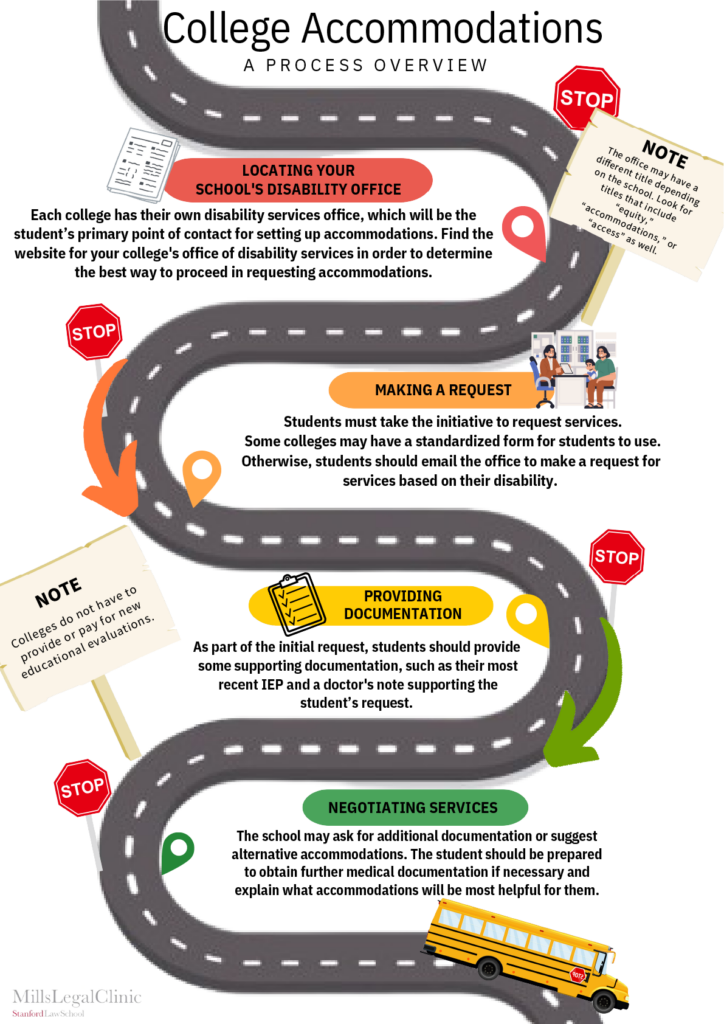
Locating Your School’s Disability Office
Each college has their own disability services office, which will be the student’s primary point of contact for setting up accommodations. Find the website for your college’s office of disability services in order to determine the best way to proceed in requesting accommodations.
Note: The office may have a different title depending on the school. Look for titles that include “equity,” “accommodations,” or “access” as well.
Making a Request
Students must take the initiative to request services. Some colleges may have a standardized form for students to use. Otherwise, students should email the office to make a request for services based on their disability.
Providing Documentation
As part of the initial request, students should provide some supporting documentation, such as their most recent IEP and a doctor’s note supporting the student’s request.
Note: Colleges do not have to provide or pay for new educational evaluations.
Negotiating Services
The school may ask for additional documentation or suggest alternative accommodations. The student should be prepared to obtain further medical documentation if necessary and explain what accommodations will be most helpful for them.
K-12 IEPs / College
K-12:
Schools must locate and identify students with disabilities.
College:
Schools do not have to proactively identify students with disabilities. Students must reach out to the school to request accommodations.
K-12:
Parents are deeply involved in the IEP process.
College:
Students advocate for themselves and communicate directly with the school.
K-12:
The school provides educational evaluations to determine the student’s needs.
College:
Students must provide their own documentation to support their request for services.
K-12:
There is a set timeline for how often IEPs/re-evaluations must occur.
College:
The timeline for readjusting accommodations may vary by school. It may be helpful to check in with the school before each semester.
K-12:
An IEP team will craft a plan to provide the student with the necessary accommodations and services.
College:
The student should be prepared to ask for the specific accommodations they believe they need.
K-12:
Disputes are handled by filing for due process with the California Office of Administrative Hearings.
College:
Disputes can be handled through an internal grievance process or by filing a complaint with the Civil Rights Department of California or the US Department of Education Office of Civil Rights.
Acomodaciones Universitarios: Un Resumen del Proceso
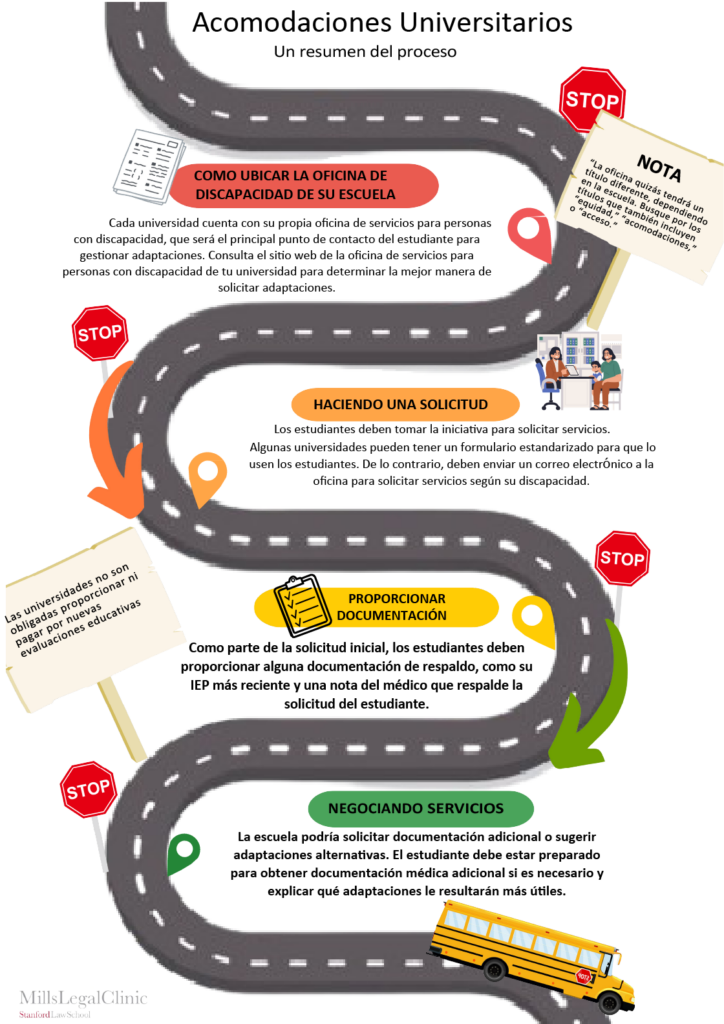
Como Ubicar la Oficina de Discapacidad de su Escuela
Cada universidad cuenta con su propia oficina de servicios para personas con discapacidad, que será el principal punto de contacto del estudiante para gestionar adaptaciones. Consulta el sitio web de la oficina de servicios para personas con discapacidad de tu universidad para determinar la mejor manera de solicitar adaptaciones.
Nota: La oficina quizás tendrá un título diferente, dependiendo en la escuela. Busque por los títulos que también incluyen “equidad,” “acomodaciones” o “acceso.”
Haciendo una Solicitud
Los estudiantes deben tomar la iniciativa para solicitar servicios. Algunas universidades pueden tener un formulario estandarizado para que lo usen los estudiantes. De lo contrario, deben enviar un correo electrónico a la oficina para solicitar servicios según su discapacidad.
Proporcionar Documentación
Como parte de la solicitud inicial, los estudiantes deben proporcionar alguna documentación de respaldo, como su IEP más reciente y una nota del médico que respalde la solicitud del estudiante.
Nota: Las universidades no son obligadas proporcionar ni pagar por nuevas evaluaciones educativas.
Negociando Servicios
La escuela podría solicitar documentación adicional o sugerir adaptaciones alternativas. El estudiante debe estar preparado para obtener documentación médica adicional si es necesario y explicar qué adaptaciones le resultarán más útiles.
K-12 IEPs / Colegio
K-12:
Escuelas deben ubicar e identificar los estudiantes con discapacidades.
Colegio:
Escuelas no tienen que identificar proactivamente a los estudiantes con discapacidades. Estudiantes deben comunicarse con la escuela para solicitar adaptaciones.
K-12:
Los padres están profundamente involucrados en el proceso del IEP.
Colegio:
Los estudiantes se defienden a sí mismos y se comunican directamente con la escuela.
K-12:
La escuela proporciona evaluaciones educativas para determinar las necesidades del estudiante.
Colegio:
Los estudiantes deberán aportar su propia documentación para respaldar su solicitud de servicios.
K-12:
Hay un cronograma establecido sobre la frecuencia con la que deben realizarse los IEP y las reevaluaciones.
Colegio:
El plazo para reajustar las adaptaciones puede variar según la escuela. Puede ser útil consultar con la escuela antes de cada semestre.
K-12:
Un equipo del IEP elaborará un plan para brindarle al estudiante las adaptaciones y los servicios necesarios.
Colegio:
El estudiante debe estar preparado para solicitar las adaptaciones específicas que crea que necesita.
K-12:
Las disputas se manejan mediante la presentación de una solicitud de debido proceso ante la Oficina de Audiencias Administrativas de California.
Colegio:
Las disputas pueden resolverse a través de un proceso de queja interno o presentando una queja ante el Departamento de Derechos Civiles de California o la Oficina de Derechos Civiles del Departamento de Educación EEUU.