
Baby, You Can Drive My Car
It’s a busy week for CodeX—yesterday, Harry Surden, former CodeX Fellow and now a Professor at the University of Colorado Law School, presented a fascinating talk about self-driving cars. Today, Thomas Lee, Associate Chief Justice of the Utah Supreme Court, will talk about whether computers can do a better job than judges. (12:30-2 p.m. Pacific, at Stanford Law School room 290).
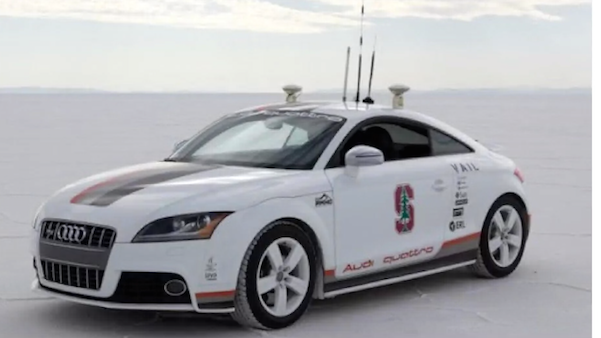
Surden, now an affiliated faculty member with CodeX, mesmerized the crowd with his discussion of “autonomous” vehicles, explaining how they work and the “theory of mind and predictability,” and raising the question of “should law be involved in fostering predictability?” (In case you are new to the party, autonomous means “computer controlled systems that can make important decision about their own behavior, with little or not human input.”) Surden co-authored his presentation with Mary-Anne Williams, of the University of Technology Sydney (She is also a CodeX affiliated faculty member).
Surden differentiated between full, partial and no autonomy and explained how partial autonomy—a mix of human and computer decisions—is already in cars, such as air bags, breaking to avoid collisions, automatic parking, cruise control, and the like. Experts expect that consumers will see fully autonomous vehicles (AVs) within three to 15 years, said Surden.
AV vehicles, he said, are expected to reduce accidents by 30% to 80%, noting that 90% of auto accidents are caused by humor error, including intoxication, inattention or falling asleep. They also can prevent or minimize getting lost. The AV cars include video cameras, and can react appropriately to signs, signals, objects and the like, said Surden. Machine learning can identify objects and process central system planning routes.

SAFETY
The presentation will be available shortly on YouTube. I’ll add the link to this post once it’s online.A key concern about AVs is how the robot would handle split second challenges, such as a situation where there may be only two options and both options could involve serious injuries or deaths. “The human ability to assess the mental states, motivations, beliefs and likely conduct of other people; and that humans are able to reliably predict the behavior and near-term movements of people around us” is called the “Theory of Mind,” he explained. Technological opacity is “the inability to know the internal state of a technological system or to understand why it takes the actions that it does.” Surden explored the issues, disussing improving predictability through design, where AVs communicate their internal states and intentions to those around them. These are some of the issues that are being explored with other autonomous systems (robots).
Baby Boomer Bonus: [Baby, You Can] Drive My Car.
Monica Bay is a Fellow at CodeX and a freelance journalist for Bloomberg BNA Big Law Business. She is a member of the California bar. Twitter: @MonicaBay Email: mbay@codex.stanford.edu.