
How Police Avoided Liability for Tasing a 17-Year-Old Girl Having a Seizure
The Stanford Center for Racial Justice has begun publishing chapters of our comprehensive Model Use of Force Policy in beta release. The Model Policy is intended to contribute to the long line of efforts to improve and reform policing and promote practices that will be fair, safe, and equitable for everyone. This essay is a continuation of our staff’s discussion examining how the Model Policy interacts with scenarios officers may find themselves in. Read Chapter 7—TASER Energy Weapons and other Conducted Electrical Weapons—here.
On January 16, 2015, Tiara Helm was at a concert in Rainbow City, Ala. with her sister when she experienced a seizure. A police officer noticed the incident and approached them, at which point Helm’s sister told the officer Helm was experiencing a seizure and needed help. Helm was carried to the lobby of the concert venue where she began seizing again while sitting in a chair. Three more officers showed up and the four of them held Helm to the ground.
Helm blacked out during the first two seizures. When the 17-year-old gained consciousness, she discovered four Rainbow City police officers on top of her, actively restraining her movement. Helm pleaded with the officers to let her go, but once the officers decided she was combative, they strengthened their holds—one even put her in a headlock. Two officers claimed that after Helm’s second seizure, she cursed and spit at them and tried to kick and bite them, but Helm’s sister maintained she never “attempted to kick, bite, or spit at the officers and never yelled at the officers or used vulgar language.” A judge eventually ruled that Helm “was not resisting, kicking, spitting, or biting. . . . [and] was therefore ‘fully secured’ and ‘completely restrained.’”
Armed with a Taser, a fifth officer arrived and warned Helm he would use it if she didn’t calm down. After repeating his threat, the officer tased Helm in her chest using “drive stun” mode—where the Taser is pressed directly on the individual—all while she was still pinned down by four other officers. The officer then warned Helm that he would tase her again unless she calmed down. He ended up tasing her two more times, each time the same as the first: using drive stun mode while Helm was restrained by the other officers. During this time, Helm blacked out again, only regaining consciousness when she was on a gurney on the way to a hospital.
Under the SCRJ Model Policy, was the officer permitted to use the Taser?
Under the Model Policy’s Taser provisions, any use of a Taser “must be limited to that which is necessary to carry out a Lawful Objective and be proportional to the totality of the circumstances.” Force is “necessary when the officer has exhausted non- or less-forceful options to achieve their lawful purpose,” and the totality of the circumstances “consists of all facts and circumstances surrounding any event.” Assuming the officer had a Lawful Objective to engage with Helm, the two threshold questions are whether using a Taser was necessary and whether such use was proportional to the totality of the circumstances.
There are a variety of non- or less-forceful options an officer has at their disposal, including de-escalation techniques such as “slowing down, maintaining a calm and composed demeanor, creating distance or physical barriers, and attempting verbal persuasion or warnings.” Here, the facts indicate that once the fifth officer arrived, he yelled at Helm while she was being held down by the other officers—telling her that “if she did not calm down, he would tase her.” He then unholstered his Taser and waved it in front of Helm, repeating his threat before eventually tasing her.
Although the officer used verbal persuasion by asking her to calm down, at no point did he attempt any other form of de-escalation. Moreover, Chapter 3 of the Model Policy states that if “speaking techniques and Physical Controls do not gain control of a subject and the subject’s physical actions become actively resistant to the point that they pose a substantial risk of causing imminent bodily harm,” an officer may escalate their use of force, but only to the extent necessary. Yet, Helm was already being held down by four officers—a Physical Control—and presented no threat to them or the public. Therefore, using the Taser was likely unnecessary, not only because the officer had yet to exhaust non-forceful options, but also because Helm was already being physically restrained and posed no imminent threat to herself or others.
The facts further indicate that when the fifth officer arrived he was told that Helm was having seizures, but he claims he never heard anyone tell him about her condition and instead encountered an “out of control female.” However, the judge also ruled that Helm “was not combative, posed no threat to others, and, to the extent she posed a risk to herself, that risk could have been managed by simply holding her head to prevent injury from her uncontrollable movements.” Importantly, the officers did not dispute that “[Helm] presented no threat to [the officers] and, during the tasings, was held down by four or five men.” The fact that she was not combative, presented no threat to anyone—including the officers—and was being restrained by multiple men suggests it is likely that applying the Taser to her chest three times was not proportional to the totality of the circumstances.
Given the analysis above, because use of the Taser on Helm was neither necessary nor proportional to the totality of the circumstances, such usage by the officer would have been prohibited by the Model Policy.
How would other parts of the SCRJ Taser policy apply to Helm’s case?
The Model Policy states that Tasers “should not be used on vulnerable populations unless they pose an imminent threat of serious bodily harm to themselves or others.” As defined in Chapter 7, vulnerable populations include children and “persons with known or obvious serious physical health problems.” Helm would have been considered a vulnerable individual because she was at the time a minor, and was experiencing a serious physical health problem that at least the four officers who held her down knew about (it is disputed whether the fifth officer who tased Helm knew she was experiencing a seizure). Furthermore, as stated above, Helm presented no threat to the officers. Because she was held down by four men, it is unlikely she posed a threat of serious bodily harm to herself or others. These reasons alone suggest a strong indication that the officer who tased Helm would have violated the Model Policy.
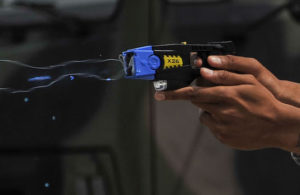
Finally, the Model Policy prohibits using a Taser “on persons who are handcuffed unless there are significant extenuating circumstances and the subject cannot be controlled by other means.” Here, the Taser was deployed three times as four other officers were already engaged in restraining Helm. Although she was not handcuffed, an argument could be made that being physically restrained by four men is substantially similar to being handcuffed. No facts suggest that while she was restrained there were any extenuating circumstances that warranted the use of a Taser, and nothing suggests the officers could not control Helm by other means. This analysis suggests that using the Taser would have been outright prohibited by the Model Policy.
What resulted from Helm’s federal civil lawsuit?
Helm was never arrested or charged with anything, because having a seizure is not a crime. However, there was never an internal affairs investigation conducted of the January 2015 incident, and the officer who used his Taser on Helm was promoted about a year later. Like so many others who experience police violence, Helm and her family turned to the last resort to achieve some kind of justice and accountability: a federal civil lawsuit claiming the police used excessive force.
In 1989, the Supreme Court decided in Graham v. Connor that excessive use of force claims brought against police officers would be evaluated using an “objective reasonableness” standard, where an officer’s use of force is judged “from the perspective of a reasonable officer on the scene, rather than with the 20/20 vision of hindsight” and “in light of the facts and circumstances confronting them.” Under this standard, if an officer’s use of force is determined to be objectively reasonable, then the use of force was not excessive.
Unfortunately, after decades of application, the reasonable officer standard not only lacks clarity on how it is analyzed, but courts have mostly failed to provide guidance on what qualities characterize the hypothetical reasonable police officer—making it significantly challenging to determine the reasonableness of an officer’s use of force. Many have argued for examining what evidence is available and can be admitted in court that clarifies who a reasonable officer is. For example, some courts have held that law enforcement policies are relevant particularly because some policies provide explicit guidance on the use of force that indicates what a local agency perceives to be reasonable.
Nonetheless, juries deciding excessive force cases often have no law enforcement training or experience and tend to be focused solely on the dangerous nature of policing, resulting in decisions that are not purely objective—but instead what commentators have referred to as “subjective-objectivity.”
Research indicates that jurors use factors such as their attitudes toward police legitimacy, gender, race, past positive experiences with the police, and attention to current events like police trials to influence their reasonableness analysis. These potential biases remove a layer of objectivity from what was articulated in Graham, whereby those assessing whether a use of force was excessive will be deferential to the police officer “because it can be scary to project oneself onto the streets and into the high-stress world of policing without the training, expertise, and experience of a professional officer.” Indeed, juries are regularly instructed to consider the uncertainties and stress of policing when assessing how a reasonable officer would have responded under the same circumstances.

In a rare occurrence, Helm’s lawsuit overcame the qualified immunity assertion by the Rainbow City officers and went to trial in a federal court. However, on day five of the trial, the jurors reached a verdict and sided with the police. During closing arguments, the officers’ lawyers “painted a picture of a chaotic, rapidly devolving incident,” reported The Marshall Project. One lawyer suggested that the situation was dangerous and the officer who put Helm in a headlock “did what any reasonable officer would do.” Based on the research discussed above, it is likely the jury’s verdict was impacted by the deference the reasonable officer standard affords police officers to use force, which too often results in a legal doctrine that rarely compensates persons injured by a police officer.
Do use of force policies matter?
Written rules alone are insufficient to assure proper conduct—and factors such as training, experience, and police culture can influence individual officer behavior. Further, the limited influence that use of force policies have on an officer’s federal civil liability also raises questions about the role of providing clear standards on the use of force.
We believe clear standards are essential. The standards provide a baseline reflecting the expectations of the department and the community. They also are a basis for training and a source of ongoing reference for officers who want to refresh their understanding of what is expected of them. Policies also ultimately help shape what a reasonable officer can and should do in a variety of circumstances.
Further, research consistently suggests that more restrictive use of force policies are correlated with reduced police killings—and are not correlated with increases in crime, harm to officers, or other types of negative effects. For example, after Seattle adopted its “necessary” standard, the city reported a significant reduction in the number of force incidents without a decrease in officer or civilian safety. Accordingly, departments can update use of force policies to reflect community values while maintaining the safety of their officers.
While we won’t know for certain whether a more restrictive, defined use of force policy would have altered the night Tiara Helm’s life was changed, we do know that her story, like so many others, should be reason to seriously question and zealously advocate for policing practices that better reflect the consensus of the communities our officers serve.
Disclaimer: The facts cited above were assumed to be true based upon the federal appeals court opinion evaluating the officers’ qualified immunity claim in the Helm case—as well as public news sources—and have not been evaluated for accuracy. The above analysis reflects the opinions of our staff and is intended for educational purposes and policy discussions.