
How Much Has Changed 70 Years After Brown v. Board? SLS’s Rick Banks Weighs In
To mark the 70th anniversary of the landmark school desegregation case, Brown vs. Board of Education, Stanford Law School’s Ralph Richard Banks, the Jackson Eli Reynolds Professor of Law, joined a recent episode of the Stanford Legal podcast to discuss the legacy of one of the most celebrated Supreme Court cases. Banks also recently wrote an essay for Stanford Lawyer about the unanimous decision, which held that state-mandated segregation of public schools violated the 14th amendment of the United States Constitution.
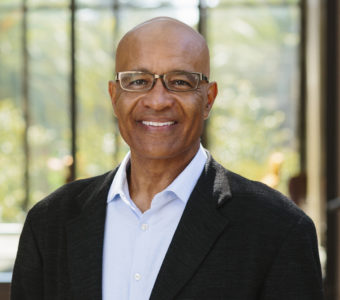
The legacy of the case, Banks observes, might be less far-reaching than many people suspect.
Podcast co-hosts Richard Thompson Ford, the George E. Osborne Professor of Law, and Pam Karlan, the Kenneth and Harle Montgomery Professor of Public Interest Law, interviewed Banks.
The following is an edited version of the full transcript, which can be found here.
Rich Ford: Tell us about Brown v. Board of Education and why you think that its legacy is less impressive than some people might believe today in 2024.
We might think of Brown in two different dimensions. One is its significance in American society generally, and in that regard, Brown was truly transformative. It was the beginning of the end of the formally segregated system known as Jim Crow. We cannot overstate the significance of that. But we might also expect Brown to have transformed the primary and secondary schools in the United States, and to have created better opportunities for the Black children and other minorities and disadvantaged students. On that score, Brown has not been nearly as effective.
Sometimes, when I’ve taught this case, I would bring a friend to class who is an African American Stanford professor who grew up in the South, and he would talk about being in the very first class of students who had the opportunity to go to a desegregated school—in the 1960s. The students will say, “I thought Brown was decided in 1954?” But the reality was that there was virtually no desegregation for 10 full years, until the Civil Rights Act was passed in 1964. Then we had a period, from the 60s through the 70s, where we did have some desegregation. But I think it’s fair to say that since the 80s, we’ve been in retreat in terms of the effort to desegregate the schools.
Pam Karlan: If you look at the five school systems that were actually at issue in Brown itself, one of them just closed the schools altogether, rather than desegregate. You started us off by saying how important Brown was as a signal and the beginning of the modern Supreme Court as an institution that gets a lot of respect out of America, and I feel like they’re often living off the fumes of Brown, if you will.
The legislators in the South made very clear that they thought the decision in Brown was illegitimate. The Supreme Court stood up to that in a way, and became sort of the hero in this story, but the irony is that they only became the hero through not actually engaging on the ground with the challenges of trying to create integrated and quality schooling. If you look at the years immediately after Brown, we can count in single digits the number of Black students who attended schools that had any appreciable number of white students, so that’s a checkered sort of history at best in terms of desegregation.
Pam Karlan: Justice Thurgood Marshall, who argued Brown for one of the groups of plaintiffs, said it was going to take ten years to desegregate, and now here we are celebrating the 70th anniversary of Brown, and we still haven’t achieved it.
People had high hopes when Brown was young, but as Brown has become a senior citizen, perhaps those high hopes have transitioned to resignation or frustration.
Rich Ford: Rick, I think you and I are roughly the same age, and I know I attended schools that were under court order to desegregate in the late 1970s and 1980s, and that was a period of time in which the schools were getting less segregated as a result of those court orders, so we had that 10 years of massive resistance where nothing happened. Then some things did start to happen and so you could imagine why people would have felt optimistic. I think my parents were cautiously optimistic that things were improving on the score, so what happened?
That’s a big story. We have two sets of resources here that are really constraining progress. One set of resources is money, the funding for schools. The other is people—families and students—and to have effective schools for all, I think we actually do need to try to bring all of those together and not have the funding disparities. And not have people segregated based on their income levels and affluence. But we haven’t been able to do that> One factor that doesn’t get enough attention for why we haven’t been able to do that is that we’ve had an extraordinary growth of economic inequality in the period since Brown. The last half-century, we’ve seen a starker growth in inequality than at any time during our lifetimes, and we’ve also seen education become ever more important in determining people’s outcomes in life. As a result of this, parents have completely changed their strategies compared to the 1950s. Parents have really doubled down on education, in terms of their time, in terms of their resources, in terms of where they decide to live. And all of these factors have led to schools being less equal across socioeconomic classes now than they were 50 years ago.
Pam Karlan: Upper middle-class and middle-class parents have the choice of where to live. Parents who aren’t affluent don’t really have that choice, and one of the ironies is that the Supreme Court was deciding Brown at exactly the moment that there was this explosion of the suburbs.
In cities like Detroit or in Cleveland, where I’m from, there were ways to desegregate the schools, but the impediment was the idea of local control that created a boundary or a barrier, so that we were not legally permitted to do what, frankly, would make a lot of sense from the standpoint of providing education to all the citizens of the state. Local control is just a stand-in for the ways in which the law and courts have allowed people to segregate themselves and also allowed the financial resources to be segregated as well.
Pam Karlan: Can you say a little bit about cases like Parents Involved?
Parents Involved is the case where the Supreme Court held that strict scrutiny should apply to efforts to integrate schools if they take into account individuals’ race in doing so, and many people decried Parents Involved as a perversion of Brown and a distortion of the meaning of Brown. Frankly, I don’t know if that interpretation is correct, though, because the reality is that Brown v. Board of Education was neither as progressive and anti-subordination-oriented as the people on the Left want, nor was it as colorblind as the people on the Right want. The hallmark of the decision is precisely that the decision was extremely narrow. The most plausible reading is that all it prohibited was the formal segregation of the schools in order to promote Jim Crow. That’s all it prohibited, and efforts to make it more than that on either the Left or the Right, frankly, are after-the-fact interpretations about what people want Brown to mean rather than what the Justices actually wrote.
Pam Karlan: Can you contrast Brown with what the Supreme Court does a dozen years later in Loving v. Virginia, which is a case where they really do come right out and say, ‘what’s been going on here is about white supremacy, and it’s got to stop.’
Loving is the only case where the Supreme Court has ever used the term “white supremacy” in a disparaging way. The Court, of course, had an opportunity to take a case comparable to Loving at the same time as Brown, which it declined to do. And the difference there is, of course, is the cultural context surrounding the decision. Things changed in ways that might’ve seemed unimaginable, frankly, to people living between 1954 and 1967, when you think about going from the post-World War II era to the Civil Rights Era. That was an extraordinary period of tumult, and the Court felt able to talk about miscegenation laws in a way it did not feel able to talk about segregated schools in 1954. Part of that, of course, is that miscegenation laws were already on the way out. States were already rolling back those laws.
Rich Ford: Desegregating schools requires a huge administrative apparatus and cooperation with local school districts, and fairly elaborate consent decrees and money, as you mentioned. Those were impediments that the Court didn’t face in a case like Loving.
That is very true. Brown required some enforcement, and this is an issue that we’ve struggled with as a society. You can’t have the Court simply make a decision and expect that effective or integrative schooling will result, so one of the challenges that we have to think about as a nation is how much is racial justice and education worth? Are we willing to give up some of the local control? Are we willing to give up some of the autonomy that people have to keep their money in their district? Maybe we’re not, right? I think that’s a mistake, though, because ultimately, when we have these disparities in education, we all bear the cost of them as a nation, so if we’re all going to bear the cost, it would be sensible for us all to pitch in and try to create a solution.
Rich Ford: Integration, at least socioeconomic integration, promotes some positive educational outcomes, arguably in and of itself, so that might be an argument for continuing to push on the integration side?
Yes, this is an issue that I was thinking about when I talked about seeing families and students as resources. It is the case that the composition of the school matters for the achievement of the students within the school, so if you have a group of poor students and the class is all poor students, that, frankly, is probably not as good of a learning environment as if you were to have some middle-income or upper-income students mixed into that mix, so we need some diversity, not only in terms of race but also in terms of income and socioeconomic status and parents’ educational levels.

Rich Ford: One of the legacies of Brown has been that for many decades, we put a great deal of focus on the integration of public schools. But in today’s environment, we might need a mix of approaches, some of which would potentially involve integrated schools, but others of which might focus more on educational quality choice, and perhaps we’re stymied because people have an almost reflexive reaction to the debate, rather than one that’s more cooperative.
I think that’s right, that we do need some experimentation. We need collection of evidence. We need people to be able to evaluate the evidence with an open mind and to really be pragmatic and solution-oriented, so I think that’s all true. I want to be clear, though, that I don’t think we should give up on integration because the reality is that we haven’t tried it that long. We didn’t try it at all until the 1960s, and then we tried it for about a decade or so, and then the retreat began, so it’s not as though we’ve tried integration for 40 years, and it didn’t work.
Integration is a heavy lift. What we need to remind ourselves in that process is that racial justice is not cheap. It costs money. It costs resources. It takes time, and that’ll be true whether we go the integration route or if we arrive at integration indirectly by creating schools that are more effective for disadvantaged students so that, over time, they become more fully integrated into society.
Rich Ford: In one sense, housing desegregation was the least successful part of the Civil Rights revolution, and the problems in school desegregation are directly related to that, so maybe one way of thinking about the disappointing legacy of Brown was that the federal courts kind of reneged on the promise of Brown. But another way of looking at it is that the costs of integration of schools, given the segregation of neighborhoods, was extremely high. You know, busing was an expensive and cumbersome remedy, and a remedy that you could imagine people disliking for reasons that have nothing to do with race.
Yes, part of the resistance is very understandable. The reason I think that our situation is somewhat tragic is that it’s actually not a story of prototypical racists who are blocking progress.
It’s actually a story of impulses that every parent feels. That they want the environment they think is best for their child. They want more resources for their child rather than less, and every parent feels that, but that leads us to a situation where you can have people acting rationally based on goals that are reasonable and impulses that are understandable, but then that leads to a world that is dramatically segregated, dramatically unequal in our society, and that’s where we are.
One possibility when I think about the relationship between housing segregation and school desegregation, is whether there is some possibility for using education to help desegregate housing, because the quality of schools in a district is a powerful determinant of the housing prices in that district, and you can see this in the Bay Area and elsewhere. Literally, when you go across a school district line, the housing prices can increase or decrease by tens or even hundreds of thousands of dollars, and so if we could solve the school problem, that also could give us some leverage, maybe, on the housing problem.
Ralph Richard Banks (BA ’87, MA ’87) is the Jackson Eli Reynolds Professor of Law at Stanford Law School, the co-founder and Faculty Director of the Stanford Center for Racial Justice, and Professor, by courtesy, at the School of Education. A native of Cleveland, Ohio and a graduate of Stanford University and Harvard Law School (JD 1994), Banks has been a member of the Stanford faculty since 1998. Prior to joining the law school, he practiced law at O’Melveny & Myers, was the Reginald F. Lewis Fellow at Harvard Law School and clerked for a federal judge, the Honorable Barrington D. Parker, Jr. (then of the Southern District of New York). Professor Banks teaches and writes about family law, constitutional law, and race and the law. He is the author of ‘Is Marriage for White People? How the African American Marriage Decline Affects Everyone’. He has a new book forthcoming: ‘The Miseducation of America: How College can Make or Break the American Dream’.