
SLS’s Dan Ho Discusses the Enduring Impact of Racially Restrictive Covenants on Real Property—and How a New AI Tool is Helping
A recent episode of Stanford Legal delved into the fascinating—and disturbing—prevalence of racially restrictive covenants in Santa Clara County’s property records. Although the Supreme Court ruled racial covenants unenforceable in 1948, these clauses—which were inserted into property deeds to prevent people who were not white from buying or occupying land—nevertheless linger in millions of deeds across the United States.
In 2021, California enacted a law that requires the state’s 58 counties to create programs to identify and redact deed records that include racial covenants—an important but monumental task. Santa Clara County alone has reported that it has 24 million deed documents dating back to 1850, totaling 84 million pages.

Enter Stanford University’s Regulation, Evaluation, and Governance Lab (RegLab), led by Stanford Law School Professor Dan Ho. RegLab, along with other partners, developed an AI tool (with an accompanying report) to help counties identify and redact the decades-old racial covenants from property records.
In conversation with Stanford Legal co-host Professor Richard Ford, Ho and RegLab fellow Mirac Suzgun, who is a JD/PhD candidate, explain their AI tool, break down the history of the racial covenants, and explain why they are making their tool available for free to other counties and entities engaged in similar identification and redaction work. Ho also talks about his personal experience with racial covenants: When he bought a home in Palo Alto in 2015, he was required to sign documentation saying the property would not be “used or occupied by any person of African, Japanese, or Chinese or any Mongolian descent…”.
Ho is William Benjamin Scott and Luna M. Scott Professor of Law at SLS and serves in a number of other roles at SLS and Stanford University. RegLab partners with government agencies to design and evaluate programs, policies, and technologies that modernize government.
The following is a shortened and edited version of the full podcast transcript, which can be found here.
Rich Ford: Everyone who went to law school remembers Shelley v. Kraemer, which held that racially restrictive covenants were unenforceable under constitutional law. I think a lot of people thought that’s the end of that issue. But that’s not quite true, is it?
Dan Ho: Correct. When I moved to Palo Alto from San Francisco in 2015, in the large set of documents that you sign when you purchase a home, was a community covenant that said that the property shall not be used or occupied by any person of African, Japanese, or Chinese or any Mongolian descent, except for in the capacity of a servant to a white person. Yes, these racial covenants were held unenforceable in 1948, but they still persist in deed records across the country. Our paper and tool are a response to recent efforts, particularly a 2021 California law, trying to do something about this by identifying, redacting, and creating a historical registry of these covenants.
Prior to 2021, California had a legislative provision that allowed homeowners to undergo an individual legal petition process to redact the racial covenant from their deed record. But as in other states that have tried this, the number of homeowners who actually pursue that process is vanishingly small. So California decided to pursue a more proactive approach. AB 1466 mandates that each of the 58 counties in California establish proactive programs to identify and redact these racial covenants. The challenge is that these deed records, in the case of Santa Clara County, can go back to 1850. Santa Clara counted and reported that it has 24 million of these documents, totaling 84 million pages. Figuring out how to engage in this process becomes a real challenge.
Rich Ford: Counties are faced with a legal obligation to go through and redact all of these documents. Are they doing it by hand?
Dan Ho: Prior to when we started this collaboration, they were doing it by hand. They had a team of folks going through and reading close to 100,000 pages to identify 400 of these racial covenants. That was obviously not going to be scalable given the sheer magnitude of the deed records.
Rich Ford: Tell us about the RegLab project and what your key findings were and what you’ve developed in order to help with this problem.
Dan Ho: RegLab has had a number of other collaborations with Santa Clara County, so we reached out to see if we could help. That’s when Mirac became involved because he was simultaneously enrolled in a course on anti-discrimination law and algorithmic fairness. The county was very enthusiastic. We formalized a collaboration whereby we secured access to the deed records and undertook the process of developing a machine learning model.
Rich Ford: How is your new model going to help get rid of these covenants and help the counties fulfill their new legal obligation?
Mirac Suzgun: The process has three primary stages. First, we convert an image of a property deed to text using one of the open source models that allows us to do OCR, Optical Character Recognition. Secondly, once we have the transcribed text, we use an open source language model, namely Mistral, to identify the portion of the text that contains unlawful discriminatory language. In the third stage, we highlight unlawful language, and then extract property addresses.
When I put it in this way, perhaps it sounds very easy but each step of the pipeline has its own issues and difficulties. For instance, in the first stage, since we are dealing with historical deeds, many deeds contain a lot of scanning artifacts and it’s sometimes hard to get a clean, spell-checked text out of them.
In the second step, it is important for our AI model to look at the entirety of the text, not just do a simple keyword search. For instance, you might think we could just look in the deeds for the word “white” or “Caucasian.” But this yields lots of false positives. The term Caucasian might might be used innocuously. The term “white” might refer to the surname of an individual, or it might be a street name, or to the color of a fence. So, it is important to look at the entirety of the text, not just one part. For that reason we realized quite early on that just a simple approach based on keyword matching would not allow us to actually identify all the racially restrictive covenants.
Finally, in the third stage, we are providing the county with a useful tool that allows it to see the highlighted unlawful language along with the extracted property address. And after this process is done, we send our documents to the County Council for final review, and it is important to highlight that at the end of the day, the county council is expected to review and affirmatively approve the sent document, so there is always a human in the loop.
Rich Ford: So, the counties can’t simply scan the documents into a computer and then wait for the tool to redact all of the racially restrictive language?
Dan Ho: AB 1466 does have a statutory requirement that the County Council ultimately review all of the provisions to sign off on them and then to re-record them. What the model does is to find and flag these proverbial needles in the haystack. And then humans can engage in the legislatively mandated review on a much, much smaller set of documents. So it’s not as if the model is actually itself taking the place of that human judgment.
Rich Ford: Can you talk a little about the history of these racial covenants?
Dan Ho: Racial covenants existed in the 19th century, but became much more prevalent in the early parts of the 20th century after the Supreme Court found racial exclusionary zoning to be unconstitutional in the Buchanan decision in 1917.
So then what happens is the mechanism of discrimination migrates towards a form of private action, in the form of these deed covenants. What’s notable about deed covenants is that while they’re a kind of private transaction, they run with the land and therefore they bind every subsequent purchaser of the home. And that’s why these have stuck around for such a long period of time.
In 1948, the Supreme Court found these covenants to be unenforceable. Then, in 1968, in the Fair Housing Act, they’re declared illegal. There’s a fascinating book by professors Rick Brooks and Carol Rose that talks about the persistence of racial covenants and the fact they were being utilized even after Shelley v. Kraemer, some even after 1968. One of the arguments by professors Brooks and Rose is that even when not legally enforceable, they have served as a kind of “signaling function.” Rose and Brooks tell this sort of story of how, in 2002, a Richmond man refused to sell his home to an African-American woman and pointed to the racial covenant, claiming he simply didn’t realize that these were not enforceable.
Rich Ford: So, the important part of these covenants running with the land is that when you buy a piece of property, you don’t have the option to get out from underneath this racial covenant. It’s a restriction that you’re bound by.
Mirac Suzgun: It might be useful to acknowledge the roles of two other actors in the enforcement of racial covenants. The first is the real estate industry, for instance institutions like the National Association of Real Estate Boards, which enforced racial covenants through racial steering, as in “steering” clients into or away from certain neighborhoods. And they made adherence to these racial covenants part of their ethical code, which further reinforced segregation in the housing market. The second actor is, unfortunately, the federal government itself. Federal programs such as the Federal Housing Administration, at the time, required racial covenants for mortgage insurance, and so they embedded segregation in housing markets across the country.
Rich Ford: So, you’ve developed this amazing tool, and now we have some information about how widespread these racial covenants are and where we find them. Could you tell us a little bit about that?
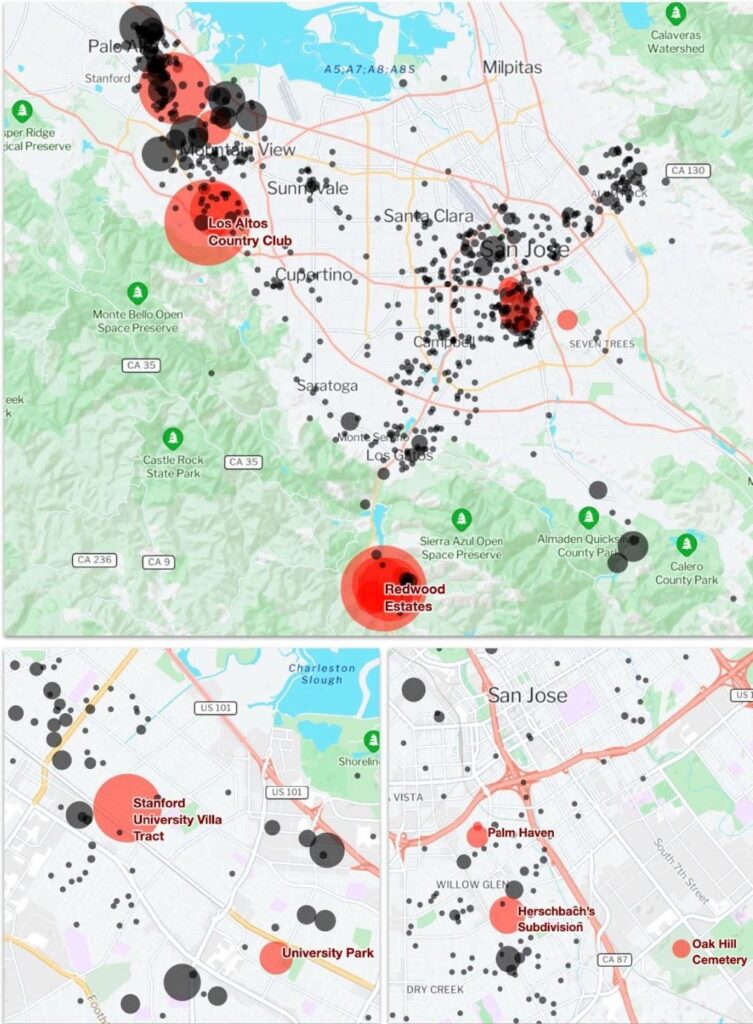
Dan Ho: The model has also led to some really rich and interesting historical findings. For instance, until doing a scan like this, we really had no idea how pervasive racial covenants were in Santa Clara County. What we were able to do is to actually geolocate these deed records by retrieving the county assessor and surveyors’ maps and matching them to the deed document. We were able to identify that right at the peak period when these racial covenants were being used, from 1920 to 1950, is when the housing units doubled in Santa Clara County. Many deed records cover potentially hundreds of properties. This led to a sobering finding, which is that we estimate that as of 1950, one in every four properties was covered by a racial covenant.
It was a actually small number of developers that bore the disproportionate responsibility for these racial covenants. Our estimate is that at the deed level, 10 developers are responsible for close to a third of all of these covenants. A poignant counter example is one developer, Joseph Eicler, who was responsible for 2,700 homes in Palo Alto alone. He is mainly known for the unique style of his homes, but he was someone who adamantly resisted putting racial covenants in the deed record. What this shows is that these covenants were not simply driven by market pressure. Eichler’s story underscores that there was real agency and individual responsibility by the small number of developers operating in Santa Clara County at that time.
Rich Ford: What’s the next step?
Dan Ho: One thing that is quite important here is that it isn’t exclusively a redaction process. As has been pointed out, we don’t necessarily want to literally erase the historical record. What’s quite notable and important about AB 1466 is that there is a requirement to retain the unredacted versions of the covenants, which really opens up this line of historical inquiry.
Rich Ford: Are there other California counties pounding on your door trying to get a hold of this technology?
Dan Ho: We are committed to doing this with an “open science” approach. We have made the model available for anyone to be able to use.We welcome being in touch with other jurisdictions that are trying to do this because one of the really careful things that Mirac did when originally curating the training data was to make sure that there were was a diversity of racial covenants in place, sourcing them from seven other counties across the country, so that the model would be one that could be used not just in a single county, but across a number of different jurisdictions.
Mirac Suzgun: Our tool is available both on our website and also on a machine learning platform known as Hugging Face. We welcome any feedback, any opportunity for collaboration. If there are any counties or cities or towns that would be interested in working with us, we will be quite honored.
Daniel E. Ho is the William Benjamin Scott and Luna M. Scott Professor of Law, Professor of Political Science, Professor of Computer Science (by courtesy), Senior Fellow at the Stanford Institute for Human-Centered Artificial Intelligence (HAI), Senior Fellow at the Stanford Institute for Economic Policy Research, and Director of the Regulation, Evaluation, and Governance Lab (RegLab). He serves on the National Artificial Intelligence Advisory Committee (NAIAC), advising the White House on AI policy, as Senior Advisor on Responsible AI at the U.S. Department of Labor, on the Committee on National Statistics (CNSTAT) of the National Academies of Science, Engineering, and Medicine, as a Public Member of the Administrative Conference of the United States (ACUS), and as Special Advisor to the ABA Task Force on Law and Artificial Intelligence. He is an elected member of the American Academy of Arts and Sciences.