
Stanford’s William B. Gould IV on the Supreme Court’s Decision in Trump v. Wilcox
The grant of an application for stay by a 6-3 Supreme Court majority in Trump v. Wilcox represents an extraordinary use of the Court’s increasingly controversial emergency docket to reverse 90 years of precedent without adequate consideration and deliberation. Without briefing or evidence, the Court claims that National Labor Relations Board (NLRB) and Merit System Board members statutorily protected from removal without cause may be arbitrarily fired by President Trump who, as Justice Kagan has written in eloquent dissent, has chosen “to take the law into his own hands.”
For nearly a century, Congress has enacted legislation creating multi-member bipartisan administrative “alphabet” agencies like the NLRB because of its belief that the independent exercise of expertise constitutes the best method of dispute resolution in the workplace. The Court’s impatient destruction of precedent on May 22 robs the country of the system chosen by Congress and 14 presidents since Herbert Hoover without the reflection that is a prerequisite to the appearance of justice as well as justice itself.
The Court purports not to have resolved the dispute. But it really has.
By concluding that fundamentally quasi-judicial authorities possess “considerable executive power,” thus rendering its appointees subject to the same “at will” employment status applicable to executive branch appointees, the Court, while feigning interest in “full briefing and argument” by counsel, has resolved the matter in the teeth of contrary precedent. By concluding, again without prior adjudication, that the NLRB and Merit Board are fundamentally different from entities like the Federal Reserve Board, presumably to soothe the markets against the intemperance of a president who has expressed an interest in firing that board’s chairman too, the Court makes grand conclusions in the absence of genuine judicial process. The result is both improper procedure and an erosion of the people’s will.
Read Stanford’s Bill Gould on Trump Labor Board Firings and Upheaval at the NLRB
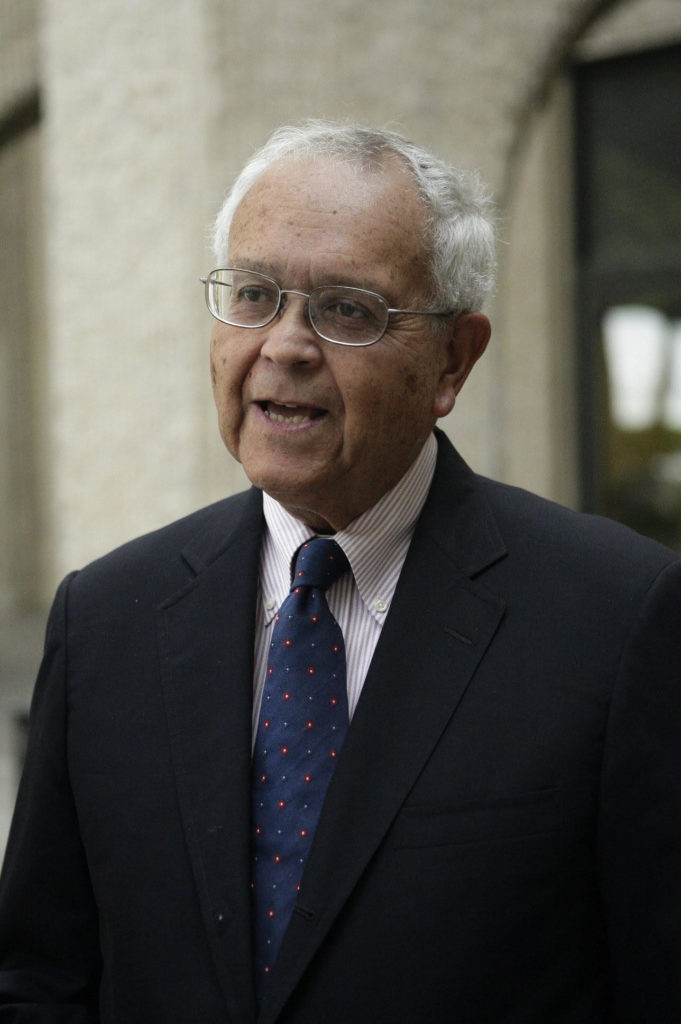
William B. Gould IV is the Charles A. Beardsley Professor of Law, emeritus, at Stanford Law School. A prolific scholar of labor and discrimination law, Gould has been an influential voice in worker–management relations for more than fifty years and served as Chairman of the National Labor Relations Board (NLRB, 1994–98) and subsequently Chairman of the California Agricultural Labor Relations Board (2014-2017). He has been a member of the National Academy of Arbitrators since 1970. As NLRB Chairman, he played a critical role in bringing the 1994–95 baseball strike to its conclusion and has arbitrated and mediated more than three hundred labor disputes, including the 1992 and 1993 salary disputes between the Major League Baseball Players Association and the Major League Baseball Player Relations Committee. Shortly after the passage of Title VII of the Civil Rights Act of 1964, he served as a consultant to the Equal Employment Opportunity Commission (1966-67) providing recommendations on seniority disputes and conciliation procedures and in 1967 he was a member of the very first Fact Finding Board established under the New York Taylor Law. Gould also served as Special Advisor to the U.S. Department of Housing and Urban Development on project labor agreements (2011–12) and as Independent Reviewer on Equal Employment Opportunity for the Mayor of San Francisco (2020-21). A critically acclaimed author of 11 books and more than sixty law review articles. His most recent book is For Labor to Build Upon: Wars, Depression and Pandemic (Cambridge University Press, Spring 2022). His memoir, “Those Who Travail and Are Heavy Laden: Memoir of a Labor Lawyer,” (Worcester Polytechnic Institute Press) will be published in Spring 2025.