
The Brief: Five Years After George Floyd, Report on Use of Force Regulation (June 2025)
Welcome to The Brief, our newsletter bringing you focused insights on race, law, policy, and technology from the Stanford Center for Racial Justice.
This edition of The Brief explores the current state of police reform in America five years after George Floyd’s murder, from our new research on use of force policies to federal oversight changes and emerging challenges facing criminal justice reform efforts.
Police Use of Force Policies Across America
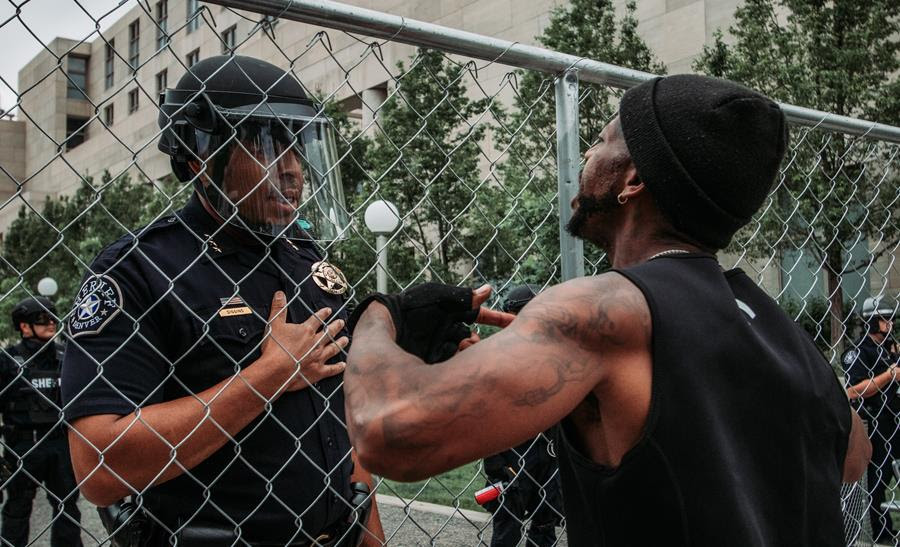
Five years after George Floyd’s killing sparked unprecedented demands for police reform, questions persist about the changes that have–and haven’t–been made to American policing. While reform efforts in Congress have stalled and calls to ‘defund the police’ have largely given way to budget increases, the policies that regulate force and the police activities that often lead to its use remain at the center of some of America’s most challenging debates.
Recent examples illustrate this ongoing tension: New York City has restricted its officers from chasing drivers who break traffic laws or commit other low-level offenses, while Oakland appears to be bowing to pressure from California Governor Gavin Newsom to loosen its pursuit policies, and the Los Angeles Police Department has deployed a wide range of force–tear gas, pepper balls, rubber bullets, and batons–to respond to protests of federal immigration raids.
In our latest research report, Police Use of Force Policies Across America, we explore the complex landscape of change in force regulation produced by the post-Floyd movement. Our study, which we believe represents the largest systematic analysis of American force regulations to date, examines 22 distinct policy dimensions across the nation’s 100 largest cities, comprising 2,200 total regulations collected through 2023. Departments have largely converged on reforms like chokehold bans (from 22% of departments in 2015-16 to 92%) and requiring officers to intervene against excessive force (from 29% to 95%), but they remain deeply divided on fundamental questions of when and how force should be used. Significantly, 48% of departments have now adopted some version of a “necessary” standard for force use that sets a higher bar than the minimum constitutional “objectively reasonable” standard required by the Supreme Court in Graham v. Connor, indicating departments’ willingness to exceed constitutional requirements.
Our research has taken on particular significance as the Trump administration has moved to end most federal involvement in police oversight and reform–a tool that has changed local policies and practices. Police reform efforts are likely to focus on state and local jurisdictions, where policymakers frequently look to policies and initiatives in other communities when developing new regulations. Our findings reveal both areas of convergence and significant policy divergences that continue to shape how hundreds of thousands of officers across the nation are permitted to use force.
This analysis represents one component of a three-part research project by the Stanford Center for Racial Justice: (1) this report (2) a soon-to-be-launched interactive database–the use of force Policy Explorer–that includes our thorough assessments of agency policies along with key excerpts of policy language; and (3) a Model Use of Force Policy–10 policy modules addressing key use of force areas such as weapons, de-escalation strategies, and physical force–drawing heavily from our analysis of the regulations in America’s largest cities.
Read the Research Report here.
Get the Model Use of Force Policy.

We’ve Redesigned Our Website
We’ve launched a redesigned website that better showcases our work and makes it easier to explore our research. The new site highlights our three core issue areas—Education & Opportunity, Justice & Safety, and Race & Society—alongside our key work areas: Analysis & Insights, Research & Reports, and Policy Solutions. You’ll also find streamlined access to Our Events, student opportunities like our Bremond Fellowship Program, and information about how to Support Our Work.
Visit us at law.stanford.edu/stanford-center-for-racial-justice to explore our latest research and discover new ways to engage with the Center’s work.
FACULTY DIRECTOR’S CORNER
Professor Ralph Richard Banks: Five Years Later
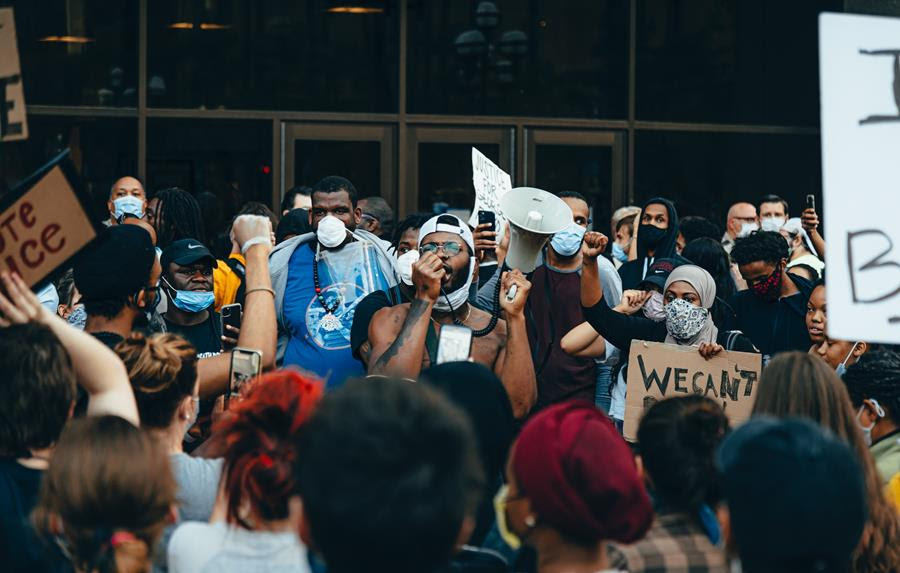
The death of George Floyd shocked the nation. It drew such attention in part because of when it happened: at the start of the pandemic, when people were physically isolated and unusually attentive to their screens. The excruciating video of his death, over such a trivial infraction, and the callousness both of the officer who put the knee to his neck and of his colleagues who passively stood by while the killing occurred—all that brought people out of their homes and into the streets for some of the largest and most widespread protests ever to occur in the United States. People of other nations demonstrated as well.
Despite the backlash against the sentiments expressed on those streets five years ago, the problems highlighted by the killing of George Floyd persist and are long-standing. African Americans have long been subject to mistreatment by law enforcement officers sworn to protect and serve. Violence and threat have long been associated with dark skin, going back perhaps to the era when slave owners remained perpetually watchful (and fearful) that those they held in bondage would rise up and take their vengeance.
The problems of police violence though are not confined to African Americans. They burden people of all races. While African Americans are disproportionately represented among those shot by police, the best available data suggests that more white people are killed by police in absolute numbers.
To address one contributor to this sorrowful state of affairs, the Stanford Center for Racial Justice has undertaken a multi-part research project to examine America’s regulation of force used by police. The report we released today analyzes the use of force policies of the 100 largest cities in the United States. Soon, we will be launching an interactive database featuring these policies, that allows for their assessment by comparison to a model use of force policy that we expect would diminish instances of police mistreatment. We hope that the Center’s research provides a basis for more evidence-based decision-making and further policy reform. But documenting these policy changes is only a first step. We need more rigorous research to evaluate which policies work—and which don’t—at reducing unnecessary force and better protecting officers and the communities they serve.
From the Stanford Center for Racial Justice
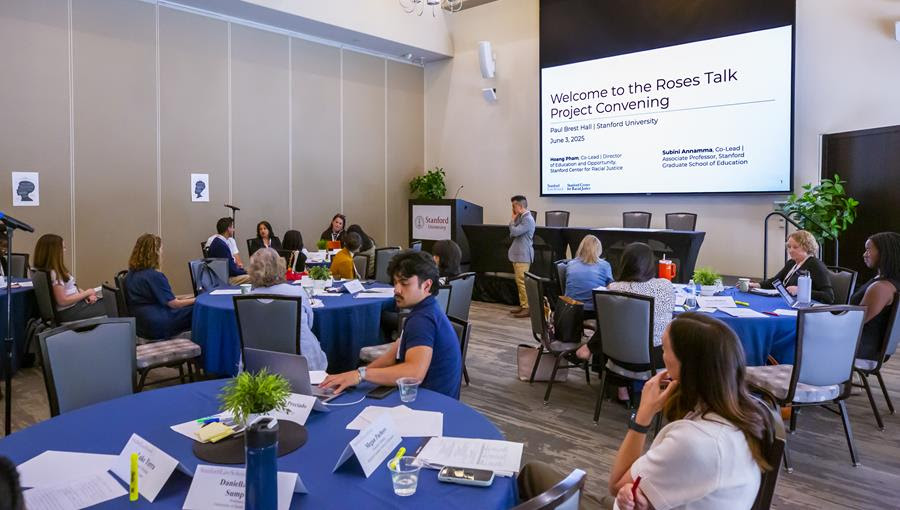
On June 3, the Center’s Roses Talk Project convened school district leaders, school administrators, and education researchers at Stanford Law School. I Christine Baker
Rick Banks, Emily Levine, Hoang Pham, Mitchell Stevens, and Dan Sutton published An Agenda for America’s Universities, featuring a set of policy recommendations for how higher education institutions can better deliver on their promise of economic opportunity and mobility.
Ev Gilbert reflected on the Roses Talk Project’s recent covening, where San José Unified school district leaders, school administrators, and education researchers met at Stanford Law School to examine the project’s preliminary findings and chart the path forward for the research partnership that harnesses the underutilized knowledge of students who face the greatest educational challenges.
In The Atlantic’s Trump Is Right About Affirmative Action: But for the wrong reasons, by Thomas Chatterton Williams, Rick Banks is quoted pointing out some of affirmative action’s limitations as a “Band-Aid” that lets society postpone “dealing with the big issues.”
A spotlight on the FIRE Fellowship created by Subini Annamma that involves both surveying formerly incarcerated youth about their experiences, and equipping them with research skills.
“People decide whether they’re against DEI or whether they’re for DEI, then they huddle with their own like-minded peers, they disavow and vilify the people on the other side. This is a poisonous dynamic. It’s a dynamic that not only divides us from each other, it also practically precludes the development of the sorts of programs that we do need because those sorts of programs are only going to come about if we can get the input and the best ideas from all segments of society. The path forward is going to involve working together and people learning from even or especially those with whom they disagree.”
Ralph Richard Banks Faculty Director, Stanford Center for Racial Justice
Assessing the future of DEI programs and initiatives in the Federalist Society’s short film examining American Alliance for Equal Rights v. Fearless Fund, a case challenging a race-based grant program under Section 1981 of the Civil Rights Act of 1866.
Things You Should Know
Supreme Court expands scope for excessive force lawsuits
In May, the Supreme Court unanimously rejected the “moment of threat” doctrine that had limited how courts evaluate police use of deadly force cases. The New York Times’ Adam Liptak analyzed the court’s ruling in Barnes v. Felix, where the justices held that courts must consider the entire context of police encounters, not just the seconds immediately preceding a shooting. The case involved Ashtian Barnes, a 24-year-old Black man killed by Officer Roberto Felix Jr. during a 2016 traffic stop outside Houston. Barnes was pulled over for unpaid tolls linked to the car’s license plate, though he wasn’t responsible for the debt. When Barnes began to drive away with his car door open, Felix jumped onto the moving vehicle and shot him twice. The Fifth Circuit had previously ruled for the officer using the “moment of threat” standard, with one judge noting he might have ruled differently if allowed to consider the officer’s role in escalating the situation. The Supreme Court’s decision sends the case back for reconsideration under the broader standard, potentially making it easier to challenge the lawfulness of police shootings in federal court.
Police use new AI to bypass facial recognition bans
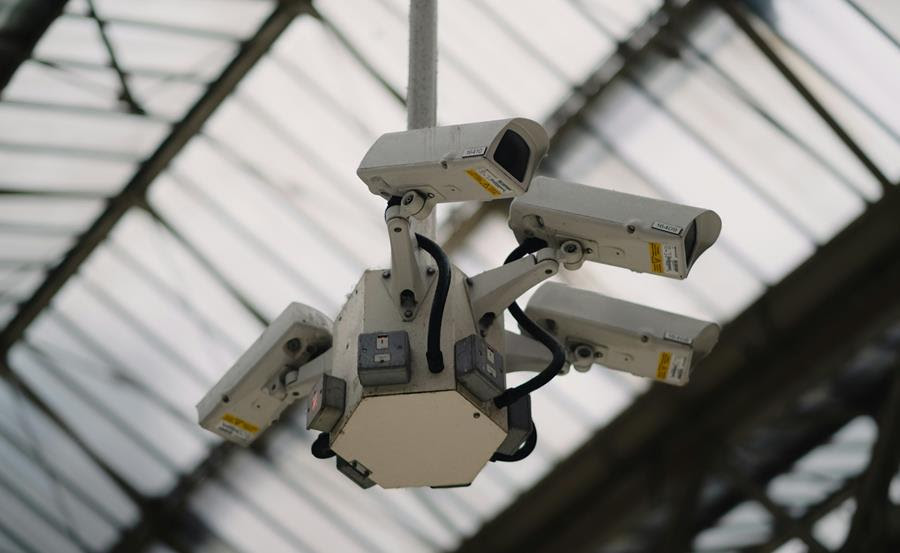
The MIT Technology Review examined how police and federal agencies are increasingly using an AI tool called “Track” that sidesteps facial recognition restrictions by identifying people through body size, clothing, hair, and other physical attributes instead of faces. Built by Veritone and used by 400 customers including police departments and universities, the technology can assemble timelines tracking individuals across multiple video feeds and locations. The Department of Justice began using Track for criminal investigations last August, while other federal agencies including Homeland Security and Defense also employ Veritone’s broader AI suite. Civil liberties advocates warn the tool creates “a categorically new scale and nature of privacy invasion” that may violate the spirit of facial recognition bans while technically complying with laws that focus on biometric data. The ACLU argues Track enables the same surveillance concerns as facial recognition but introduces new risks, particularly as the Trump administration expands monitoring of protesters, immigrants, and students.
Trump DOJ dismisses police investigations in Minneapolis, Louisville, and several other cities
As noted above, the Justice Department announced it will dismiss federal investigations into police departments in Minneapolis, Louisville, and several other jurisdictions, reversing findings of constitutional violations made during the Biden administration. Assistant Attorney General Harmeet Dhillon who said the move ends what she called the “failed experiment of handcuffing local leaders and police departments with factually unjustified consent decrees,” NPR’s politics team reported. The decision affects investigations opened after high-profile police killings, including probes into Minneapolis police following George Floyd’s murder and Louisville Metro Police after Breonna Taylor’s death. The Trump administration is also closing investigations into police departments in Phoenix, Trenton, Memphis, Mount Vernon, Oklahoma City, and the Louisiana State Police, with Dhillon indicating a broader review of all pending federal oversight agreements. Civil rights advocates criticized the decision as putting communities at risk, while former Biden Civil Rights Division head Kristen Clarke defended the investigations as data-driven and carefully negotiated with law enforcement leaders.
Here’s what else we’re following.
Mapping Police Violence Releases Use of Force Data: A new analysis of nearly 3,000 law enforcement agencies estimates that American police use force against at least 300,000 people annually, with over 80% of those subjected to force reportedly unarmed. Mapping Police Violence
Trump Administration Targets Criminal Justice Nonprofits: The Vera Institute of Justice lost $5 million in federal funding after the Department of Justice abruptly canceled all five of its grants, citing that the organization’s work “no longer effectuate[s] the program goals or agency priorities.” Mother Jones
New Orleans’ Police Secret Facial Recognition Program Exposed–and Paused: A Washington Post investigation revealed how police in New Orleans secretly used a private network of over 200 facial recognition cameras for two years to monitor city streets. The program was paused in April after The Post began investigating. The Washington Post