
Managing Multidistrict Litigation: What’s Working, What’s Not, and What’s Next
Multidistrict litigation (MDL) now dominates the federal civil docket. With roughly 65% of all federal civil cases consolidated into MDLs, these cases have significant implications for the health and safety of millions of Americans. With the explosive growth in MDLs comes extraordinary responsibilities—and challenges—for the transferee judges tasked with managing these sprawling cases.
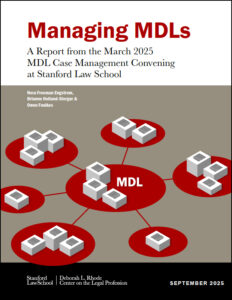
Last spring, the Deborah L. Rhode Center on the Legal Profession gathered leading transferee judges, scholars, and practitioners to reflect on the state of MDL case management. On September 23, 2025, Professor Nora Freeman Engstrom, Stanford Law 3L Owen Foulkes, and former Rhode Center Civil Justice Fellow Brianne Holland-Stergar published their report from the Convening, Managing MDLs: A Report from the March 2025 MDL Case Management Convening at Stanford Law School.
We sat down with the authors to talk about what they learned, what’s at stake, and what comes next.
Q: Why did the Rhode Center host the MDL Case Management Convening?

Nora: We’re at a critical juncture. Transferee judges are making enormously consequential decisions, including which attorneys to appoint to leadership, how to vet claims, and how to usher complex cases to conclusion. These decisions can affect hundreds of thousands of litigants and, in many cases, the legitimacy of the civil justice system itself.
Currently, MDL judges have largely unfettered discretion when making these high-stakes determinations. Rule 16.1—the first federal rule to directly address MDL practice—is set to go into effect later this year, and it provides some guidance. But it provides a light touch, rather than a heavy hand.

Now, is it good that transferee judges have so much freedom and flexibility? I, personally, think it is. Each MDL is somewhat different; it makes sense for judges to have latitude to create bespoke procedures, responsive to the MDL’s particular needs and challenges. Furthermore, MDLs have long been a site of innovation and experimentation. I’d be wary of any “fix” that freezes MDLs in their current form. Yet, as I explained in my remarks at the start of the Convening, even as we give transferee judges room to build innovative procedures, we have a responsibility to supply a firm foundation for that construction. Transferee judges might not want to be told what to do. But they may want to know what’s been done and how it’s worked. A judge may want to blaze her own trail, but she doesn’t want to proceed in the dark. We at the Rhode Center hosted the Convening to supply that critical illumination.
Q: Who attended the Convening?
Owen: We gathered a diverse set of influential MDL judges, MDL plaintiffs’ and defense attorneys, and scholars. Our goal was to ensure that the Convening featured a wide range of opinions and perspectives. And it certainly did; we’re confident that the discussion at the Convening—recorded in Managing MDLs—reflects a spectrum of opinions and experiences when it comes to MDL case management.
Q: What specific issues did Convening participants focus on?
Brianne: We structured the day around the following four controversial and high-stakes case management challenges:
- Claim integrity: MDL judges, litigants, and scholars have long debated how to fairly and efficiently weed out truly nonmeritorious claims. But the current weapons in judges’ arsenals are, most agree, imperfect. Some are too strong, others too weak, and few get at the root of the problem. Thus, participants grappled with a difficult question: How can judges best eliminate nonmeritorious claims without stifling valid ones?
- Common benefit fees: In MDLs, some attorneys (usually, those appointed to leadership positions) take the laboring oar; they litigate and bankroll the litigation on behalf of all MDL plaintiffs. Not surprisingly, on those occasions that the litigation is successful, they want to be paid for the effort they exert and the expenses they incur. Currently, these payments take the form of common benefit fees, paid from “sidelined” lawyers to those lawyers who performed common benefit work. Yet, these fees are controversial. Practitioners and scholars debate just how much sidelined lawyers should pay, exactly what work ought to be eligible for compensation, and whether these payments are even necessary. Tackling these questions, participants debated whether common benefit fees are justified, and if so, how the transfers—from some lawyers to other lawyers—ought to be made.
- Leadership: In MDLs, transferee judges appoint the lawyers who will litigate the case on behalf of the plaintiffs—and, in making these appointments, judges have enormous (essentially unfettered) discretion. How should that discretion be exercised? For instance, how should judges balance an attorney’s experience litigating MDLs with the need to develop a pipeline of newer attorneys prepared to shepherd future MDLs to a resolution? Should judges appoint leaders with lots of cases? Or, does that create its own pernicious incentive to hoover cases up, leading to the problem of nonmeritorious claims (discussed above)? Should they trust their own judgment? Or, should they let plaintiffs’ lawyers have a say?
- Case closure: A fair and efficient resolution is the end goal in every MDL, but how should that goal be achieved? Complicating that determination, certain goals (e.g., achieving finality) can come with serious drawbacks (e.g., exerting undue settlement pressure on individual plaintiffs). Recognizing these tradeoffs, participants wrestled with how cases ought to wind down and when and how “straggler” claims ought to be remanded back to transferor courts.
Q: What are some of the key takeaways discussed in Managing MDLs?
Nora: The report is a treasure trove of insights into MDL case management, and there are more than a few takeaways we hope readers will absorb. Here, I’ll highlight several that readers may find particularly noteworthy:
- Convening participants largely agreed MDLs should remain laboratories for innovation—flexibility allows judges to test creative approaches and tailor procedures to the individual needs of each case. Notably, virtually no one in attendance advocated for more stringent rules to govern MDL case management.
- Many participants commented on the potentially outsized role that forces like mass-tort advertising, lead generators, and third-party litigation funding play in the lifecycle of modern MDLs. There was a general sense that we ought to better understand how these mechanisms are shaping—and possibly distorting—the filing and litigation of claims.
- Participants also generally agreed that judges should be actively involved in selecting plaintiffs’ lead counsel. While in the past some judges have deferred to “leadership slates” proposed by the attorneys themselves, many were glad to see judges playing a more active role in selecting attorneys, including by interviewing applicants and inquiring into team cohesion and the attorneys’ history of collaboration.
Q: Did the Convening reveal areas where more research is needed?
Owen: Absolutely. Managing MDLs highlights numerous areas for future research. Participants stressed, for instance, that we lack reliable data on the prevalence of nonmeritorious claims. Similarly, more work is needed to understand how AI can responsibly support (rather than distort) claim vetting. We hope that the report will inspire academics to dive into these and other important questions.
Q: What do you hope readers take away from the report?
Brianne: That MDL management isn’t just an esoteric procedural question. The choices judges make reverberate across the justice system, shaping how mass harms are resolved. The Convening, as detailed in Managing MDLs, underscored that MDLs are both sites of innovation and sources of tension. Our hope is that by candidly airing challenges, sharing best practices, and identifying research priorities, we can help ensure that MDLs continue to evolve in ways that serve both efficiency and fairness.
Q: Where can readers learn more about this issue?
Nora: At the Rhode Center, we’ve developed a practical, accessible toolkit to increase visibility into MDLs and to assist judges, clerks, and practitioners as they manage MDLs. The toolkit focuses resources on six high-impact issues in MDLs: promoting claim integrity; leadership and personnel decisions; common benefit funds; bellwether trials; judicial adjuncts, magistrates, and special masters; and facilitating and structuring settlements. We also maintain a repository of monthly JPML reports that detail key information and statistics on pending MDLs. Readers can visit https://clp.law.stanford.edu/mdl-toolkit/ to access these resources.
Nora Freeman Engstrom is the Ernest W. McFarland Professor of Law at Stanford Law School. A nationally recognized expert in both tort law and legal ethics, she explores the day-to-day operation of the tort system, including the system’s interaction with alternative compensation mechanisms, such as no-fault automobile insurance and the Vaccine Injury Compensation Program.
Owen Foulkes is a third year JD candidate at Stanford Law School. He is a co-author of Managing MDLs and on the Editorial Board of the student journal, Stanford Law and Policy Review.
Brianne Holland-Stergar is a former Rhode Center Civil Justice Fellow and a co-author of Managing MDLs.