
New Paper Analyzes Water Permitting for Confined Animal Facilities in California
This week, the Environmental and Natural Resources Law & Policy Program, in collaboration with the Climate and Energy Policy Program, released a white paper detailing California’s failure to adequately monitor and oversee confined animal facilities (CAFs) under the Porter Cologne Water Quality Control Act (Porter-Cologne Act), California’s equivalent to the Clean Water Act.
California is home to a significant proportion of the CAFs in the United States, including more large commercial dairies than any other state. These facilities produce millions of pounds of manure each year. If not properly managed, this waste can pollute surface water, contaminate groundwater, and precipitate algal blooms, resulting in potentially severe human health consequences and long-term environmental damage.
Pursuant to the Porter-Cologne Act, the Regional Water Resources Control Boards (Regional Boards) require CAFs to self-report their manure production and waste management practices in annual reports. In theory, the Regional Boards review these reports for procedural violations (e.g., failure to report adequate information) and possible substantive violations (e.g., failure to comply with waste management practices).
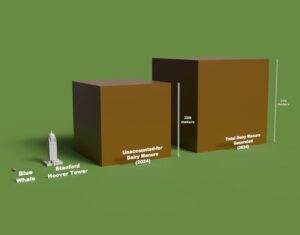
See methodology and references below.
Our white paper analyzed 1,280 annual reports submitted to Regional Boards in 2023 and 2024. It reveals that CAFs often fail to accurately report their waste production and manure disposal practices and that Regional Boards frequently fail to follow up on these serious omissions or inaccuracies.
As one example, we found that CAFs repeatedly underreported the manure they produced. According to the United States Department of Agriculture, each beef cow produces approximately 10 tons of manure annually. One CAF nonetheless reported that their 4,505 head of cattle produced a mere 211.5 tons of manure in 2023, which equates to only 0.05 tons of manure per cow annually. That estimate deviates from the scientific literature by a factor of 200. The relevant Regional Board did not report this instance as a potential violation in California Integrated Water Quality System (CIWQS), the Regional Boards’ water quality database that logs information related to permit compliance, violations, and enforcement. As a result, it is impossible to assess whether manure is properly managed at California’s many dairy CAFs. Indeed, several Regional Boards do not even require CAFs to report the quantity of manure that they produce. Without such information, there is no way for Regional Boards or the surrounding communities to understand the potentially devastating water quality impacts and human health consequences from these facilities or to take corrective action.
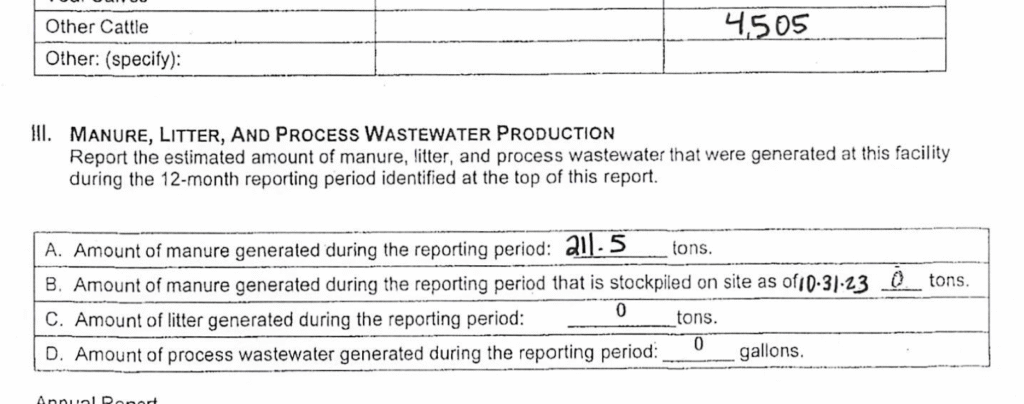
Superior Cattle Feeders (Slater), Excerpt from Annual Report (General Order No. R7-2021-0029, NPDES No. CAG017001) 1 (2023).
While available reporting information is woefully incomplete, several annual reports suggest likely violations of water quality standards. The Porter-Cologne Act authorizes Regional Boards to take action when CAFs mismanage manure. Finally, the white paper concludes with several recommendations that the Regional Boards could implement to more effectively safeguard California’s water quality with respect to CAFs. We recommend creating a more streamlined reporting system that will allow the Regional Boards to efficiently review annual reports. We also identify mechanisms that Regional Boards might use to assess fees that would enable them to build greater internal capacity to review these annual reports and respond accordingly. Without such oversight, the annual reports submitted by CAFs are largely a paper exercise that fails to protect the public.
Read more here and see accompanying dashboard here.
Zoe Robertson is a third-year J.D. Candidate at Stanford Law School. Her work focuses on the intersection of environmental law, animal welfare, and bioscience. She has previously published work in the Stanford Law and Policy Review and The Hill.
Methodology
Based on the annual reports we examined, we calculated a total of 21,369,372 tons of generated manure in 2024 from a subset of 588 dairies within the Region 5 Water Board. To convert this weight of manure to a volume, we divided it by a fresh manure bulk density of 1.09 tons per cubic meter (ASAE 2003) and found a volume of 19.6 million cubic meters. From our manure nutrient accounting analysis, we estimated a total of 64,688 tons of unaccounted-for nitrogen. To convert this weight of nitrogen to a volume of fresh manure, we first used a USDA estimate of 12.92 lbs of nitrogen per ton of fresh manure (USDA 2014), then divided it by the fresh manure bulk density of 1.09 tons per cubic meter (ASAE 2003), resulting in a volume of 9.2 million cubic meters.
References
Manure Production and Characteristics (ASAE Standards 2003 No. D384.1 FEB03). (2003).(http://large.stanford.edu/publications/coal/references/docs/ASAEStandard.pdf)
Kellogg, R. L., Moffitt, D. C., & Gollehon, N. R. (2014). Estimates of Recoverable and Non-Recoverable Manure Nutrients Based on the Census of Agriculture. United States Department of Agriculture, Natural Resources Conservation Service, Resource Economics and Analysis Division. (https://www.nrcs.usda.gov/sites/default/files/2022-10/ManRpt_KelMofGol_2007_final.pdf)
tshannon. (2011). Hoover Tower [3D model]. Thingiverse. (https://www.thingiverse.com/thing:5621) (Creative Commons Attribution-ShareAlike 3.0).
Lvov, Bohdan. (2017). Blue whale (textured) [3D model]. Sketchfab. (https://sketchfab.com/3d-models/blue-whale-textured-d24d19021c724c3a9134eebcb76b0e0f) (Creative Commons Attribution-ShareAlike 3.0)