
The Brief: AI and constitutional rights, Partisan redistricting (June 2026)
Welcome to The Brief, our newsletter bringing you focused insights on race, law, policy, and technology from the Stanford Center for Racial Justice.
AI, Policing, and Constitutional Rights
In 2013, a federal court in Manhattan held that the NYPD’s stop-and-frisk practices violated both the Fourth Amendment’s reasonable suspicion requirement and the Fourteenth Amendment’s Equal Protection guarantee, finding a pattern of racial profiling. To oversee reforms, the court appointed an Independent Monitor, who has spent more than a decade assessing the department’s compliance with both constitutional standards. In late April, the Monitor submitted to the court a new research study, which we authored in partnership with Stanford SPARQ, that focuses AI tools on a question central to that compliance work: what officers actually say during encounters with civilians, and what their language reveals about whether the law is being followed.
Body-worn cameras, mandated under the Floyd remedial orders, capture an objective record of many officer-civilian interactions that is largely invisible in stop reports and other administrative documents. Using machine learning and natural language processing, our SPARQ colleagues worked from a large sample of body camera footage and classified investigative encounters under New York’s four-level De Bour framework, separating brief interactions where civilians remain free to leave from Level 3 stops that constitute detentions—with roughly 82% accuracy. Applied at scale, the models found that encounters officers had logged as low-level interactions with Black and Hispanic civilians linguistically resembled Level 3 stops more closely than the documentation suggested.
The study’s analysis of consent searches revealed parallel concerns: across a full year of documented consent requests, the word “search” appeared in just 46% of encounters and “consent” in only 13%, despite a New York City law requiring officers to explain a person’s right to refuse and confirm their understanding. Officers also more often relied on ambiguous “[do you] mind” phrasing when speaking with Black civilians, and used commands more frequently in encounters with both Black and Hispanic civilians. These patterns do not establish discriminatory intent on their own, but they line up with the kind of differential treatment that raises Equal Protection concerns.
Earlier work on the Floyd litigation has documented disparities in who gets stopped. This study extends that record by examining how those encounters actually unfold. The concerns about AI in policing are real. Surveillance platforms have led to wrongful arrests, predictive systems can entrench the patterns they were trained on, and the LLM-based tools used increasingly in policing and prosecution, which our own research has examined, can bring bias into consequential decisions.
But this study illustrates that the same technology can be turned toward enforcing civil rights, by enabling constitutional review at a scale humans cannot match. The NYPD records millions of investigative encounter videos each year, while quarterly Monitor audits and the department’s ComplianceStat meetings examine only a few hundred videos. AI tools can help close that gap by flagging encounters that warrant closer review, revealing the dynamics that produce civilian complaints, and giving courts and oversight bodies a fuller picture of what compliance looks like in practice.
Read the Study.
Download the Executive Summary.
FACULTY DIRECTOR’S CORNER
Professor Ralph Richard Banks on Callais and Partisan Redistricting
The Supreme Court’s decision at the end of April in the Louisiana v. Callais voting rights case justifiably provoked an extraordinary amount of media attention and criticism. If not unexpected in light of previous rulings, the Court’s decision was nonetheless shocking. It rejected a long-standing interpretation of a key provision of the Voting Rights Act, a landmark piece of congressional legislation enacted during the Civil Rights era to make real the unfulfilled promises of the Reconstruction era a century earlier.
The Court’s Callais decision will undermine American democracy in two ways: it will diminish the power of Black and other minority voters to elect the candidates of their choice, and it will further accelerate an already worrisome trend of partisan redistricting.
Callais concerned a challenge to the state legislature’s having intentionally created a majority-Black congressional district to avoid potential liability for violating the VRA’s prohibition of minority vote dilution. The Supreme Court made it difficult, indeed nearly impossible, to prove vote dilution by jettisoning the long-standing effects test and instead requiring evidence tantamount to proof of discriminatory intent. The implication of that change, in turn, is that jurisdictions will rarely, if ever, be required (or even permitted) to take race into account in order to enhance minority voting power.
While the direct effect of the ruling is to diminish Black voting power, its indirect effect may be even more important. The drawing of district lines to enhance minority voting power operated, in many cases, as a constraint on partisan redistricting. Callais will thus fuel partisan redistricting, a pernicious practice that the Court has previously announced as non-justiciable (meaning it’s not subject to judicial oversight or regulation).
Partisan redistricting turns on its head the idea that voters should choose their representatives. Instead, it enables the supposed representatives to choose their voters, predictably entrenching the power of whatever political majority controls the redistricting process.
Spurred by Callais, Republican-leaning states are diminishing the power of Democrats to elect the representatives of their choice, a development that other states have countered by redrawing district lines to diminish the power of Republicans. In California, for example, Republican-leaning voters constitute roughly a third of the electorate, yet as few as 4 of the state’s 52 congressional districts will likely be held by a Republican.
The unfortunate effects of Callais are already apparent. In the first week of June, in Allen v. Milligan, an Alabama redistricting controversy, the Supreme Court overrode a trial court judgment and endorsed a congressional map that left Alabama with only one majority-Black district out of seven, even though Black voters are roughly a quarter of the electorate.
The Court’s misguided endorsement of partisan redistricting and its refusal to enforce the VRA as Congress intended will not usher us into a colorblind era, as some commentators suppose. Instead, it will aggravate the polarization and tribalism that now plague American society.
If we are to maintain our democracy, we need to do better.
From the Stanford Center for Racial Justice
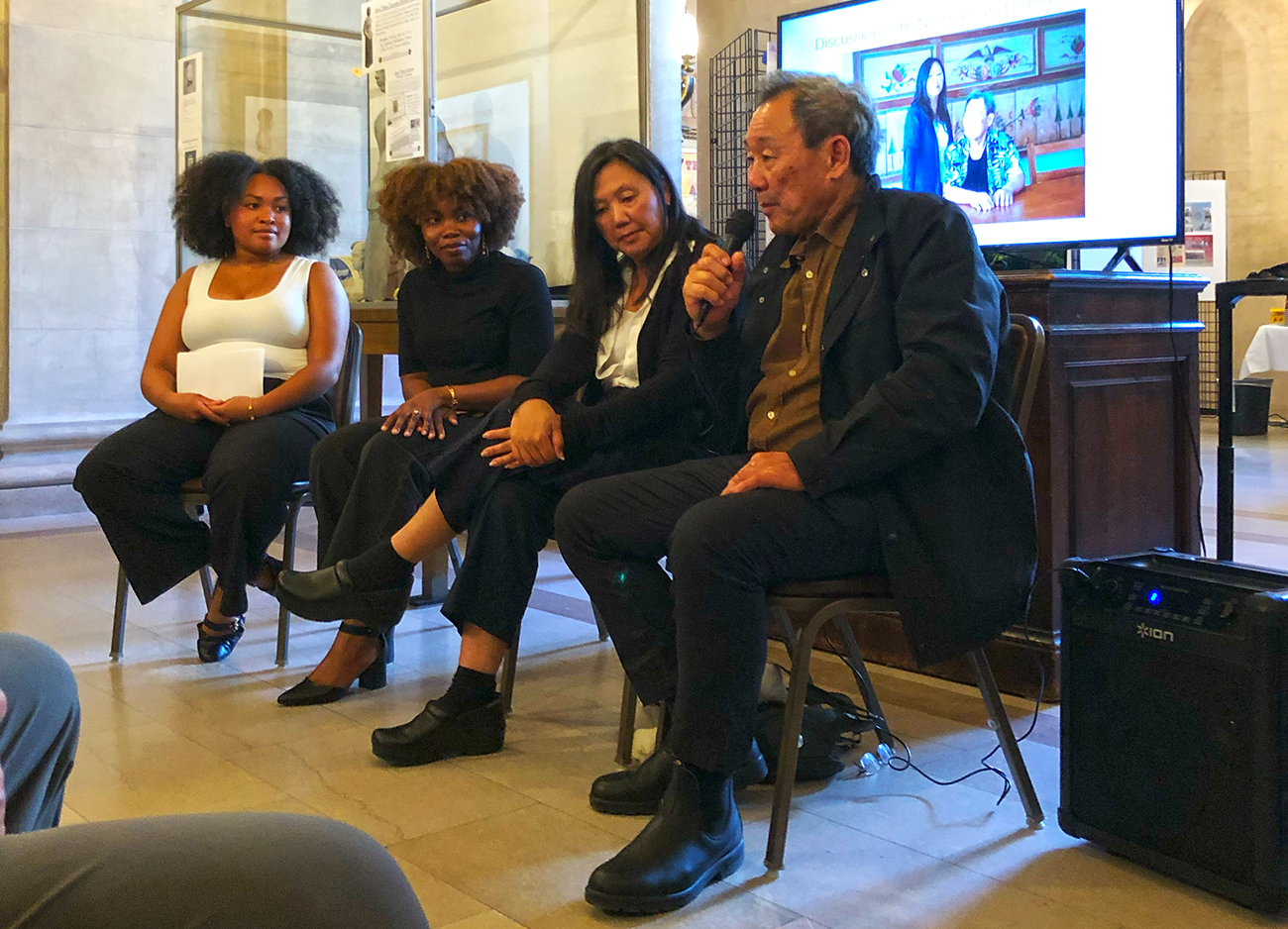
On May 26, Nini Tufon, JD ‘28, and Nkemjika Emenike, JD ‘28, interviewed Norman and Sandra Wong, the great-grandchildren of Wong Kim Ark, whose landmark 1898 Supreme Court victory affirmed birthright citizenship.
The Center, together with American Legion Cathay Post 384, hosted Justice, History, Preservation, a San Francisco reception celebrating Wong Kim Ark and the landmark 1898 Supreme Court decision that established birthright citizenship. Attendees met sculptor Alicia Ponzio, who is creating a bronze bust of Wong Kim Ark for San Francisco’s Chinatown, alongside Wong’s great-grandchildren, Norman and Sandra Wong. The Center’s team—Nini Tufon, Nkemjika Emenike, Ayomide Oloyede, Tarina Ahuja, and Hoang Pham—presented their research supporting the project.
Rick Banks served as a panelist at the Santa Clara Law Review’s annual symposium, “The Changing Landscape of Constitutional Interpretation and Its Impact on Immigration Law, Reproductive Rights, and Education Law,” which brought together students, faculty, and practitioners to examine pressing constitutional questions across these fields.
Bremond Fellows Brionna Bolaños, JD ’27, and Dayle Chung, JD ’27, discussed their research at Stanford Law School, taking up whether a president’s decision to federalize the National Guard is justiciable and how the California Racial Justice Act reshapes the evidence litigants can use to show discrimination in criminal cases.
The Roses Talk Project Team, including Hoang Pham, Reva Kale, Nini Tufon, Erzsabet Gonzalez, Daniela Flores, Lily Hong, Tarina Ahuja, and Ayomide Oloyede, welcomed Gunderson High School students and their families to campus to participate in a full day of learning and relationship building grounded in workshops designed to center student needs. Sessions were developed to be responsive to both what students shared in the Roses Talk Report and a series of policy workshops conducted in spring 2026 with stakeholders from across Gunderson High School and San José Unified School District. The Project was also awarded a Stanford Research Development Office grant to support a summer convening bringing together over 80 stakeholders from Gunderson and the San José Unified School District to develop education policy implementation strategies and shape the project in its next phase.
ON THE RECORD
“For a lot of the pattern-of-disparity claims under the Racial Justice Act, there’s a sole focus on statistical evidence, but the literature and the court cases are ignoring other categories of evidence. I argue that pattern-of-disparity claims shouldn’t be equated with statistical claims, and that litigants and courts should give significant weight to non-statistical evidence as well. The statute asks us to look to the totality of the evidence—we should take it at its word.”
Dayle Chung, JD ’27, and Bremond Fellow at the Center
Discussing her research on California’s Racial Justice Act at the Center’s recent Bremond Fellows event.
FROM CHALLENGING PRECEDENT
Redefining Executive Force After Trump v. Illinois: Oregon’s Withdrawal and the Growing Shadow of Federal Power
In the latest post on the Center’s Challenging Precedent blog, law student Samantha Taylor examines what the Trump administration’s surprise retreat in Oregon reveals about the future of federal force. In February, the administration dropped its Ninth Circuit appeal of an order blocking the deployment of federalized National Guard troops in Portland—an effort that began in September 2025, when President Trump federalized the Oregon Guard in response to anti-ICE protests. The withdrawal followed the Supreme Court’s decision in Trump v. Illinois, which affirmed a Seventh Circuit block on a parallel deployment. In a fractured ruling spanning four opinions, the majority held that 10 U.S.C. § 12406 lets the president call up the Guard only where the “regular forces”—the U.S. military—are themselves unable to execute the law, reading that limit against the Posse Comitatus Act’s long-standing skepticism of military involvement in civilian affairs. Taylor argues that this apparent victory for state sovereignty may prove illusory: by closing off § 12406, the Court may instead push the administration toward invoking the Insurrection Act, an exception to Posse Comitatus, recasting Oregon’s withdrawal less as a defeat than a tactical regrouping, with chilling consequences for protesters and immigrant communities.
Read the full post.
Here’s what else we’re following.
Justice Department concludes Yale School of Medicine discriminated by race in admissions
A year-long Civil Rights Division investigation announced on May 14 found that Yale School of Medicine intentionally “discriminated against other applicants to benefit preferred race classes of Black and Hispanic” in violation of Title VI. The Department cited internal admissions materials, interviews structured to reveal applicants’ race, the treatment of socioeconomic status as a “racial proxy,” and a statistical analysis finding no change in racial disparities between admitted students before and after Students for Fair Admissions v. Harvard. The Department reached the same conclusion about UCLA’s medical school roughly a week earlier.
EEOC moves to end workforce demographic reporting and rescind 1979 anti-discrimination guidance
The EEOC, under Trump-appointed chair Andrea Lucas, has submitted to the White House proposals to end the annual EEO-1 collection—which has required companies with 100 or more workers to report employee race, ethnicity, sex, and job category since 1966—and to rescind a 1979 regulation that gave employers a roadmap for voluntarily addressing race and gender imbalances. As NPR reports, the EEO-1 data has anchored decades of discrimination investigations. At the same time, Lucas has defended an EEOC subpoena demanding the University of Pennsylvania identify Jewish employees who may have witnessed antisemitic acts on campus, telling a recent audience that “there is no other way to protect victims of harassment and discrimination unless you collect information about them.”
OMB proposes federal grant rules rewrite barring DEI and expanding termination authority
The Office of Management and Budget released a 400-plus page rewrite of the regulations governing federal grants, implementing President Trump’s August 2025 executive order on federal grantmaking. OMB says the revisions uphold “basic American principles of equality and equal opportunity” by prohibiting agencies from applying DEI or other identity-based concepts. The rewrite also broadens agencies’ authority to unilaterally terminate awards that no longer effectuate program goals or agency priorities and requires senior political appointees to conduct pre-issuance reviews of all discretionary awards. Comments are due July 13.