
Justice for All? Why We Have an Access to Justice Gap in America—and What Can We Do About It?
On a recent episode of the Stanford Legal podcast, Professors David and Nora Freeman Engstrom, co-directors of Stanford Law School’s Deborah L. Rhode Center on the Legal Profession, delve into what they describe as an access to justice crisis in the United States. In three-quarters of civil cases in state courts, they say, at least one party lacks a lawyer, usually because they cannot afford one. And, as they explain, this pro se crisis is just a small part of a much larger problem.
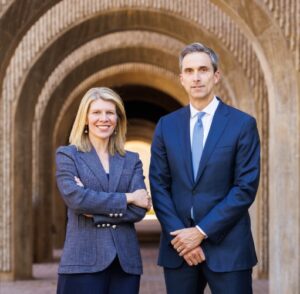
Stanford Legal co-host Pam Karlan, the Kenneth and Harle Montgomery Professor of Public Interest Law, interviewed the Engstroms about the roots of the access to justice crisis, how it impacts individuals and families—and what can be done to fix it.
The following is an edited version of the full podcast transcript, which can be found here.
Pam Karlan: On one hand, people often think there are too many lawyers in the United States, but then there’s this countervailing issue of there not being enough legal services.
Nora Freeman Engstrom: In the United States, we have plenty of lawyers, but people’s ability to get access to justice is actually pretty dismal. In three-quarters of civil cases in state court—and state court is where the vast majority of cases are litigated in this country—one side lacks a lawyer. Sometimes, both sides lack a lawyer.
Pam Karlan: What kind of cases are we talking about here where three-quarters of the people don’t have lawyers?
David Freeman Engstrom: Generally, these are low-dollar, but highly consequential cases. They tend to be debt collection actions, evictions, mortgage foreclosure actions, and a lot of family law claims, including child support enforcement actions. There are approximately 15 million cases a year where at least one side lacks a lawyer. Another feature of these cases also really stands out: These cases tend to pit an institutional plaintiff—for instance, a bank, a credit card company, a corporate landlord, a municipal housing authority, or some other government agency—against an individual defendant without a lawyer.
Pam Karlan: And we’re not even counting in the cases where people don’t get to court in the first place: individual plaintiffs who’ve been defrauded or wronged, who would go up against a corporate defendant if they had a lawyer or the resources.
Nora Freeman Engstrom: Yes, the pro se crisis—all those folks in court without counsel—is really just the tip of the iceberg. Below all these folks we see are all these cases that never make it into court at all. These are people with rights that are violated but never vindicated. And it’s exactly as you say: It’s the person who has an uninhabitable apartment, but never seeks to enforce her right for habitable housing, or the person who’s jerked around by the insurance company and never gets the claim paid and just ultimately shrugs her shoulders and gives up, or the woman who’s being abused by her spouse and never gets that domestic violence restraining order that she needs.
Pam Karlan: Why can’t people get lawyers for these kinds of cases?
David Freeman Engstrom: The Stanford Law Review had a symposium last year on access to justice, and Nora and I wrote an introductory essay in that symposium that I can commend to the listeners. It’s titled “The Making of the A2J Crisis,” and in that essay, we roll through all the different causes.
One issue is attribution. Many Americans don’t even necessarily know that the problem that they have is a legal problem in the first place, and that’s really important to keep in mind. They don’t even know that they should resolve a certain matter by going to court.
Another issue is expense. Legal services are really expensive. Anyone middle class or below is priced out of the market for legal services that cost, on average, $300 an hour. And, although there is some legal aid to help people, there’s clearly not enough, and, adding to the insufficiency, there are restrictive rules that limit what types of legal services can be provided and by whom.
Pam Karlan: But why are we seeing such an uptick in pro se litigation rates? There’s some evidence that, over the past few decades, pro se rates have more than doubled.
David Freeman Engstrom: Yes, rates of pro se litigation is up sharply, although assessing the exact amount is challenging. But why?
In the Stanford Law Review essay, we note that, interestingly, poverty rates haven’t really changed so much in recent decades. What has increased is economic precarity. Most American households can’t really weather any significant financial hit, and so when they get hit with health care bills that they can’t pay, or fall behind on their rent, they descend into poverty and debt collection actions, and evictions frequently follow—and it is these cases that are really choking courts. These cases overwhelmingly end in default judgments: The defendant fails to show up because the defendant has no meaningful legal help.
Nora Freeman Engstrom: All this is bound up together. For example, once your wages are garnished pursuant to a default judgment, it sure is harder to pay rent, and if you’re not paying rent, then it sure is easy to get evicted. And it cuts the other way, too. Once you’re evicted, it’s really hard to keep your job, and it’s hard to keep your family together, and so legal problems have a way of cascading on one another.
Pam Karlan: And none of these cases that we are talking about would be done on contingent fee cases, correct?
Nora Freeman Engstrom: That’s mostly right. The access to justice problems David and I are focused on are particularly acute in areas where lawyers charge by the hour—areas involving housing, families, and debt collections. But they’re not isolated to these areas. A lot of people think, for example, that there’s no access to justice problem in the personal injury sphere because, if you’re hurt, you can get a lawyer on a contingency fee basis. That’s right if you’re a high wage earner and you’re really seriously injured. But it is not necessarily the case if you are an elderly person or a child. As I’ve written about, there are access to justice problems that afflict certain areas of the personal injury ecosystem too.
David Freeman Engstrom: Right now in the American legal system, the most numerous type of case is consumer credit debt collection actions. If you look back 30 or 40 years, torts and contract actions were neck and neck on state court dockets. Now, torts have largely fallen away for a variety of reasons, and contract claims, which include debt collection claims, are ascendant. The question is: what happened? It is a really interesting part of all of this and something that you really need to understand to have a full, 360-degree view of the problem. The debt collection industry has learned to leverage a lot of technology, what you would call robotic process automation, to build the pleadings and everything else you need to do in order to generate legal filings and then get them into court. About 60 percent of these cases are brought by debt buyers–that is, entities that buy tranches of debt from the originators, and then use all of this automation to assembly-line filings. However, restrictive rules that say that only lawyers can practice law mean that technology is not nearly as available to the individual defendants on the other side.

Pam Karlan: Let’s talk about restrictions we have on the provision of legal services. The United States is different from other countries where there are all sorts of people who provide legal services. Nora, could you tell us a little bit about how we ended up in this situation?
Nora Freeman Engstrom: As we have said, lawyers are expensive and they’re the only game in town. I call this the two-door problem, which is: If you have a legal problem, or you’re trying to vindicate or defend your legal rights, and you’re going to make your way into court, you’ve got two choices in the United States. You can represent yourself. Or you can hire one of these very expensive lawyers. You can imagine a third choice, right? Like, some sort of “lawyer lite.” Like when I have a sprained ankle, I don’t need to go to a full MD. I can go to a physician’s assistant or a nurse practitioner. Some problems are smaller and more easily addressed—and often better addressed—by someone without a law degree. But in the United States, we don’t have a third door. We have no third option—nothing between a full lawyer and going it alone.
Now, in terms of how we ended up in this situation, it’s fascinating! I am just finishing a paper entitled Auto Clubs and the Lost Origins of the Access-to-Justice Crisis that I wrote with James Stone, a Stanford Law grad who was a fellow at the Rhode Center last year, that sheds light on this. The paper tells this origin story by recovering the lost history of auto clubs. We explain that, in addition to the roadside assistance that we have today, the AAA of yesteryear provided legal services, and actually a lot of legal services. You could go to your auto club if you were in a car accident, and you thought the other person was at fault, and they would represent you. Or, if you were at fault, they would represent you. They would represent you even in criminal matters and provide a defense. Essentially, by joining an auto club, you had a lawyer for all things auto.
Pam Karlan: So, what happened? Why did the auto clubs stop providing legal services?
Nora Freeman Engstrom: It’s a crime in nearly every state for a non-lawyer to supply legal advice or assistance, and those laws have been around for a long time. It’s these laws, called unauthorized practice of law restrictions, that create the two-door problem I just discussed.
Now, auto clubs weren’t running afoul of those laws because lawyers employed by the clubs were providing legal assistance. So, you might be thinking: how is it that a lawyer providing legal assistance is going to run afoul of an unauthorized practice of law rule, designed to prevent the practice of law by nonlawyers? In the 1920s and 30s, the organized bar developed an argument. Never before had there been rules banning what was called “the corporate practice of law,” which is to say lawyers working for non-law firms. Yet, in the 1920s and 30s, the bar simply created a new prohibition. Pursuant to this new prohibition, not only can nonlawyers not practice law. Additionally, if a lawyer is not self-employed or employed at a law firm, the lawyer is also engaged in the unauthorized practice of law. That’s also a no-no. A lawyer’s relation to his client should be personal, and the responsibilities of the lawyer to the client should be direct, they said. Pursuant to this new idea, the bar argued that it’s improper to have things like auto clubs where the lawyers were working for the club and providing legal services.
So, peddling this newly minted prohibition, the bar shut down the auto clubs. And this wasn’t an altruistic move. They weren’t worried about consumer harm. All evidence suggests that the auto clubs were booming, and people were quite thrilled with the services that they received. We argue that the bar fashioned a new argument at a time when the organized bar was under a lot of financial strain, and they wanted to crush the competition.
Pam Karlan: Can you tell us a little bit about some of the innovations that you’re now seeing to try to address the access to justice problems we’ve discussed?
David Freeman Engstrom: There is a movement afoot in the United States, across many states, to relax the usual rules that say that only lawyers can practice law and to try to open up a space for non-lawyer alternative legal services providers. That can include what I refer to sometimes as “human non-lawyers.” These would be along the lines of a nurse practitioner, or a physician assistant. But these providers could also include non-human non-lawyers, i.e., software-driven models of legal provision. This is an important moment, and I think the success or failure of this movement to open up this space for new types of legal services, and new delivery models, is really going to shape the future of the civil justice system. We have advised multiple state supreme courts on how to responsibly relax those rules. And we’ve also done what we think is some really neat empirical work looking at what has happened in the first two states that did this, Utah and Arizona. In both states, there was a liberalization of these rules to create a little more space for non-lawyer legal services providers.
Nora Freeman Engstrom: The big question is: what happens if you relax Rule 5.4? That’s the modern version of the rule, created in the 1920s and 30s, that says lawyers have to practice in law firms or as solo practitioners. They can’t work for things like auto clubs.
David Freeman Engstrom: We are seeing a lot of interesting new service delivery models. Law firms have started to develop tiered legal services, with, for instance, a purely software-based, do-it-yourself tier at the bottom. In the middle, something that involves perhaps a paralegal or a paraprofessional. And then at the top, full representation by a lawyer.
Given the tangle of unauthorized practice of law restrictions, in most states, law companies like LegalZoom are currently limited to what we call document assembly. But, in Utah and Arizona, LegalZoom is using the rule relaxation to hire lawyers to supplement those document assembly services. A lot of non-law companies that just provide, for example, immigration services can now layer in some legal services, so they can provide more wraparound services that they couldn’t offer previously. There’s a company in Utah that helps people achieve expungement of their criminal record in a software-based way. It’s a very robust user-friendly platform.
Pam Karlan: Can you touch on what is happening with generative AI?
David Freeman Engstrom: One of the many things that generative AI brings to the table is “mapping”—the ability to take a plain language description of a legal problem that someone is experiencing. It can take a plain-language description and map it to what we would call a legal ontology in order to understand what the possible actions and outcomes would be, and then come back to the individual who would otherwise go without meaningful legal help with a roadmap for what to do next. That’s real promise, but also, frankly, peril. Generative AI makes these tools much easier to create, but we need to ensure that these tools are high quality and trustworthy.
David Freeman Engstrom and Nora Freeman Engstrom co-direct SLS’s Deborah L. Rhode Center on the Legal Profession, the premier academic center working to make the civil justice system more accessible, equitable, and transparent.
David, the LSVF Professor in Law and an expert in civil procedure and administrative law, focuses his current work on the future of courts and legal services in the age of AI. His book, Legal Tech and the Future of Civil Justice, was published last year. He currently serves as the Reporter for the American Law Institute’s Principles of the Law, High-Volume Civil Adjudication, which will offer courts guidance on the millions of low-dollar but consequential cases, including debt and eviction, that shape Americans’ lives each year. He also co-founded the Filing Fairness Project, an ambitious, multi-state collaboration to modernize court technologies and increase access.
Nora, the Ernest W. McFarland Professor of Law, is a nationally recognized expert in both tort law and legal ethics. In her far-ranging scholarship, she explores the day-to-day operation of the tort system, including the system’s interaction with alternative compensation mechanisms, such as no-fault automobile insurance and the Vaccine Injury Compensation Program. For the American Law Institute, she serves as a Reporter for the Third Restatement of Torts: Miscellaneous Provisions; a Reporter for the Third Restatement of Torts: Medical Malpractice (read recent coverage here); and as an Adviser to the Third Restatement of Torts: Remedies.