
The Guardrails of Democracy
At a Time of Strain for Institutions in the United States and Globally, Stanford Law’s Neukom Center is examining How the Rule of Law is Defined, Defended, and Rebuilt

Professor Diego Zambrano learned early what it means to live where the law can’t be relied upon. In his native Venezuela, he recalls, laws were unevenly enforced and public institutions offered little protection from arbitrary power. Members of Zambrano’s family were repeatedly subjected to violent crime with little expectation that the perpetrators would be brought to justice. His uncle eventually left the country after a carjacking, later bringing Zambrano to the United States as a teenager.
The United States was hardly free of crime or institutional failures, but Zambrano observed a system in which rules were more consistently enforced, public officials operated within recognizable legal frameworks, and institutions imposed limits on individual power. Those experiences fostered a deep love for his adopted country and a lasting appreciation for its legal traditions. He is especially drawn to John Adams’ 1780 formulation in the Massachusetts Constitution, where separation of powers was intended to secure “a government of laws and not of men.”
Zambrano’s faith in American legal institutions—and his awareness of their fragility—drives his work as faculty director of Stanford Law School’s Neukom Center for the Rule of Law, established four years ago through a major gift from the late William H. “Bill” Neukom, LLB ’67, and his wife, Sally.
The Neukom Center is expanding its reach at an urgent moment for the rule of law. Courts, law enforcement institutions, and democratic guardrails face mounting pressure around the world, raising fundamental questions about judicial independence, executive power, and whether legal institutions can retain public trust as partisan conflict intensifies.
A university center like Neukom offers a rare space to think expansively about these issues, says Zambrano, also associate dean for Global Programs. The center’s role, as he describes it, is to put rigorous thinking into the hands of judges, policymakers, and others positioned to act on them and, just as importantly, to teach law students about their role in sustaining the rule of law.
A Critical Mission
Across the country, a growing number of clinics, programs, and research centers are focusing on democracy and the rule of law. The Neukom Center occupies a distinct place in this landscape as a law school-based initiative dedicated to strengthening legal institutions and preparing lawyers to sustain them.
The center builds on decades of work led by Erik Jensen, director of the Rule of Law Program, which became part of the Neukom Center when it launched in 2022. Jensen’s projects in Afghanistan, Bhutan, Iraq, Rwanda, and elsewhere enabled generations of students to engage with rule-of-law challenges around the world. Their efforts included writing more than a dozen textbooks tailored to local legal systems.
The Neukom Center has given that foundational work an institutional home while extending the law school’s reach across a wide range of rule-of-law questions, including through collaborations with Stanford University’s Center on Democracy, Development and the Rule of Law.
The Neukom Center draws on the expertise of a broad group of affiliated faculty whose work spans constitutional law, international law, comparative law, democratic institutions, and legal ethics, among other areas. They include Curtis J. Milhaupt, William F. Baxter-Visa International Professor of Law; Bernadette Meyler, JD ’03, Carl and Sheila Spaeth Professor of Law; and Hoover Institution Senior Fellow Eugene Volokh. With the Hoover Institution, the center is currently engaged in a major new initiative to strengthen the institutions that support American democracy. And across its teaching and research, it is working to move promising ideas from the university into real-world practice.
Once “largely in the background of American public debate,” the rule of law “now confronts readers almost daily in the news,” Jensen says. “If a law school doesn’t take on these tough questions, who will? It is the ultimate project of a law school to explore various dimensions of the rule of law.”
An “Essentially Contested” Concept
Jenny Martinez, Stanford’s current provost and a Neukom Center-affiliated faculty member, was dean of the law school when the center opened in 2022. In a press release announcing its launch, she said, “The rule of law provides the basis for just and prosperous societies. In countries with weak rule of law, people lack safety and freedom, while societies with robust rule of law allow people to thrive.”
And yet, for all its resonance, “the rule of law” is what scholars call an essentially contested concept. It is invoked with deep conviction but holds different meanings, often inspiring more certainty about its importance than clarity about what it requires.
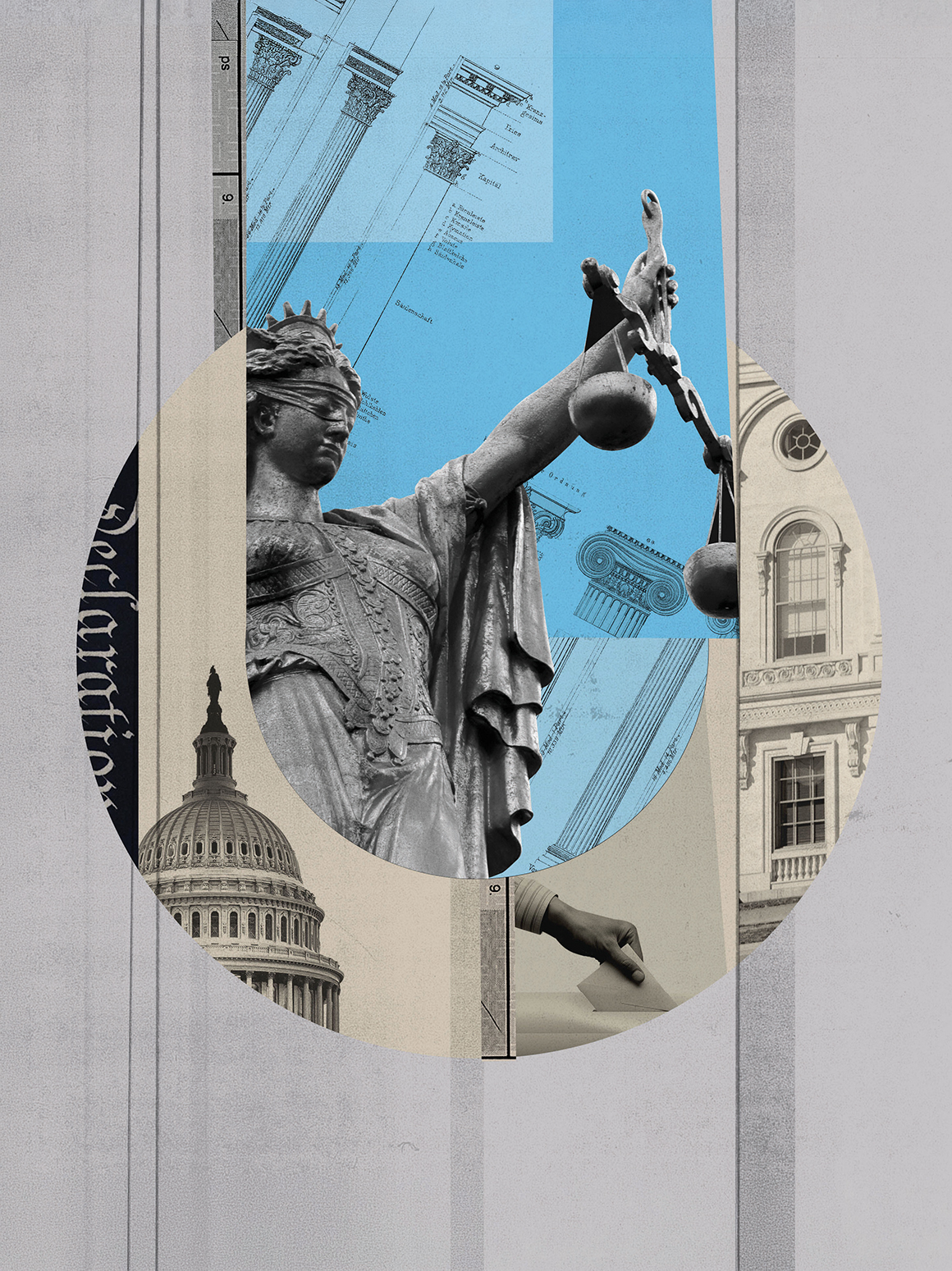
In countries that have emerged from dictatorship or authoritarian rule, rule of law carries a sense of urgency and a broad mandate, Zambrano says. Americans, accustomed to a legal system that has operated with substantial continuity for generations, may be more likely to focus on individual procedural protections. But growing strain on courts and other democratic institutions has brought the domestic stakes to the fore.
Zambrano’s rule-of-law definition begins with non-arbitrariness, the principle that the government cannot simply act according to the preferences of whoever happens to hold power. Laws and government decisions should be clear, understandable, and predictable, and they should emerge from processes capable of producing reasoned outcomes.
Democracy gives majorities the authority to govern. The rule of law, Zambrano explains, channels and tempers that authority.
Scholars often distinguish between a “thin” conception of the rule of law—centered on process, predictability, and equal application—and a “thick” conception that also incorporates human rights, dignity, and justice. Lucy Ricca, the Neukom Center’s executive director, views this tension as central to the center’s intellectual work. “There are always different opinions circulating and playing off each other, which is exactly what we want.”
Still, a country can operate through stable, predictable rules without being democratic, Ricca says. The Neukom Center is concerned with the rule of law “as a function of democracy and a framework for democracy”—and “with the difficult questions and work that follow,” she says.
Hard Questions at a Pivotal Time
The center is tackling a large number of those difficult questions in its role at the Hoover Institution’s Economic and Security Commons, an initiative chaired by Hoover Director Condoleezza Rice. Scholars from across the country, in nearly 30 working groups, are developing practical responses to the major challenges facing American democracy and the global order. Zambrano co-chairs the Justice, Rule of Law, and the Constitutional Order group with Professor Michael McConnell, Richard and Frances Mallery Professor of Law, faculty director of Stanford’s Constitutional Law Center, and a senior fellow at Hoover. The team includes faculty from Stanford, Harvard, Duke, and the University of Virginia.
The aim is to move beyond broad warnings about institutional decline and develop specific ideas for what should come next. The mandate for Zambrano and McConnell’s group ranges from questions of crime and public safety to abuses of executive power.
One line of inquiry concerns presidential pardons. At the state level in Texas, an independent board reviews applications and recommends pardons to the governor to avoid leaving the decision to one official. A similar process at the federal level, Zambrano says, could help temper a power that presidents have faced criticism for using politically.
A larger focus is the growing politicization of the Justice Department. Its legitimacy has long depended on a measure of independence from executive influence, particularly when prosecutorial decisions may affect the president’s allies, opponents, or personal interests. That independence depends not only on formal law but also on norms of restraint that have grown increasingly fragile in an era of intense polarization, Zambrano says.
“If a law school doesn’t take on these tough questions, who will?”
Erik Jensen, Director, Rule of Law Program
The group is examining reforms that could strengthen the DOJ’s independence, restore damaged norms, and limit opportunities for political interference. It is working with Harvard Law Professor Jack Goldsmith, co-author of After Trump: Reconstructing the Presidency, which proposes reforms aimed at protecting law enforcement independence and reinforcing institutional checks on presidential power. The effort draws participants and ideas from across the political spectrum.
The group will present its preliminary findings in late 2026 and refine them through subsequent workshops before releasing policy briefs and specific reform proposals.
Lawyers as the Vanguard
Although questions about the rule of law surface throughout legal education, courses devoted specifically to the subject remain uncommon at American law schools. Stanford Law, however, has long engaged with the field through Erik Jensen’s State-Building and the Rule of Law course, which has connected students with legal systems around the world for decades.
Responding to growing student interest in democracy and the role of lawyers in protecting American legal institutions, Zambrano recently created the Rule of Law, Democracy, and Authoritarianism workshop with former Neukom fellow Lawrence J. Liu. Launched last academic year, the course asks students to examine not only what the rule of law means but also how lawyers should respond when it begins to erode.
“We thought this was especially important given the context of the U.S. government and the Trump administration,” says Liu, now an associate professor of law at Washington University. “After all, we are training future lawyers. So how should lawyers think about the rule of law and our role in defending against or preventing rule-of-law backsliding?”
The workshop combines foundational and comparative study with discussions led by scholars and policy experts working on current threats to legal institutions. One theme, Liu says, is lawyers’ fidelity not just to particular rules and institutions but to the value of law itself.

Lawyers often serve as the first line of restraint on public power, Zambrano says. They advise presidents, agencies, and companies about where legal authority ends—defining what formal compliance requires and what upholding the purposes and processes of law demands. And in addition to understanding legal systems, they must help design, strengthen, and defend them.
Liu describes lawyers as “the vanguard” of the rule of law. “Before, many sitting in the United States might assume that rule-of-law problems are things that happen elsewhere,” he says. “I think now there’s a greater emphasis on lawyers needing to take responsibility here at home.”
And the Neukom Center gives students the opportunity to turn that responsibility into action. In a 2023–24 Law and Policy Lab, students confronted a specific way that authoritarian governments can exploit American legal institutions: by using ostensibly private lawsuits to burden and intimidate journalists, dissidents, and other critics. Zambrano has written about and testified before Congress about the practice.
Working with staff for New Hampshire Senator Jeanne Shaheen, the students studied cases in which foreign governments or state-linked entities used U.S. courts against political opponents. The students drafted a statutory provision allowing judges to dismiss lawsuits before trial when a foreign government or its proxy files a claim aimed at suppressing protected expression.
Their proposal became the basis for the bipartisan Foreign Anti-SLAPP Act, introduced in March 2026 by Shaheen and Louisiana Senator Bill Cassidy.
Policy Lab student Leo Rassieur, JD ’25, says the experience offered “a really interesting puzzle” and lessons in the broad principles of the rule of law and the painstaking work of drafting a rule. “Our goal was to target a specific abuse—using U.S. courts as a tool of transnational political repression—without drafting a statute so broad that it sweeps in meritorious claims.”
The center also brings students into its research and programming through a fellows program launched during the 2025–26 academic year. The program pairs students with faculty and center fellows on research projects and assembles the cohort for conversations with scholars, judges, and public officials.
Amanda Morrison, JD ’27, says the fellowship offered a way to engage with the concerns that brought her to law school, including “defending the integrity of the legal system, preventing abuse of power, and advancing democratic values.”
Morrison has researched how developments in trade law affect the predictability and fairness associated with the rule of law, as well as ways to improve public participation in policymaking. Fellow Dayle Chung, JD ’27, contributed research to Zambrano’s forthcoming book on private enforcement, How Americans Enforce the Law (Stanford University Press) (see more in The American Way of Enforcing the Law). Chung and Morrison also helped draft a public comment concerning a Justice Department proposal affecting state bar disciplinary investigations of federal lawyers.
“We can understand our system better by understanding what it is not.”
Dayle Chung, JD ’27, Neukom Center fellow
Chung says the fellowship’s comparative dimension has been especially valuable. Looking at how other countries structure courts, constrain executive power, and counter democratic backsliding can expose assumptions that often go unnoticed in the American system. “We can understand our system better by understanding what it is not,” she says.
And the Neukom Center’s educational mission extends far beyond Stanford. Its recently launched Rule of Law Teaching Hub collects syllabi, readings, and other instructional materials from law and policy courses around the country, creating a national resource for instructors in a field that is still somewhat dispersed.
“Rule-of-law courses remain relatively uncommon, and the instructors who teach them are spread across institutions and often approach the subject from very different perspectives,” says Liu, who led the Hub’s development. “Though we do not purport to distill a rule-of-law ‘canon,’ we hope the Hub makes existing work easier to find, learn from, and build upon.”
Courts Across Borders
Courts can serve as checks on arbitrary power—or as instruments through which autocrats consolidate it. The judiciary is therefore a central focus of the Neukom Center’s work, and its approach leans comparative and international. The center looks across legal systems to examine how courts gain independence, maintain public confidence, and respond when democratic institutions come under pressure. Zambrano, whose own scholarship focuses on Latin America, has a number of projects underway in the region, many examining how courts are rebuilt after authoritarian rule.
One project in Colombia is testing whether rule-of-law education can affect judicial decision-making. The center is developing a course for Colombian judges designed to sharpen their recognition of arbitrariness, due-process failures, and other rule-of-law concerns. Researchers will examine whether judges who receive the training identify those problems more consistently—and whether the lessons are ultimately reflected in their rulings.
In a comparative study of how judges are selected, Zambrano and Ludmilla Martins da Silva, JSM ’22, JSD ’27, conducted more than 50 interviews in Colombia and examined appointment practices in Mexico, Ukraine, and the United States. Their article, “Informal Norms in Judicial Selection,” published in The American Journal of Comparative Law, shows how informal vetting, professional networks, political bargaining, and outside influence can determine who becomes a judge—sometimes reinforcing merit but other times fostering patronage or political loyalty.
Surprisingly, they found no clear link between major changes to formal selection rules and improved judicial independence. The lesson, they argue, is that focusing solely on written rules is not enough—reformers must also confront the informal norms and political networks that ultimately dictate how those rules operate.
The comparative approach also gives students an immersive view of other legal systems. In Rwanda, for example, Jensen has helped Stanford Law students secure clerkships with judges on the country’s Supreme Court and Court of Appeal, offering a close look at the workings of courts in another country.
In addition, the center infuses judicial experience directly into its courses and law school programming through its Visiting Distinguished Judge Program. Recent visitors have included judges from the Colombian Constitutional Court, Poland’s Constitutional Tribunal, and the Supreme Court of the United Kingdom.
At its annual fall conference in 2025, scholars from Venezuela, Hungary, Poland, and elsewhere examined what happens when courts have been compromised by authoritarian rule—and what it takes to rebuild them. One of the most daunting challenges, Zambrano says, is determining how to restore judicial integrity after prolonged authoritarian rule.
For Zambrano, those questions are especially urgent in Venezuela. He is organizing a group of Venezuelan law professors to draft proposals for rebuilding the country’s judiciary should a democratic transition become possible. Their recommendations could inform critical decisions about who remains on the bench, how judicial independence is restored, and whether Venezuelans can once again trust the courts to constrain public power.
“A Durable Home”
“Even a thin definition of the rule of law requires a pretty thick institutional arrangement to make it happen,” Jensen observes. The promise of “a government of laws and not of men” rests on a complex web of institutions and unwritten norms that the phrase itself can easily obscure.
That complexity explains the extraordinary breadth of the center’s work. The rule of law, Zambrano says, is less a discrete academic field than a lens for examining nearly every question about how power is exercised, constrained, and legitimized.
“The goal of a university is to produce ideas and to search for truth,” he adds. “It’s not to save the world.” But a center like Neukom, he says, is critical to developing, testing, and teaching those ideas. “We need to have people constantly thinking about these issues and putting ideas out into the world.”
For Jensen, the Neukom Center’s significance lies in giving that work an enduring institutional base. “The center is a great opportunity for the law school institutionally, but also for the faculty and students associated with it. After my many decades of rule-of-law work at Stanford, it is gratifying to see the field have a durable home here. The real promise is that a new generation of faculty and students can build on that foundation as they defend the rule of law against current and future threats to undermine it.” SL