
Stanford’s John Donohue on the Proposed Livestreamed Execution of Major Nidal Hasan
On November 5, 2009, Major Nidal Hasan, an Army psychiatrist stationed at Fort Hood, brought a handgun to the U.S. Army base and opened fire. The mass shooting killed 13 people and wounded more than 30 others. Hasan was convicted of 13 counts of premeditated murder and 32 counts of attempted premeditated murder and sentenced to death.1 U.S. Defense Secretary Pete Hegseth announced on October 8, 2026, plans to livestream the execution by firing squad of Hasan, scheduled for December 3, 2026, at Fort Hood, which would mark the first public execution in the United States in nearly a century.2
Here, Stanford’s John Donohue III, one of the leading empirical researchers in the legal academy over the past 30 years, discusses Hegseth’s proposal.
You’ve studied and taught about the legal and policy aspects of capital punishment. Can we start with the status of the death penalty in the U.S. and internationally, comparing this country to peer nations?

Only two affluent nations (of the 38 OECD countries)—the United States and Japan—still regularly carry out executions. Japan executed 3 people in 2000 and 1 person in 2025, while the U.S. executed 85 in 2000 and 47 in 2025.3 Of course, dictatorial regimes often rely on the death penalty, so it is still used extensively in countries like China, Iran, and North Korea. And while Russia has not officially carried out an execution since 1996, enemies of Putin do have a tendency to die under suspicious circumstances. It does little to enhance our status in the world to be linked to tyrannical regimes by our continued use of capital punishment.
One sign of progress is that the United States has been moving away from the death penalty over the last 30 years. In the mid-1990s, roughly 300 death sentences were handed down across the U.S. each year, and last year that number fell to only 23, a greater than 90 percent reduction.4 But there are still plenty of inmates on death row across the country, and executions can persist for a long time, even if new death sentences in the U.S. were to fall to zero.
Hegseth has said that he wants to livestream Hasan’s execution so that it will deter similar atrocities. What does the research say about the death penalty as a deterrent?
This is a terrible idea for a number of reasons. There is no credible evidence that the death penalty deters murder. As I have written, “It is now widely accepted among top-flight empirical scholars that not a single study credibly supports the view that capital punishment as administered anywhere in the United States provides any added deterrent beyond that afforded by a sentence of life imprisonment.”5 Determined efforts to establish a deterrent effect of the death penalty have uniformly failed, and so the idea that a public execution of the type that Secretary Hegseth desires will have a beneficial effect is without empirical support.
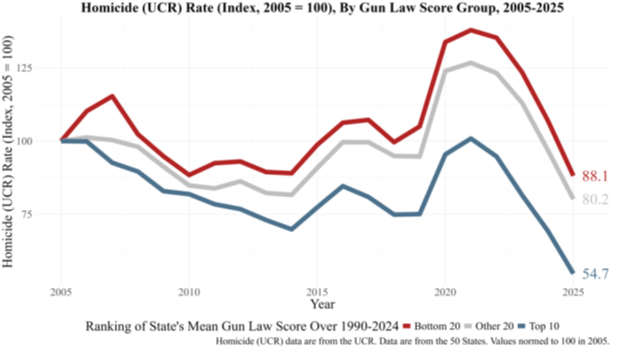
Note that if one were really interested in reducing the rate of murder in this country, one would look to the experience of the states that have regulated guns most extensively—none of which other than Virginia executed anyone in the last twenty years. As the figure below shows, the top 10 regulating states have enjoyed an enormous drop in the murder rate over the last two decades while the other 40 states have lagged far behind. Rather than moving backwards, policymakers should be examining the full array of policies that the more progressive states have adopted to reduce the burden of homicide, which is uniquely high in the United States among affluent nations.
What does your research say about the proposal to livestream the execution?
There has been no public execution in the United States for nearly ninety years, so we don’t have extensive statistical research on this question, but as someone who studies crime and the overall literature relevant to this question, I can make an educated guess. I think such a televised execution is far more likely to provide an inducement to future terrorist attacks than to serve as a deterrent. It is not hard to imagine terrorist organizations using any such video of an execution of an “Islamic martyr” in their recruiting advertisements, and they have certainly responded to other provocative acts, such as the abuse of detainees at Abu Ghraib, by seizing Americans and beheading them on video in the most brutal fashion (as with Nick Berg, whose 2004 killing was presented as revenge for Abu Ghraib)6. Indeed, the 2002 murder in Pakistan of former Stanford student and Wall Street Journal reporter Daniel Pearl was videotaped and circulated as terrorist propaganda.7
Moreover, the highly criticized spectacle of public executions in the 1930s in the United States was deemed by the public to be so degrading that politicians across the board supported the end of the practice.8 To bring it back after nearly 90 years would clearly be a step in the wrong direction.
You’ve also looked at racial bias in capital punishment. What do the numbers tell us about that in the U.S.?
When the Connecticut Supreme Court struck down the Connecticut death penalty as unconstitutional under the state constitution in the 2015 case State v. Santiago, Justices Norcott and McDonald, concurring, endorsed Justice Robert Berdon’s earlier warning that “[w]hen a capital defendant marshals a compelling argument that the death penalty as it is administered in our state is incurably racist …we should stop dead in our tracks until we have given the argument our most serious attention.”9 This compelling evidence was established for capital regimes across the nation two decades ago in a sophisticated national-level study, Explaining Death Row’s Population and Racial Composition. In that study, researchers Blume, Eisenberg, and Wells analyzed data on murders and the composition of death row from 1977 through 1999 in the 31 states that sent more than ten defendants to death row during this time period.10 This study found strong evidence that the race of the perpetrator and victim had a powerful impact on the likelihood of a death sentence being imposed.
The specific finding that Black offender/White victim murders were treated more harshly than other types of murders has been found for jurisdictions throughout the country, from California to Connecticut—and not just in the deep South.11 In fact, the California Supreme Court has been presented with extensive evidence on racial bias in the administration of the California capital punishment system—including my expert report on that issue. On May 27, 2026, the Court unanimously ordered the California Attorney General to show cause why the state’s death penalty should not be declared to violate the California Constitution because of racial bias.12 Since California has the largest population of death row inmates (well in excess of 500), this case has the potential to deal a major blow to the death penalty in the United States.
Could the televised execution lead to a renewed examination of capital punishment in the U.S.?
I suspect that if Hegseth gets his wish and the public execution proceeds as planned, it will likely further diminish support for the death penalty in the United States. This may also be the impact of the recent failed effort to execute Christa Pike in Tennessee on September 30, 2026; she was given two rounds of lethal injection drugs and yet still managed to live.13 Botched executions and vivid reminders of the brutality of capital punishment will continue to reduce enthusiasm for a practice that our allies have almost uniformly rejected as barbaric and ineffectual.
The death penalty persists in the United States largely for one reason: low-information voters are amenable to arguments that it will keep them safer and demagoguing politicians realize they can exploit that fear for their own benefit. In fact, virtually everyone should oppose the death penalty. Conservatives who fear governmental abuse and incompetence should look at Secretary Hegseth’s proposal as confirmation that their skepticism about unwise governmental actors being given greater power than necessary should lead them to shun capital punishment. Liberals who are concerned with avoiding injustice and the immorality of the state killing individuals for no identifiable benefit should similarly stand in opposition. Indeed, Justice Scalia, who once held out the case of Henry Lee McCollum as the exemplar of why the death penalty was necessary (before we learned that McCollum had been wrongly convicted), long maintained that, because the Catholic Church had not declared the death penalty immoral, he could in good conscience uphold it.14 This argument is no longer available as the Church in 2018 declared the death penalty “inadmissible.”15
Is there anything else you’d like to add?
Supporters of the death penalty from Pete Hegseth to Justice Scalia typically resort to the type of “specious reasoning and seductive eloquence”16 that Cesare Beccaria hoped to eliminate from discussions of criminal justice in 1764 when he noted that any criminal sentence that serves no legitimate penological function is merely an immoral and needless imposition of suffering.
Indeed, Scalia once ridiculed opposition to the death penalty by describing in detail a horrific “case of the 11-year-old girl raped by four men and then killed by stuffing her panties down her throat. See McCollum v. North Carolina. . . . How enviable a quiet death by lethal injection compared with that!”17 But Scalia’s emotional rhetoric only underscored yet another problematic feature of capital punishment in the United States: The more heinous the crime, the greater the pressure to solve the case and the greater the likelihood that anger and emotion will undermine the capacity of the criminal justice system to correctly identify and prosecute the perpetrator. As we now know, the death row inmate that Justice Scalia described—Henry Lee McCollum—who spent 31 years in prison, nearly all of them on death row, from the time of his arrest at age 19 until his release in 2014, was completely innocent (as confirmed by the DNA-identified actual perpetrator)18 and would have been executed if Justice Scalia’s opposition to the extensive array of appeals afforded to death row inmates had been heeded.
For those who understand the facts of a death penalty regime, from the enormous fiscal burden it places on jurisdictions, to the inevitable wrongful convictions, to the scarring issues of racial bias, to its utter fecklessness in reducing crime, to its arbitrary implementation and its mis-use to advance the careers of ambitious political actors, there is really only one clear answer: abolish this antiquated, counterproductive, and morally dubious practice.
John J. Donohue III, the C. Wendell and Edith M. Carlsmith Professor of Law at Stanford Law School, has been one of the leading empirical researchers in the legal academy over the past 30 years. He is an economist as well as a lawyer and is well known for using empirical analysis to determine the impact of law and public policy in a wide range of areas, including civil rights and antidiscrimination law, employment discrimination, criminal justice and the death penalty, and factors influencing crime, such as guns, incarceration, policing, and legalized abortion.
Citations:
[1] Fort Hood Shooter Hasan Sentenced to Death, U.S. Army (Aug. 28, 2013), https://www.army.mil/article/110393/fort_hood_shooter_hasan_sentenced_to_death; Ex-Army Major Who Killed 13 at Fort Hood Set to Be Executed by Firing Squad, NBC News (Oct. 2026), https://www.nbcnews.com/news/us-news/ex-army-major-fort-hood-shooting-execution-firing-squad-rcna601791.
[2] Pentagon Plans Public Livestream of Its First Firing Squad Execution in Decades, CNN (Oct. 8, 2026), https://www.cnn.com/2026/10/08/politics/pete-hegseth-vows-to-make-first-firing-squad-execution-in-decades-public; Pentagon to Livestream Firing Squad Execution of Fort Hood Shooter, NPR (Oct. 9, 2026), https://www.npr.org/2026/10/09/nx-s1-5996529/firing-squad-livestream-execution-fort-hood-shooter.
[3] Death Penalty Info. Ctr., The Death Penalty in 2025: Year End Report (Dec. 2025), https://deathpenaltyinfo.org/research/analysis/reports/year-end-reports/the-death-penalty-in-2025; Death Penalty Info. Ctr., The Death Penalty in 2000: Year End Report, https://deathpenaltyinfo.org/facts-and-research/dpic-reports/dpic-year-end-reports/the-death-penalty-in-2000-year-end-report; Amnesty Int’l, Japan: Cruel Execution a Stain on Country’s Human Rights Record (June 27, 2025), https://www.amnesty.org/en/latest/news/2025/06/japan-cruel-execution-a-stain-on-countrys-human-rights-record/.
[4] Death Penalty Info. Ctr., The Death Penalty in 1996: Year End Report, https://deathpenaltyinfo.org/facts-and-research/dpic-reports/dpic-year-end-reports/the-death-penalty-in-1996-year-end-report; Death Penalty Info. Ctr., The Death Penalty in 2025: Year End Report (Dec. 2025) (reporting 23 new death sentences in 2025), https://deathpenaltyinfo.org/research/analysis/reports/year-end-reports/the-death-penalty-in-2025.
[5] See John J. Donohue III, Empirical Analysis and the Fate of Capital Punishment, 11 Duke J. Const. L. & Pub. Pol’y 51 (2016), https://scholarship.law.duke.edu/djclpp/vol11/iss1/3/; see also John J. Donohue & Justin Wolfers, Uses and Abuses of Empirical Evidence in the Death Penalty Debate, 58 Stan. L. Rev. 791 (2005), https://users.nber.org/~jwolfers/Papers/DeathPenalty(SLR).pdf.
[6] American Beheaded on Web Video, Wash. Post (May 12, 2004), https://www.washingtonpost.com/wp-dyn/articles/A19048-2004May11.html (reporting that Nicholas Berg’s killers described his murder as revenge for the abuse of Iraqi prisoners at Abu Ghraib).
[7] Pakistan/U.S.: Videotape Shows Pearl Was ‘Brutally Slaughtered,’ Radio Free Europe/Radio Liberty (Feb. 2002), https://www.rferl.org/a/1098899.html; The Man They Called Danny, Stanford Mag., https://stanfordmag.org/contents/the-man-they-called-danny.
[8] Rainey Bethea was publicly hanged before a crowd estimated at up to 20,000 in Owensboro, Kentucky, on August 14, 1936; the backlash led Kentucky to outlaw public executions in 1938. A smaller public hanging, of Roscoe “Red” Jackson, took place in Missouri on May 21, 1937. See The U.S. Last Held a Public Execution in the 1930s. The Pentagon Wants to Change That, NPR Illinois (Oct. 9, 2026), https://www.nprillinois.org/2026-10-09/the-u-s-last-held-a-public-execution-in-the-1930s-the-pentagon-wants-to-change-that; A New Book Returns to America’s Final Public Hanging, NPR (Dec. 7, 2025), https://www.npr.org/2025/12/07/nx-s1-5585009/a-new-book-returns-to-americas-final-public-hanging.
[9] State v. Santiago, 318 Conn. 1 (2015) (Norcott & McDonald, JJ., concurring) (quoting State v. Cobb, 251 Conn. 285 (1999) (Berdon, J., dissenting)), https://www.courtlistener.com/opinion/2827332/state-v-santiago/.
[10] John H. Blume, Theodore Eisenberg & Martin T. Wells, Explaining Death Row’s Population and Racial Composition, 1 J. EMPIRICAL L. STUD. 165, 169 (2004), https://doi.org/10.1111/j.1740-1461.2004.00006.x.
[11] See John J. Donohue III, “Empirical Analysis and the Fate of Capital Punishment,” 11 Duke Journal of Constitutional Law and Public Policy 51-106 (2016), http://scholarship.law.duke.edu/djclpp/vol11/iss1/3.
[12] Order to Show Cause, Office of the State Pub. Defender v. Bonta (Cal. May 27, 2026); see Death Penalty Info. Ctr., California’s Landmark Racial Bias Challenge to the Death Penalty Moves Forward, https://deathpenaltyinfo.org/californias-landmark-racial-bias-challenge-to-the-death-penalty-moves-forward. As of October 2, 2026, 563 people were under sentence of death in California. Cal. Dep’t of Corr. & Rehab., Condemned Inmate Summary, https://www.cdcr.ca.gov/capital-punishment/condemned-inmate-summary-report/.
[13] Tennessee Governor Halts Executions After Christa Gail Pike Survives Lethal Injection, NPR (Oct. 1, 2026), https://www.npr.org/2026/10/01/nx-s1-5986822/tennessee-governor-halts-executions; Christa Pike Execution Attempt: What Happened?, CNN (Oct. 1, 2026), https://www.cnn.com/2026/10/01/us/christa-pike-execution-tennessee.
[14] Antonin Scalia, God’s Justice and Ours, First Things (May 2002), https://firstthings.com/gods-justice-and-ours/.
[15] Pope Francis: ‘Death Penalty Inadmissible,’ Vatican News (Aug. 2, 2018), https://www.vaticannews.va/en/pope/news/2018-08/pope-francis-cdf-ccc-death-penalty-revision-ladaria.html (announcing the revision of paragraph 2267 of the Catechism of the Catholic Church).
[16] Cesare Beccaria, On Crimes and Punishments (1764); see Bernard E. Harcourt, Beccaria’s On Crimes and Punishments: A Mirror on the History of the Foundations of Modern Criminal Law (Univ. of Chi. Coase-Sandor Inst. for Law & Econ. Working Paper),
https://chicagounbound.uchicago.edu/cgi/viewcontent.cgi?article=1633&context=law_and_economics (quoting Beccaria’s call for “mathematical rigour which will cut through the cloud of specious reasoning, seductive eloquence and diffident doubt”).
[17] Callins v. Collins, 510 U.S. 1141, 1143 (1994) (Scalia, J., concurring in denial of certiorari), https://www.law.cornell.edu/supct/html/93-7054.ZA.html.
[18] Equal Justice Initiative, North Carolina Man Exonerated and Released After 30 Years on Death Row (Sept. 2014), https://eji.org/news/henry-mccollum-exonerated-released-north-carolina-death-row/; Ctr. for Death Penalty Litig., The Unlikely Exoneration of Henry McCollum, https://www.cdpl.org/unlikely-exoneration-henry-mccollum/. McCollum and his half-brother Leon Brown were released on September 2, 2014, after DNA evidence implicated Roscoe Artis, and were later pardoned by Governor Pat McCrory.