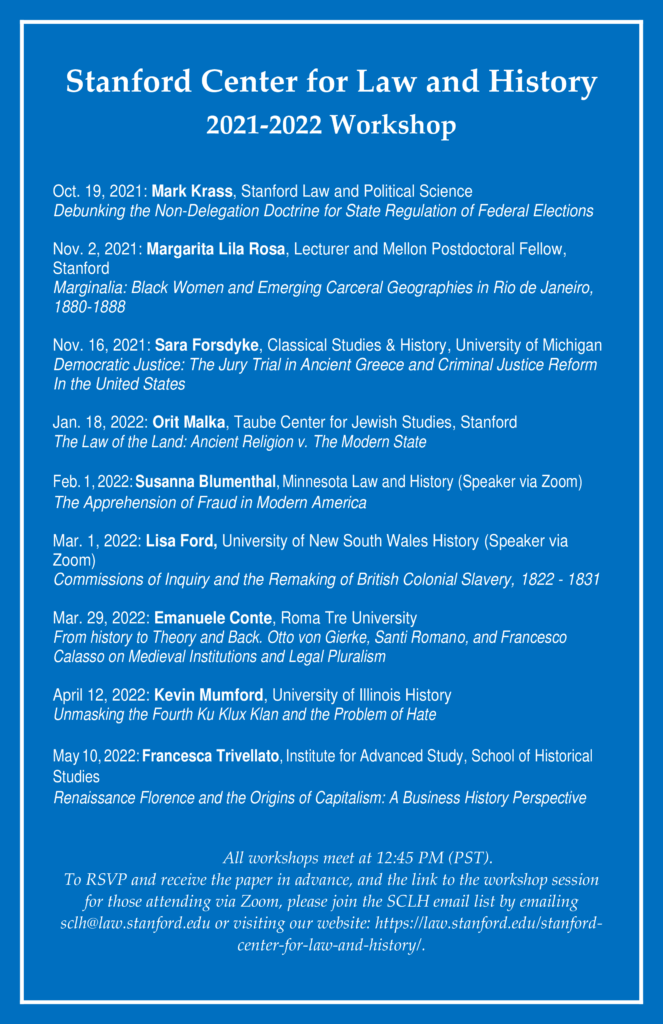
“Debunking the Non-Delegation Doctrine for State Regulation of Federal Elections” with Mark Krass
- This event is archived.
The Stanford Center for Law and History will hold its first workshop of the Quarter on Tuesday, October 19, from 12:45-1:45 PM (Pacific). Mark Krass, Stanford Law and Political Science, will share the paper: “Debunking the Non-Delegation Doctrine for State Regulation of Federal Elections.”
Current guidelines do not allow us to bring food into events. For those who attend in-person, however, lunch will be provided at 12:25PM, 20 minutes before the talk at a table in Crocker Garden to the left of Room 190 entry doors.
We also ask all those who attend in-person to comply with current Stanford event guidelines which can be found here.
To RSVP, click here. Those who confirm their attendance will receive a separate email containing the paper and link to the event.
Paper Abstract:
One objection to the conduct of the 2020 federal election concerned the key role played by state executives in setting election rules. Governors and secretaries of state intervened to change a host of regulations, from ballot deadlines to polling times, often acting pursuant to legislation granting them emergency powers. Some advocates, politicians, and judges cried foul. They argued that state legislatures may not devolve the power to set the “Times, Places, and Manner” of Congressional elections under article I, section 4 of the Constitution.
This Essay contests that view. Drawing on a survey of elections statutes in the thirteen original colonies, I argue that Elections Clause delegations were a pervasive part of early American practice. Executive officers like sheriffs and local officials like selectmen had enormous discretion to determine the time and place of elections, and sometimes also their manner. And that discretion was repeatedly affirmed by Congress. As a matter of original meaning, this legacy suggests that legislatures today may indeed delegate under the Elections Clause.