
Alex Kasner, JD ’15, Honored With Scribes Award for Best Law Review Student Note
The United States’ long and complicated history with government leaks, as explained by Alex Kasner, JD ’15, in the Stanford Law Review note, “National Security Leaks and Constitutional Duty,” took center stage at the most recent National Conference of Law Reviews.
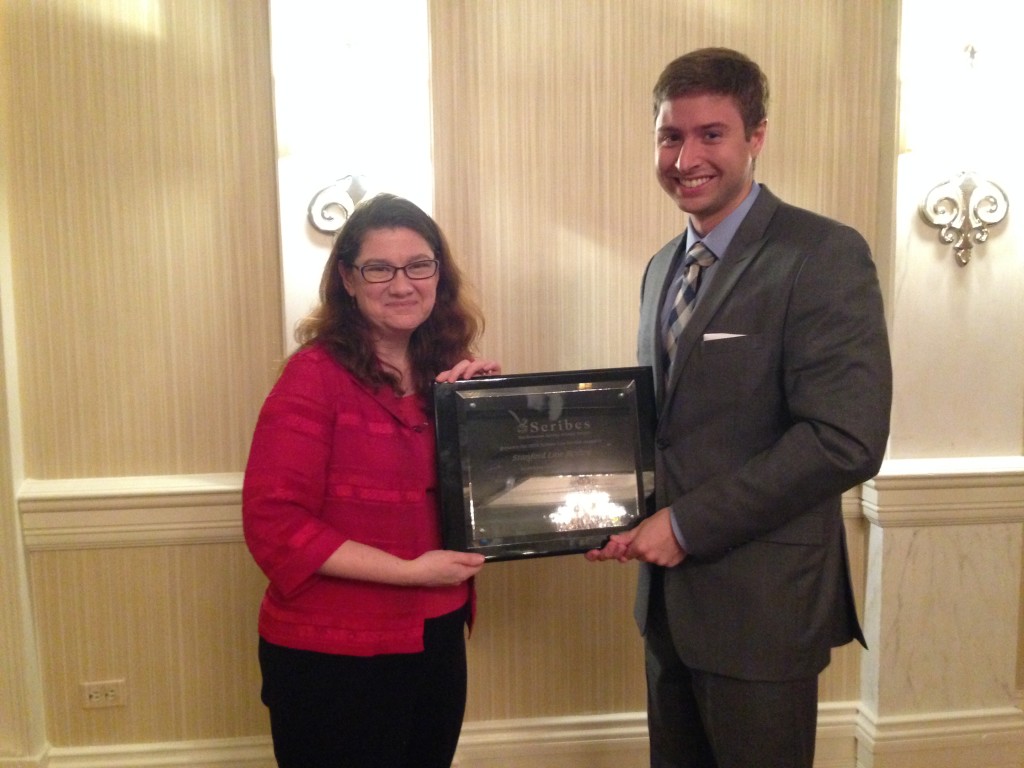
During the event’s Scribes Law Review Dinner on March 12, 2015, Kasner was honored with the 29th annual Scribes Law-Review Award for his piece, which presents one of the first concentrated studies of the Constitution’s Article VI Oath Clause and the obligation it places on executive officers to resist unconstitutional government behavior.
The award is annually presented to the best student-written law review note published in the preceding year. Kasner’s submission was chosen out of fifty-two entries submitted; he is the first Stanford Law School student to ever receive the award.
“I was obviously quite honored to hear that I had been selected for the Scribes Award,” Kasner said. “Looking at the history of past winners and reading some of their pieces, I was struck by the creativity of their topics and the careful and considered approaches they took to their legal analysis and writing.”
Scribes Law-Review Award Committee members called Kasner’s note “a provocative thesis” dealing with timely and interesting issues important to the United States right now.
“I was impressed by the way the note explored legal scholarship, case law, and the Constitution’s text, drawing on all of it but staking out a position all its own,” said Mary Bowman, JD ’98, Chair of Scribes’ Law-Review Award Committee. “And in doing so, the prose was ‘clear, succinct, and forceful,’ which is what Scribes promotes.”

For Kasner, writing the piece provided him with an opportunity to focus on his interest of the intersection between national security and structural constitutional law.
“The question of who decides which bundle of rights we possess as a people in the midst of state security concerns is just as important as the rights that we decide are worth protection,” Kasner said. “That decision seems to have fallen to the executive branch itself, which is now, as a descriptive matter, largely responsible for drafting, enforcing, and adjudicating national security policy. And yet the leaks of former executive employees like Edward Snowden and the resulting national debates over surveillance demonstrate that the opaque executive may not be infallible in its constitutional determinations. Rather, these are larger debates often worth having as a nation on the whole.”
Kasner says he hopes the piece will help readers understand the complex history the United States has had with leaks and whistleblowers as well as answer larger questions surrounding constitutional interpretation and separation of powers in the national security state. “The very best thing you can do as a writer is inspire another author to pick up the baton and explore a kernel of your piece in more depth,” Kasner said.