
Constitution Day 2025: Originalist vs. Progressive Visions of the Constitution
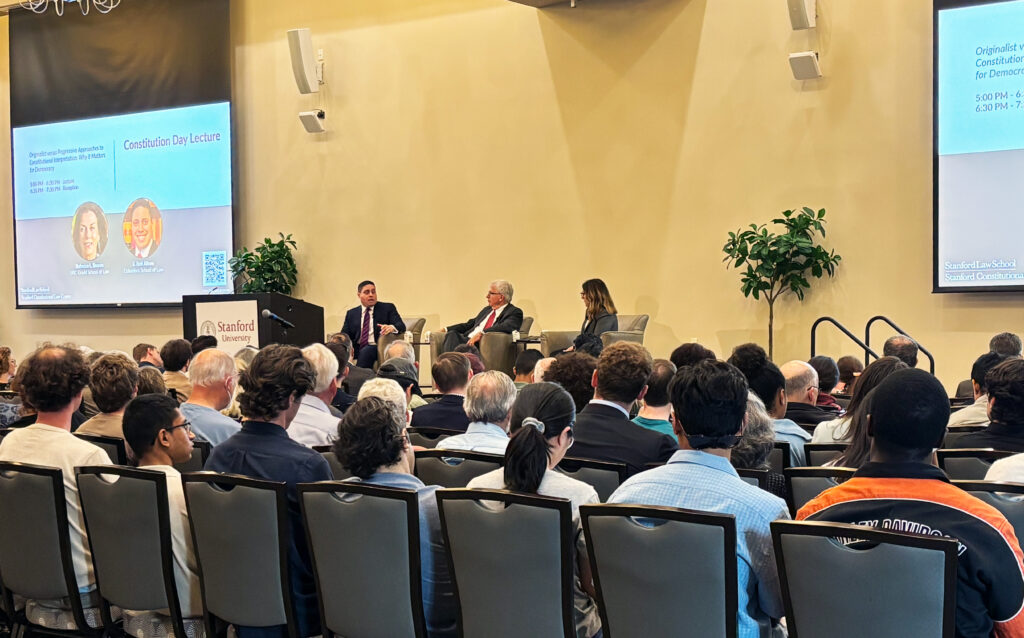
This year’s Constitution Day at Stanford Law School went straight to the heart of modern constitutional debate: should judges interpret the U.S. Constitution through an originalist lens or a progressive one? Held September 26 in Paul Brest Hall, the annual event marked the federal holiday commemorating the Constitution’s signing in 1787. Constitution Day invites the community to reflect on the meaning and relevance of the document that has guided American democracy for more than two centuries.
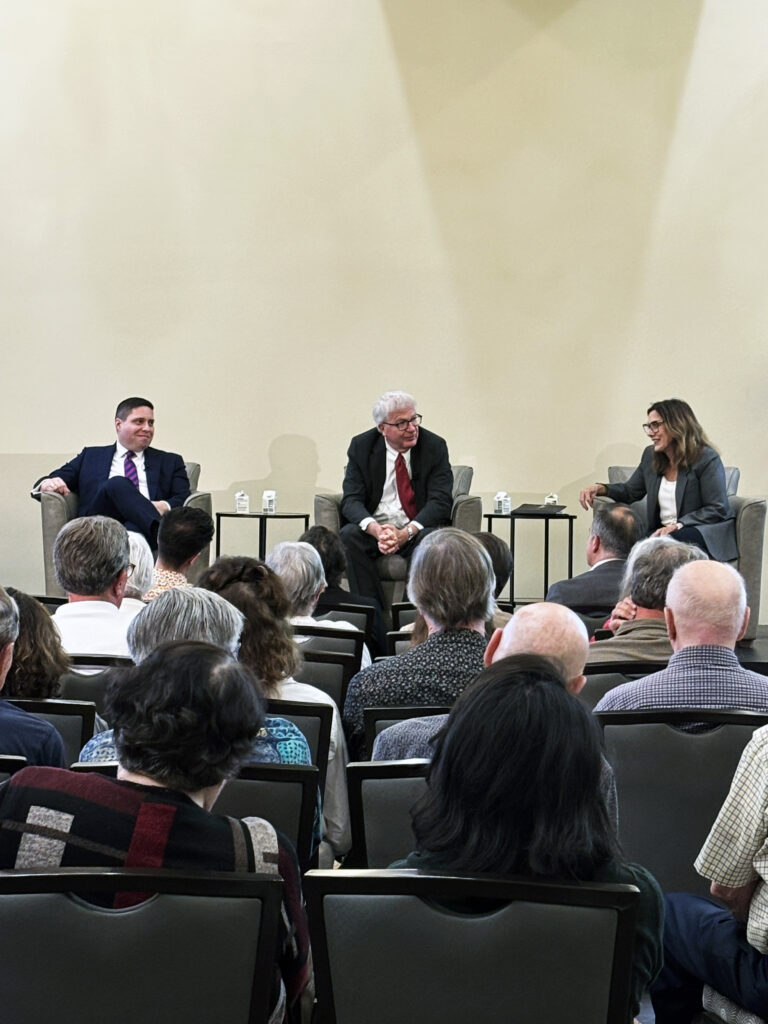
Originalist versus Progressive Approaches to Constitutional Interpretation: Why It Matters for Democracy was presented by the Stanford Constitutional Law Center. The event featured professors J. Joel Alicea of Catholic University’s Columbus School of Law and Rebecca Brown of the USC Gould School of Law. Alicea argued for the originalist perspective, Brown for a progressive approach, and together they explored some of the most enduring questions of constitutional law.
Michael McConnell, the Richard and Frances Mallery Professor of Law, director of the Constitutional Law Center, and a senior fellow at the Hoover Institution, moderated the discussion.
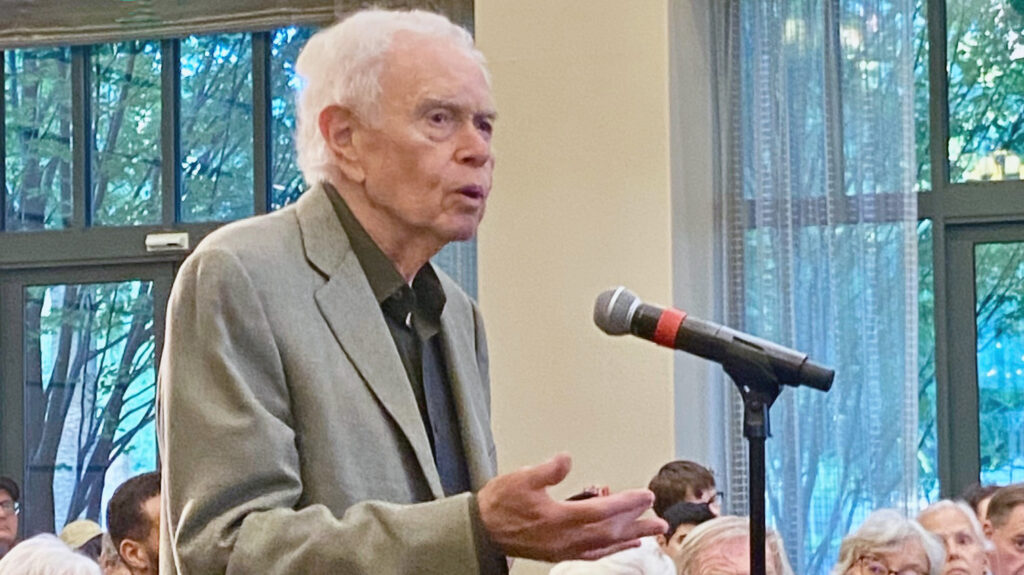
The evening carried added resonance with Stanford Law Professor Paul Brest in attendance in the Stanford Law School hall that bears his name. Credited with coining the term “originalism” in his 1980 law review article The Misconceived Quest for the Original Understanding, Brest posed the first question during the Q&A portion of the event, framing the debate as a matter of degree. He asked both speakers where, on the spectrum between the framers’ specific intentions and the broader principles underlying a clause like Equal Protection, their theories of interpretation fall.
“It is an honor to be asked a question by the great Paul Brest,” Alicea said.
Opening Remarks
George Triantis, JSD ’89, the Richard E. Lang Professor of Law and Dean of Stanford Law School, welcomed the more than 170 attendees, including Stanford students, faculty, alumni, and members of the local community. Constitution Day events are held every year (close to September 17) at academic institutions across the United States.
McConnell, a former judge on the U.S. Court of Appeals for the Tenth Circuit, introduced the program and emphasized its broader purpose. “We thought this year that it would be especially helpful to look at the way in which constitutional adjudication proceeds across ideological divides. What are the differences and what are the similarities—and to have a serious discussion of that. Both of our speakers are accomplished not just in writing about constitutional interpretation from their perspectives, but also in modeling how we can talk to one another constructively across divides.”

The Case for Originalism
Alicea, the St. Robert Bellarmine Professor of Law at Catholic University’s Columbus School of Law, began by framing the central question: why are we bound by the Constitution at all? Legitimate authority, he argued, exists only when it is directed toward the common good—the social conditions that enable individuals to flourish in community with one another. Because every member of society bears responsibility for seeking the common good, each also holds political authority. In practice, however, that authority must be transmitted to a governing body capable of exercising it effectively. In the United States, that transmission occurred through the Constitution.
From this account, Alicea argued, originalism naturally follows. “Originalism is simply faithful agency,” he said. “It requires judges to interpret the Constitution as the people themselves would have understood it when they ratified it.” Departing from that understanding would be to undermine the very authority the people exercised when they constituted their government.
He drew analogies from other areas of law: just as statutory interpretation looks to what the enacting Congress meant, constitutional interpretation must respect the meaning fixed at the time of enactment. To substitute modern preferences for original meaning, Alicea warned, would be akin to a child redefining a parent’s commands or to judges arbitrarily rewriting statutes based on what a later Congress might want.
Alicea acknowledged that societies may adopt different constitutional systems, such as Britain’s parliamentary model, but emphasized that the U.S. Constitution deliberately separates ordinary legislation from “higher law” entrenched through Article V amendment procedures. Unless the people themselves amend that framework, he concluded, fidelity to their political authority requires judges to interpret the Constitution according to its original meaning.
The Case for Progressivism
Brown, the Rader Family Trustee Chair in Law at USC’s Gould School of Law, began by noting that there is no “pre-ordained” way to read the Constitution. Every theory of interpretation, she said, must be defended on its own terms. The threshold question is why the Constitution binds us at all.
One answer, often associated with originalism, is that legitimacy comes from the ratification process itself: the founders enacted the Constitution in a democratic manner, and subsequent generations are bound to obey their commands. Brown acknowledged the appeal of this process-based account but pointed to what she sees as its limits. By freezing meaning in the past, she said, it risks undermining America’s commitment to self-government. Future generations cannot fully govern themselves if they are forever constrained by decisions made centuries earlier.
For Brown, a constitution earns its authority only if it establishes the conditions for each generation to engage in self-government and pursue its own conception of justice. That is why, she argued, the Constitution’s most important provisions—such as “liberty” and “equal protection”—are written in broad, abstract terms.
Brown stressed that the progressive approach does not give judges a blank check. Drawing on the common law tradition, she explained that judges are required to weigh text, history, precedent, and principle, and to derive rules that can be applied to current cases. “Judges must give reasons for their conclusions, and must reconcile them with constitutional principle—all transparently and acknowledged.”
Common Ground
Although they approached constitutional interpretation from different perspectives, Alicea and Brown both emphasized that theories of interpretation cannot simply be assumed; they must be defended as legitimate accounts of why the Constitution binds us. And both underscored that promoting democratic self-government is central. The real dispute is over how best to preserve it—by adhering to original meaning, or by allowing constitutional principles to evolve.
In the discussion that followed, McConnell steered the conversation to the role of courts, the reach of legislative power, and the protection of individual rights, then invited questions from the audience.
About the Stanford Constitutional Law Center
The Stanford Constitutional Law Center focuses particularly on the separation and scope of legislative, executive, and judicial powers; the structure of constitutional democracy; the freedoms of speech, press, and religion; and the right of privacy, including the privacy of personal data in a digital world. Founded in 2006 by former Dean Kathleen Sullivan, the Constitutional Law Center is currently led by Faculty Director Michael W. McConnell, Richard and Frances Mallery Professor of Law.
About Stanford Law School
Stanford Law School is one of the world’s leading institutions for legal scholarship and education. Its alumni are among the most influential decision makers in law, politics, business, and high technology. Faculty members argue before the Supreme Court, testify before Congress, produce outstanding legal scholarship and empirical analysis, and contribute regularly to the nation’s press as legal and policy experts. Stanford Law School has established a model for legal education that provides rigorous interdisciplinary training, hands-on experience, global perspective and a focus on public service.