
For Stanford Law’s Class of 2026, a Commencement Message of Community and Purpose
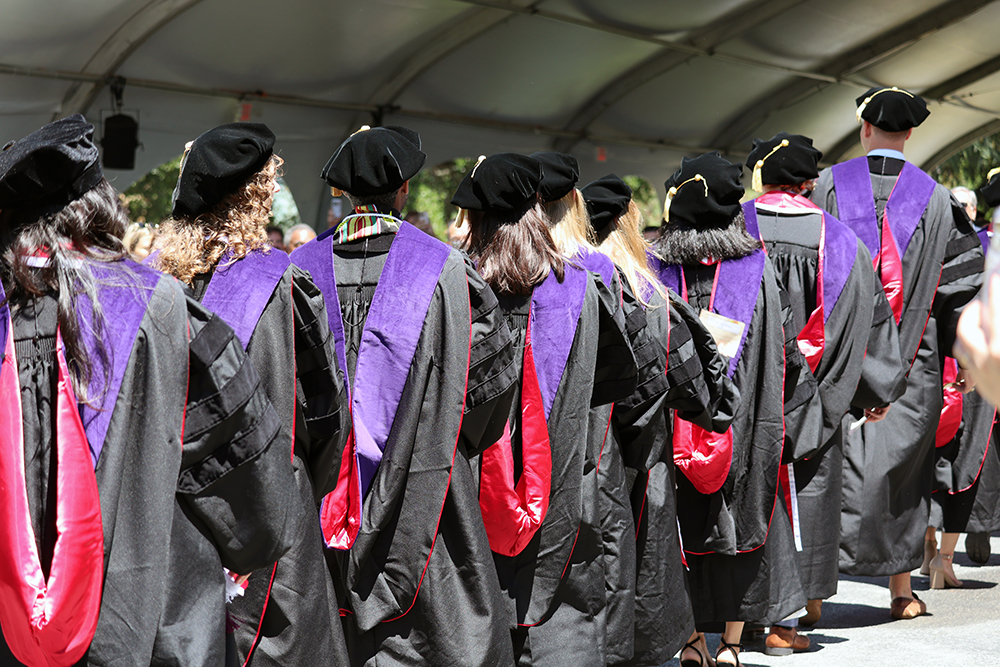
The 2026 commencement ceremony at Stanford Law School was a celebration of 259 graduates and of the communities that carried them to the day. As the Class of 2026 gathered on June 13 beneath the large white tent in front of Canfield Courtyard, speakers looked ahead to the graduates’ next chapters while returning often to family, friendship, gratitude, professional responsibility, and the enduring importance of community.
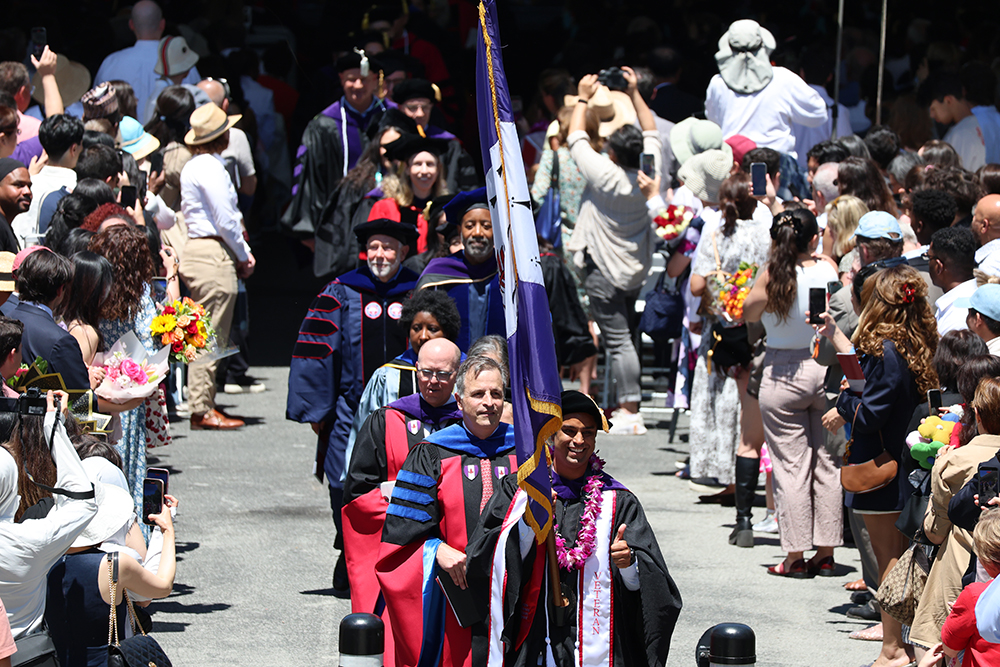
As the Stanford Law graduates enter a profession shaped by rapid technological change and renewed attention to the role of legal institutions in public life, they were encouraged to remain rooted in their communities and values.
The class was composed of 176 JDs, 75 LLMs, 7 JSMs, and 1 JSD.
Dean George Triantis, JSD ’89, Richard E. Lang Professor of Law, opened the ceremony by thanking the family members, friends, and others who had supported the students throughout their time at Stanford Law. “Your love, encouragement and support have been key to bringing them to this moment and we celebrate you at the same time as we celebrate the Class of 2026,” Triantis said.
Grounded for the Journey Ahead
In his charge to the class, Triantis urged the graduates to be bold and resilient, while remaining connected to the people, values, and communities that would ground them in the years ahead.
He drew on the Greek myth of Antaeus, the powerful wrestler who remained invincible as long as he stayed in contact with the earth, his mother Gaia. For Triantis, the story offered a lesson about the grounding each person needs in order to withstand setbacks and recover from adversity.

“We each need grounding, a base that can renew us and from which we gain the power to be bold, to learn, to withstand and recover from setbacks,” he said.
For many graduates, he said, that grounding begins with family and friends. It also includes the relationships formed at Stanford Law—with classmates, professors, instructors, and staff—and the values that help lawyers remain rooted when professional roles and obligations become difficult.
“In the practice of law, there will be tension between your responsibility to your client, on the one hand, and to justice and the rule of law, on the other,” he said. “Your values are what will sustain you when the role ends and the person remains.”
Triantis also encouraged graduates to be a source of grounding for others. Lawyers, he said, often meet people when they are facing adversity or risk, when clients are confronting a lawsuit, a criminal charge, the dissolution of a business, insolvency, or a decision about whether to pursue a new opportunity. The rules of the profession, including confidentiality, attorney-client privilege, and fiduciary duty, create the scaffolding for trust. But the deeper work depends on the humanity of the lawyer.
Returning to the myth of Antaeus, Triantis noted that Antaeus was not defeated by being thrown to the ground. He was defeated only when Hercules lifted him into the air and cut him off from his source of strength.
“The lesson here is that you can fail and recover,” Triantis said. “But do not let the forces that pull you into your career, whether ambition or plain busyness, and other aspects of life disconnect you from the people who sustain you, the values that ground you, the community that claims you.”
LLM and JD Students Offer Advice and Thanks
The ceremony also featured remarks from two graduating students: LLM graduate Mahishaa Balraj and JD graduate Jared James Hrebenar.

Balraj, who is from Sri Lanka, reflected on the diversity, warmth, and camaraderie of the advanced-degree class, which included students from 31 countries and nearly every continent. She described a group that included environmental lawyers, human rights defenders, law firm partners, government officials, public prosecutors, and judges—“people so accomplished that fitting them all into one cohort really should be against the rules.”
“I arrived here not entirely sure I deserved to be in these rooms,” Balraj said. “What happened here was transformational, and I am grateful for every minute of it.”
Balraj organized her remarks around the concepts of community, conscience, and courage. In an age when artificial intelligence can pass the bar, write briefs, and perhaps even predict verdicts, she said, human judgment and compassion remain essential.
“An algorithm can now do almost everything they trained us to do,” Balraj said. “The one thing it cannot do is care.”
Community, she said, is “who we care about.” For Balraj, who came to Stanford 10,000 kilometers from home, that community became a source of belonging. “I know now that if I land in Italy, Peru, or Thailand, I have a person. I have a home. I have family,” she said.
Jared Hrebenar built his remarks around a familiar law school discipline: citation. From the first day of law school, he said, students are taught that every claim must be traced to authority. What initially feels tedious can become a deeper lesson.

“Every idea has a root, every institution we interact with has a foundation, and every person we meet has a background, a source of their own,” Hrebenar said.
Commencement, he said, is a moment to recognize the sources of the graduates’ own success: parents, friends, families, partners, faculty, staff, administrators, and classmates. If the day had footnotes, he said, “the citations would far outpace the text.”
Hrebenar reflected on the education that took place outside the classroom: studying in Munger, riding the bus back from 1L Prom, waiting in line for Monday morning breakfast, and having late-night conversations with fellow students.
The most important sources the graduates would cite, he said, were one another. As the graduates leave Stanford Law, Hrebenar said, they must ask what they want to be cited for in the future.
“We’re becoming lawyers in a time where the load-bearing institutions of our society, and the rule of law itself, are being tested like never before,” he said. “More than doctrine and caselaw, I hope that we can bring to those institutions the decency, honesty, and kindness that we’ve seen displayed in one another.”
Professor Anne Joseph O’Connell Wins Hurlbut Teaching Award
Anne Joseph O’Connell, Adelbert H. Sweet Professor of Law, received the John Bingham Hurlbut Award for Excellence in Teaching. The award, presented by Advanced Degree Class President Khurliman Autniyazov and JD Class President Will Avery Paisley, recognizes a Stanford Law professor who “strives to make teaching an art.”
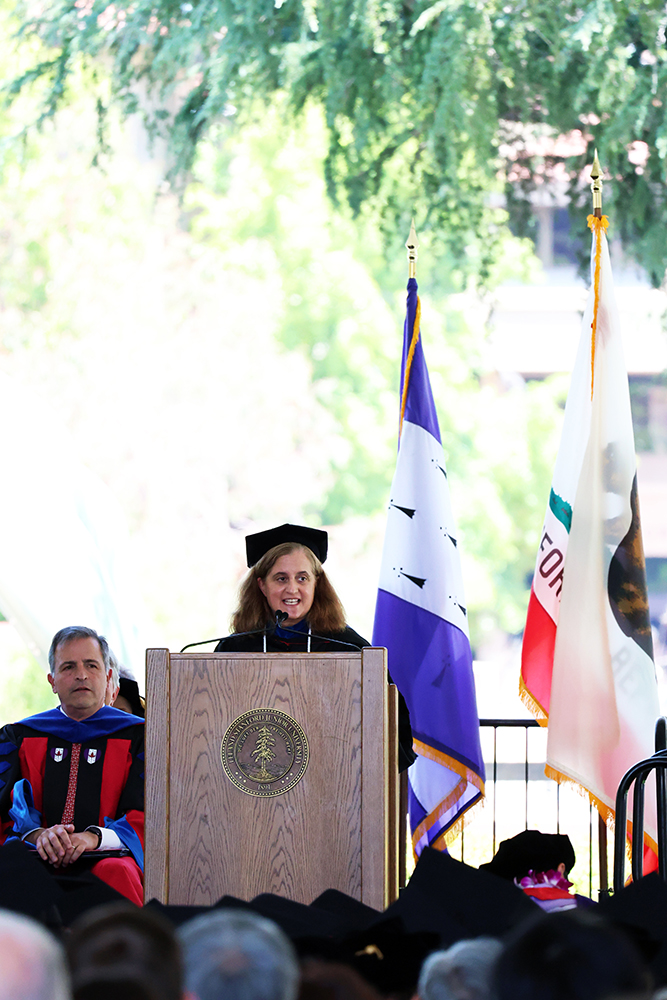
O’Connell, a scholar of administrative law and the federal bureaucracy, delivered an address that mixed humor, practical wisdom, legal references, and reflections on how to make decisions in a world that demands both speed and patience.
She began with a story from late April, when, just hours after learning she would be addressing the graduating class, she was injured in an electric scooter accident while trying to avoid a cyclist. The episode, she said, yielded two lessons: “She who hesitates is lost” and “Look before you leap.”
Her speech, she told the graduates, was about “acting fast and acting slow.”
Lawyers, O’Connell said, often must act quickly. They bill in six-minute intervals, file requests for emergency relief, answer client questions on short timelines, and live with constant deadlines.
But speed has limits. “Just because you have to doesn’t mean you can,” she said, noting the prevalence of burnout in the legal profession. Completion may be better than unfinished perfection, she said, but lawyers also must survive, and find joy.
Acting slowly, O’Connell emphasized, is not the same as procrastination. Difficult legal questions often require time, humility, and restraint. Borrowing a phrase from medicine, she said: “Don’t just do something. Stand there.”
At a moment when graduates are entering a profession facing profound challenges to the rule of law in the United States and abroad, O’Connell offered her own decision-making framework: LIVE. The acronym, she said, stands for limit choices, inspire yourself outside of decisions, veer off the path from time to time, and experience and rely on emotions.
She encouraged graduates to limit their options when too many choices become paralyzing; to seek inspiration outside the law through art, music, sports, friendships, and habits that foster creativity; to veer from expected paths without panicking; and to make room for intuition and emotion, even while guarding against bias.
Staff and Student Awards
The 2026 Staff Appreciation Award went to Faye Deal, associate dean for admissions and financial aid. The award winner is selected annually by the graduating class and honors a staff member who has “played an integral role in the lives of the graduating students.”
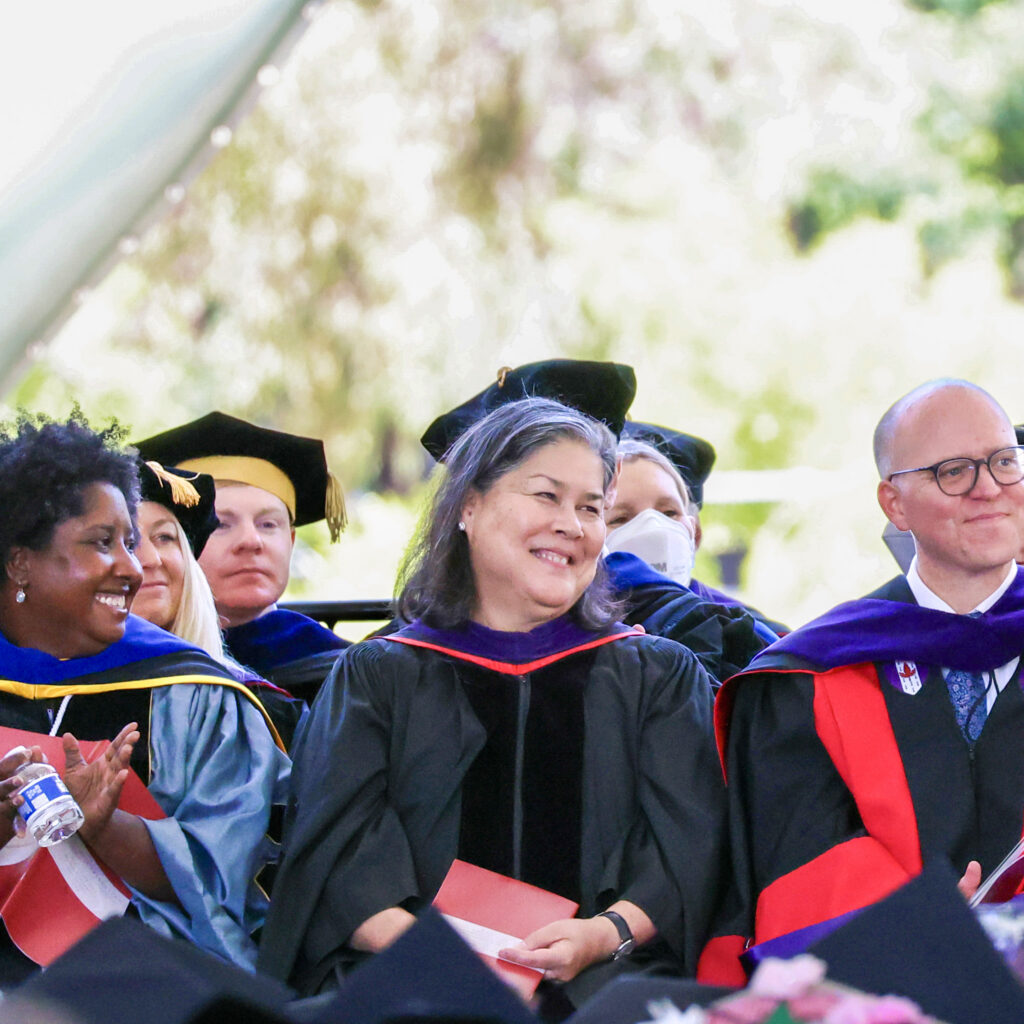
“All of us who remain here will miss your presence,” said Deal, whose longtime leadership in admissions made her one of the first Stanford Law connections for every member of the class. Noting that she was not fond of goodbyes, Deal drew on a phrase from her home state of Hawaii: a hui hou, meaning “until we meet again,” a warm, hopeful alternative to a final farewell. “It signals that the separations are fleeting and temporary only. And we will meet again.”
Delia Appiah Mensah, co-president of Stanford’s Black Law School Association, among other roles, was the winner of the 2026 Dean’s Award for Excellence in Service to Stanford Law School, which recognizes a graduating student who has made a “distinctive and exceptional contribution to legal education or the quality of student life at Stanford Law.” Award recipients are chosen by their peers and the law school faculty and staff.
Mensah credited her classmates with helping her figure out “the type of lawyer I want to become … This award might have my name on it,” she said, “but the community we built was all together. Thank you to everyone for building that community with me.”
About Stanford Law School
Stanford Law School is one of the world’s leading institutions for legal scholarship and education. Its alumni are among the most influential decision makers in law, politics, business, and high technology. Faculty members argue before the Supreme Court, testify before Congress, produce outstanding legal scholarship and empirical analysis, and contribute regularly to the nation’s press as legal and policy experts. Stanford Law School has established a model for legal education that provides rigorous interdisciplinary training, hands-on experience, global perspective and a focus on public service.