
How Will AI Reshape Politics? New Volume Co-Edited by Stanford Law’s Nathaniel Persily Explores the Stakes
STANFORD, Calif., May 6, 2026 — As artificial intelligence reshapes political campaigns, public administration, national security, public opinion, and democracy, a new volume co-edited by Stanford Law School professor Nathaniel Persily, JD ’98, offers a timely, wide-ranging analysis of what AI may mean for politics and for the field of political science.

The volume, Artificial Intelligence, Politics, and Political Science, will be published by Cambridge University Press later this year. However, given the fast-changing nature of the subject matter, the draft of the book has been made available today, in advance of publication, giving policymakers, scholars, journalists, and the broader public early access. The volume represents the report of the Presidential Task Force on AI, Politics, and Political Science of the American Political Science Association, co-chaired by Persily and New York University professor Joshua A. Tucker.
Persily, the James B. McClatchy Professor of Law at Stanford Law School and co-director of the Stanford Law AI Initiative, is a leading scholar on the regulation of technology and the law of democracy.
The volume brings together more than 50 political scientists and scholars, writing on topics that include democracy, elections, public opinion, race and gender, the labor market, national security, public-sector governance, political theory, research methods, and teaching.
“The topic of AI and politics is evolving so rapidly that we felt the need to release pre-prints of the chapters well before publication,” said Persily, who teaches Governing Artificial Intelligence: Law, Policy, and Institutions at Stanford Law. “We hope that this volume generates a society-wide conversation on the political implications of AI. Of equal importance, we hope the book captures the state of the discipline of political science as it grapples with new research opportunities and teaching challenges presented by this revolutionary technology.”
From Social Media to AI
This volume is a successor to Persily and Tucker’s earlier volume, Social Media and Democracy: The State of the Field and Prospects for Reform, published in 2020, also by Cambridge Press. This newest volume considers the intersection and interaction of social media and AI, but it goes well beyond the topics relating to the information ecosystem and democracy. The task force authors explore AI’s impact on all kinds of political phenomena, from national security to the labor market to public opinion.
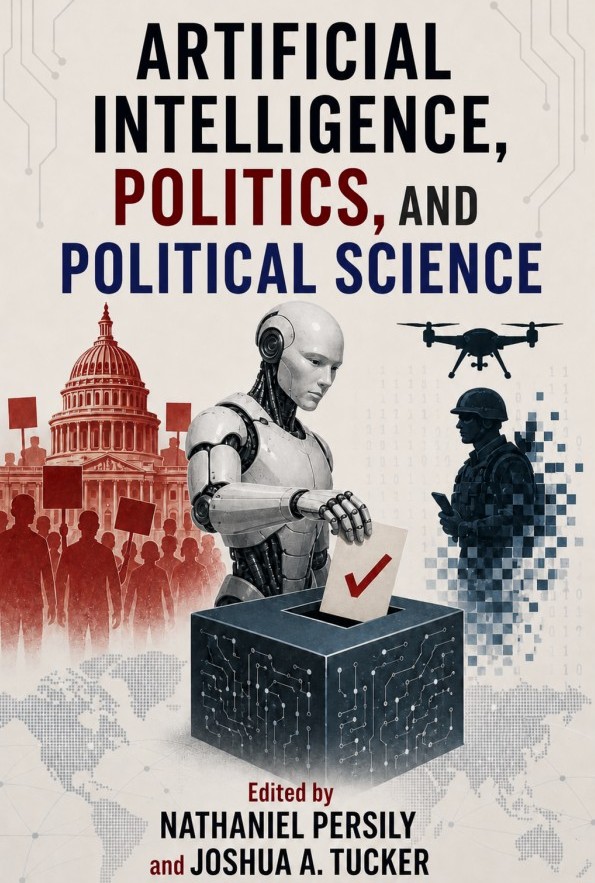
“Our experience studying social media has helped prepare us to analyze the political implications of this newest technology,” Tucker said. “However, the impact of AI – both on society and on the profession of political science has the potential to be much more dramatic. Not only will political scientists be exploring the shifts in politics due to AI, but they will be increasingly using AI as a tool to analyze these political phenomena.”
The editors express both “anxiety and excitement” regarding the impact of AI on politics and political science. Cautioning that we are at an early stage in evaluating the implications of this technology for political actors and those who study them, the volume represents a clarion call for political scientists to join in the efforts to steer the technology toward socially productive ends. While the development of AI has long been considered primarily the purview of computer scientists, the volume makes the case that considerations of AI’s political implications deserve to be front and center as the technology advances. Moreover, with chapters on political science methodology and teaching, the volume also seeks to provide guidance on questions that professors of political science need to be asking – and answering – to deal with the AI revolution.
Stanford’s Role in AI, Law, and Democracy
For Stanford Law School, the project reflects a growing body of work at the intersection of artificial intelligence, governance, democracy, and law. Through the Stanford Law AI Initiative and related centers and programs, law school faculty and researchers are examining how AI is affecting courts, administrative agencies, legal practice, elections, civil rights, and democratic institutions.
Other Stanford University contributors to Artificial Intelligence, Politics, and Political Science include Linda Eggert, assistant professor of philosophy; Rob Reich, the McGregor-Girand Professor of Social Ethics of Science and Technology; and Jennifer Pan, the Sir Robert Ho Tung Professor of Chinese Studies and professor of communication. Eggert and Reich contributed to a chapter on AI and political theory, while Pan contributed to a chapter on AI and the online information ecosystem, including the production and persuasion effects of AI-generated political content.
Persily’s scholarship has long focused on the law of democracy, including voting rights, redistricting, campaign finance, political parties, and election administration. He is a co-author of The Law of Democracy, a leading election law casebook, and has served as a special master or court-appointed expert in redistricting cases in several states. His more recent work has examined the governance of technology and technology’s impact on democracy, including as co-editor, with Tucker, of Social Media and Democracy: The State of the Field and Prospects for Reform, and as co-editor, with Erik Brynjolfsson, Alex Pentland, and Condoleezza Rice, of The Digitalist Papers: Artificial Intelligence and Democracy in America.
Read Artificial Intelligence, Politics, and Political Science
About Stanford Law School
Stanford Law School is one of the world’s leading institutions for legal scholarship and education. Its alumni are among the most influential decision makers in law, politics, business, and high technology. Faculty members argue before the Supreme Court, testify before Congress, produce outstanding legal scholarship and empirical analysis, and contribute regularly to the nation’s press as legal and policy experts. Stanford Law School has established a model for legal education that provides rigorous interdisciplinary training, hands-on experience, global perspective and a focus on public service.