
In Lillick Chair Lecture, Orin Kerr Examines the Fourth Amendment Challenges Posed by Flock Cameras
Orin Kerr, the Stella W. and Ira S. Lillick Professor of Law, recently marked his appointment to the endowed chair with a lecture at Stanford Law School on how the Fourth Amendment should apply to Flock cameras, automated license plate readers that allow police to search large databases of vehicle-location data.
The issue goes to the heart of Kerr’s scholarship on how courts adapt longstanding Fourth Amendment protections to new technologies. In his recent book, The Digital Fourth Amendment: Privacy and Policing in Our Online World (Oxford University Press), the former federal prosecutor explains how courts instinctively recalibrate Fourth Amendment doctrine when technological change alters the balance between privacy and government power.
The cases he discussed in the lecture showed just how difficult it can be to achieve that balance.
The two poles are easy to articulate, Kerr said: broad Fourth Amendment protection on one end, very little protection on the other. “But most people will want something that’s in the middle, and it turns out there’s no middle ground,” he said. “You can craft a rule, but it’s just an uncomfortable judicial rule.” Kerr predicted that courts may therefore end up “dividing sharply, running towards the extremes over time.”
Dean George Triantis, who introduced Kerr, called him “the country’s leading scholar when it comes to the Fourth Amendment protection of personal data.” He noted that Kerr’s work has been cited in hundreds of judicial decisions, including a number of U.S. Supreme Court opinions, and praised his scholarship as “learned, rigorous, influential, and accessible to a broad audience beyond lawyers and judges who rely on his work.”
Kerr, who joined Stanford Law in early 2025, said he chose Flock cameras as the subject of his lecture because the law surrounding them is changing so rapidly. The previous week alone had brought a Senate Judiciary Committee hearing, a Fifth Circuit oral argument, and conflicting district court rulings, he explained. “This is a moving target,” Kerr said. “Not only are the court decisions just starting to come, but the underlying doctrine is changing quickly.”
A Hard Line to Draw
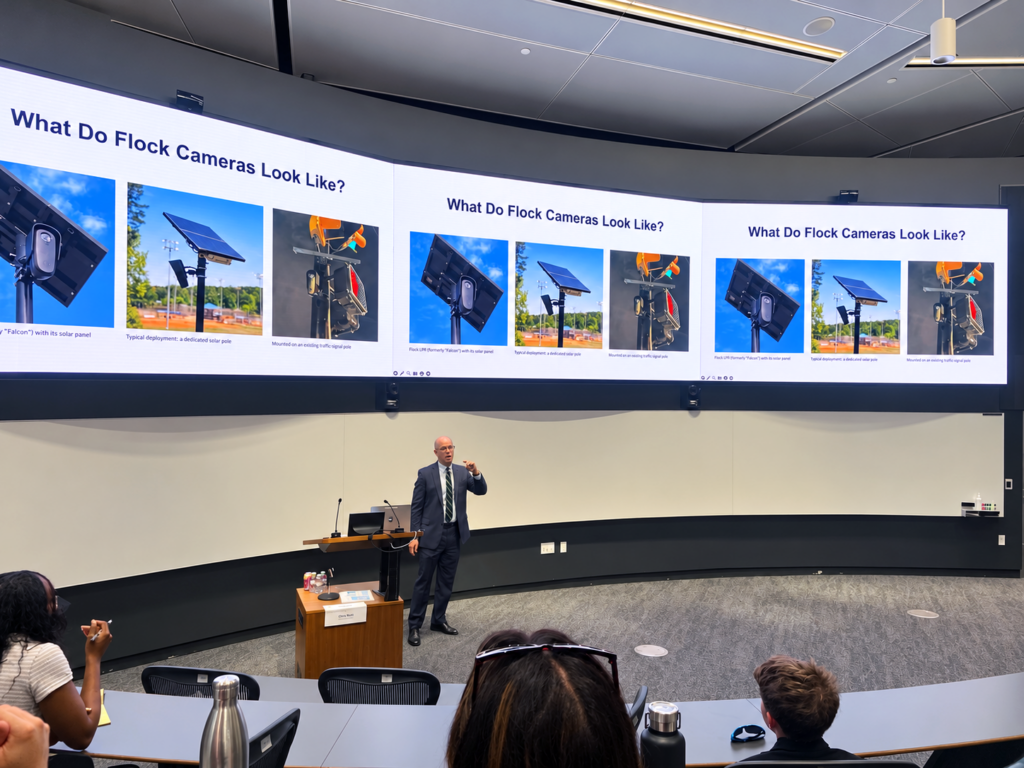
Flock is one provider of automated license plate readers, cameras that photograph passing vehicles and upload information to searchable servers. Local agencies may search their own cameras and, in many jurisdictions, a much broader network. Searches can also go beyond license plates to vehicle descriptions such as a “dark SUV with rear bumper damage.”
To explain the doctrinal tension, Kerr traced the law of public surveillance through a series of Supreme Court decisions. In United States v. Knotts in 1983, the Court held that police use of a radio beeper to follow a vehicle on public roads was not a Fourth Amendment search because a person has no reasonable expectation of privacy on a public roadway.
Advancing technology complicated that principle, Kerr explained. In United States v. Jones in 2012, several justices suggested that long-term GPS tracking could implicate privacy even if shorter surveillance did not. Then, in Carpenter v. United States in 2018, the Court recognized privacy interests in the accumulated record of a person’s movements.
How much remains of Knotts’ rule that public movements are not private if the Fourth Amendment now protects “the totality of your physical movements,” Kerr asked. “There’s a lot of tension there,” he said.
Courts have often managed that tension by asking how much the government actually learned through the search. But Kerr said the Supreme Court’s recent decision in Chatrie, involving geofence location data, shifted the focus to the technology’s broader capabilities. “What matters is the capability of long-term surveillance,” he said.
That makes license plate readers particularly difficult, he said. One camera trained on a public road looks much like traditional police observation. A network of cameras capable of reconstructing movements across a city, or beyond, looks very different, he said.
Courts could focus on camera density, he said, or distinguish a single camera from a network. But any numerical threshold invites police to stay just below it. A rule against networking raises the matter of what exactly counts as a network when data from separate cameras can simply be combined afterward.
“There is no easy middle ground,” Kerr said. “I think we’re going to see courts grapple with this, and I don’t think they’re going to have great answers for this.”
About Stanford Law School
Stanford Law School is one of the world’s leading institutions for legal scholarship and education. Its alumni are among the most influential decision makers in law, politics, business, and high technology. Faculty members argue before the Supreme Court, testify before Congress, produce outstanding legal scholarship and empirical analysis, and contribute regularly to the nation’s press as legal and policy experts. Stanford Law School has established a model for legal education that provides rigorous interdisciplinary training, hands-on experience, global perspective and a focus on public service.