
Remembrance: Professor Byron Sher
Byron Sher, a long-time Stanford Law School professor and California state legislator who helped usher in landmark environmental laws—including the first state law to mention “global warming”—died on Sept. 12 at his home on a pear orchard in Placerville where he once oversaw a yield of 500 tons of the fruit in a single harvest.
Sher was 98.
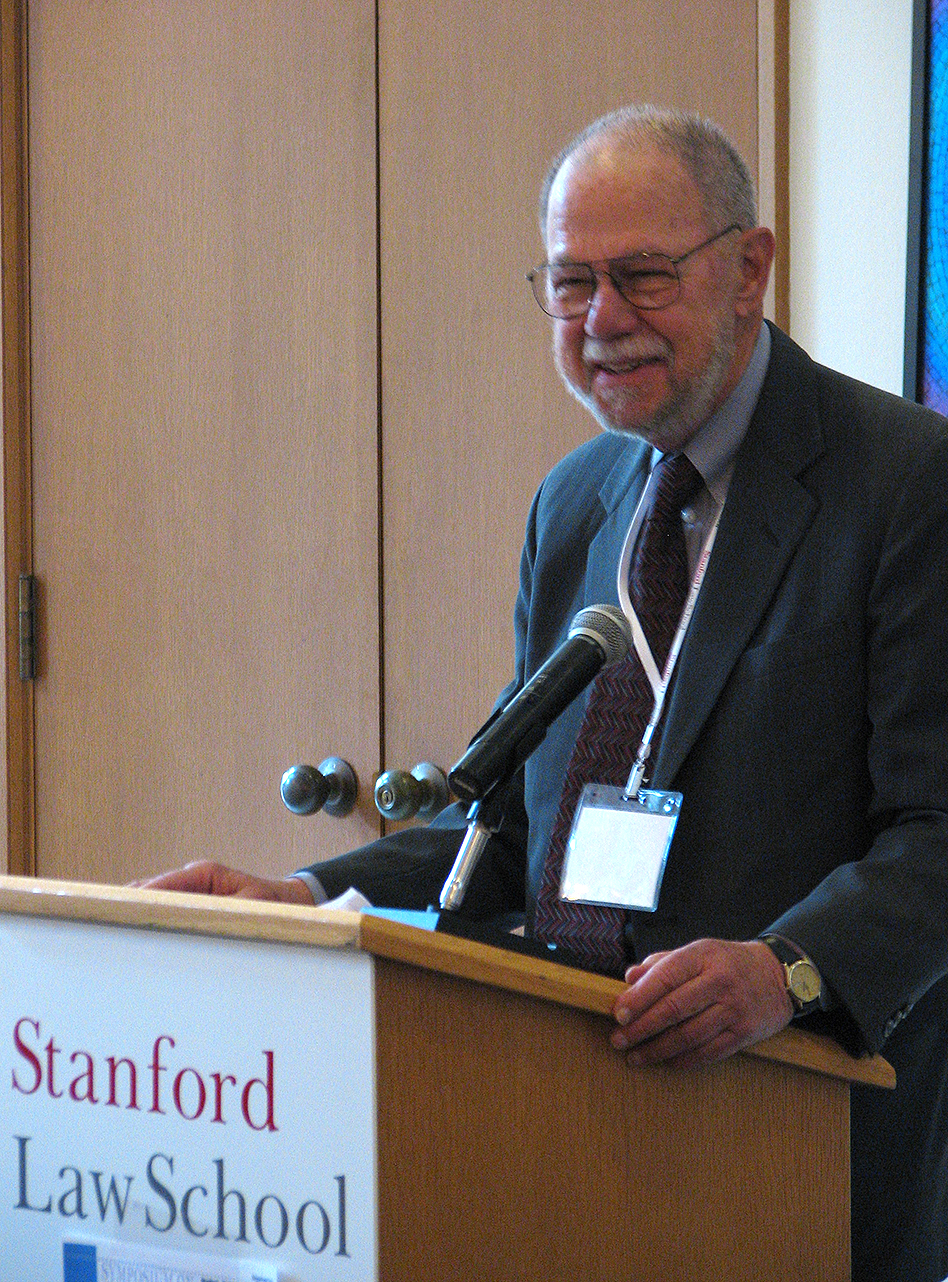
In 2002, Sher authored California’s Renewables Portfolio Standard (RPS) law, requiring that 20 percent of retail electricity sales in the state come from renewable sources by 2017 (the law has been updated twice to accelerate targets).
“Byron understood how to bring together stakeholders to pass something, even if it wasn’t perfect, in order to set the foundation for bolder future legislation,” says Sanjay Ranchod, JD 2001, who served as a legislative aide to Sher before law school and now is chief counsel for the California Energy Commission, which jointly administers the RPS in the state.
A native of Missouri, Sher graduated from Harvard Law School in 1952, joining the Stanford Law School faculty in 1957. Until he retired in 1998, he taught—later on a part-time basis—on topics ranging from commercial and contracts law to consumer rights and legislation. In 1960, Sher coauthored a book for undergraduate students, Law in Society: An Introduction to Freedom of Contract, Cases and Materials, with the late Professor Harold Shepherd, JD 1922 (BA 1919). Sher was also involved in various committees on campus, including one charged with addressing student demands to cancel exams during the Vietnam War. He became a professor emeritus in 1992.
Within the broader university, Sher was a member of the University Human Relations Commission that addressed racial issues on campus, including Black Stanford basketball players’ protests against Brigham Young University over the Mormon church’s prohibition against Black priests; and a committee created to handle grievances from employees dismissed after an April 1971 hospital sit-in over the firing of a Black custodian.
Beloved on campus—he was once described as “gentlemanly to the core,” and Professor Barton H. “Buzz” Thompson, Jr., JD 1976 (BA 1973, MBA 1975), who took contracts with Sher as a 1L, says he had a “perpetual smile”—Sher’s most significant accomplishments were nevertheless in the realm of politics, where he first served as a Palo Alto city council member (with an endorsement from Pete McCloskey, JD 1953 (BA 1950), then mayor, and later in the California State Assembly and State Senate. In 1988, Sher wrote a bill requiring the state to keep track of greenhouse gases; he also authored the California Clean Air and Safe Drinking Water Acts and laws on underground storage tanks, e-waste recycling, and the protection of rivers.
“It was almost as if Byron had two lives,” Thompson says, of his distinct contributions in the classroom and the state capitol.
As a professor, Thompson says, Sher “always made it seem like it was a pleasure for him to be able to teach us and a pleasure to work with us.”
Meanwhile, as a state politician, he remains “the most effective legislator on environmental issues,” says Thompson, who created the Environmental and Natural Resources Law and Policy Program and was the founding director of the Stanford Woods Institute for the Environment. “I don’t think there has ever been anyone in the legislature who has been as visionary and effective in actually getting bills passed.”
Thompson says Sher was always willing to serve as a resource for students, including providing mentorship and guidance on the legislative process.
“We wanted our students to not only be good at academics but to be great lawyers, and that’s what Byron would always openly and enthusiastically participate in,” Thompson says.
In a 2014 oral history, Sher said one of his earliest forays into politics was in a 1963 letter to the editor of the Stanford Daily about the then-proposed Stanford Linear Accelerator. Soon after, he became involved in unsuccessful efforts to oppose the Oregon Expressway.
“I had a pretty good temperament to be in politics, and I did not take personally disagreements with people,” he said in 2014.
Ranchod, who says Sher inspired him to go to law school, says Sher was “the foremost state environmental legislator” in the country.
He was also, he adds, “a humble, pragmatic, super-smart, wonderful human being.”
Sher was predeceased by his wife Linda Bowser Sher, JM 1974, a Russian studies scholar and artist who often worked on Sher’s political campaigns. Among his survivors are his three children Adrienne, Benjamin, and Katherine.
About Stanford Law School
Stanford Law School is one of the world’s leading institutions for legal scholarship and education. Its alumni are among the most influential decision makers in law, politics, business, and high technology. Faculty members argue before the Supreme Court, testify before Congress, produce outstanding legal scholarship and empirical analysis, and contribute regularly to the nation’s press as legal and policy experts. Stanford Law School has established a model for legal education that provides rigorous interdisciplinary training, hands-on experience, global perspective and a focus on public service.