
Stanford Law School’s Neukom Center for the Rule of Law Launches New Teaching Hub
As legal and democratic institutions come under renewed strain around the world, interest in the rule of law as a field of study has grown. But professors setting out to teach it face a sprawling and “essentially contested” subject, shaped by competing definitions and a wide range of possible approaches. They must decide which texts, countries, and historical moments to emphasize, and how to tackle questions of executive power, judicial independence, corruption, democratic backsliding, and the role of lawyers.
A new resource from the Neukom Center for the Rule of Law at Stanford Law School is designed to help. The Rule of Law Teaching Hub brings together course information, publicly available syllabi, curated readings, country case was studies, and practical guidance for instructors developing or refining courses in the field.
The Hub reflects the four-year-old Neukom Center’s broader mission to advance accountability, just laws, open government, and accessible justice through research, teaching, and practical engagement.

While a handful of schools and organizations offer resources related to rule of law education, the Hub is unusual in both its scope and its approach, according to Lawrence J. Liu, an associate professor of law at Washington University in St. Louis who served as the Hub’s principal developer while a fellow with the Neukom Center. It pairs a broad survey of existing law school courses with a synthesis of the common questions, materials, and teaching choices that shape them. It is also designed to connect a relatively small and dispersed community of instructors, scholars, and practitioners working in the field.
“Rule of law courses remain relatively uncommon, and the instructors who teach them are spread across institutions and often approach the subject from very different perspectives,” Liu said. “Though we do not purport to distill a rule of law ‘canon,’ we do hope that the Hub makes existing work easier to find, learn from, and build upon. By offering syllabi, readings, case studies, and teaching frameworks, we encourage instructors and students to adapt the materials to their own goals.”
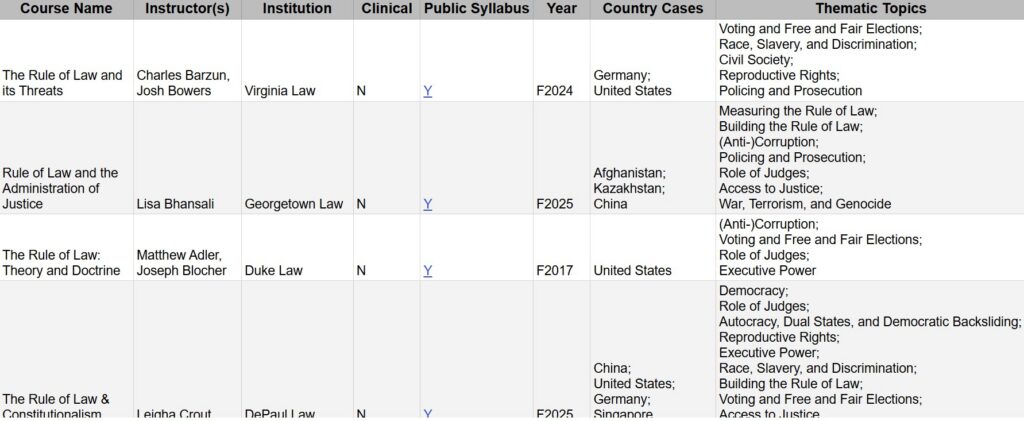
At launch, the Hub’s syllabus repository includes information on 26 rule of law-related courses offered at more than a dozen universities, primarily U.S. law schools.
The Hub also identifies common building blocks that instructors can adapt to their own goals and areas of expertise. Its teaching resources are organized around four areas: approaches to rule of law teaching, conceptualizing the rule of law, country case studies, and thematic topics.

“Teaching is central to the Neukom Center’s work because the rule of law depends on each generation understanding both the institutions that sustain it and the responsibilities those institutions place on lawyers,” said Professor Diego A. Zambrano, faculty director of the Neukom Center. “The Hub creates a foundation for deeper collaboration among educators and helps prepare students to recognize and respond when legal systems come under strain.”
The courses collected in the Hub reflect the breadth of the field. Some focus on the philosophical foundations of the rule of law, while others emphasize doctrine, comparative study, public policy, clinical practice, or the role of lawyers in protecting legal and democratic institutions.
Neukom Center fellows Nicola Tommasini and Leigha Crout also contributed to the project.
The center plans to continue expanding the repository and invites instructors, scholars, and practitioners engaged in rule of law teaching, research, or practice to contribute to the project.
About the Neukom Center for the Rule of Law
Building on Stanford Law School’s legacy of rule of law scholarship, the Neukom Center advances accountability, just laws, open government, and accessible justice worldwide through rigorous research, practical engagement, and partnerships that drive real-world impact. The center works across several focus areas, including Judicial Independence and Quality, Private Enforcement and the Rule of Law, and Restoring the Rule of Law.
About Stanford Law School
Stanford Law School is one of the world’s leading institutions for legal scholarship and education. Its alumni are among the most influential decision makers in law, politics, business, and high technology. Faculty members argue before the Supreme Court, testify before Congress, produce outstanding legal scholarship and empirical analysis, and contribute regularly to the nation’s press as legal and policy experts. Stanford Law School has established a model for legal education that provides rigorous interdisciplinary training, hands-on experience, global perspective and a focus on public service.