
The President Who Would Not Be King
Stanford Law Professor Michael McConnell Delivers the Princeton Tanner Lectures on Human Values
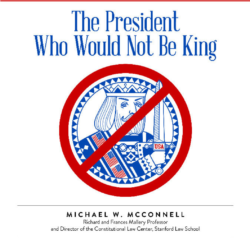
Taking an historical perspective on a very current topic under much debate, on November 28 and 29, 2018, Stanford Law School (SLS) Professor Michael McConnell delivered the 2018 Tanner Lectures at Princeton University. A renowned constitutional law expert, McConnell’s lectures addressed executive power and its limits under the U.S. Constitution. Professor Stephen Macedo, chair of the Tanner Lectures Committee at Princeton and Christopher L. Eisgruber, president of Princeton University, attended both lectures.
“Given his exemplary record of distinguished and influential scholarship, it should come as no surprise that Michael McConnell was invited to deliver the Tanner Lectures,” said M. Elizabeth Magill, Richard E. Lang Professor of Law and dean of Stanford Law School. “Joining a distinguished roster of learned past lecturers, Michael’s Tanner Lectures teach us something new about executive power, one of the knottiest issues at our country’s founding and today. Michael’s combination of deep learning and practical sense, as always, offers the listener and reader many insights that all can learn from.”
The Tanner Lectures on Human Values, established in 1978 by the American scholar, industrialist, and philanthropist, Obert Clark Tanner, serve to advance and reflect upon scholarly and scientific learning related to human values. The lectures are presented annually at selected universities, including Stanford, Berkeley, Cambridge, Harvard, Michigan, Oxford, Princeton, Utah, and Yale. Other legal luminaries including Laurence H. Tribe, Richard Posner, Kathleen J. Sullivan (former Stanford Law School dean) and several U.S. Supreme Court members, including Ruth Bader Ginsburg, Antonin Scalia and Stephen Breyer, have given Tanner Lectures.
Executive Power & the Constitution
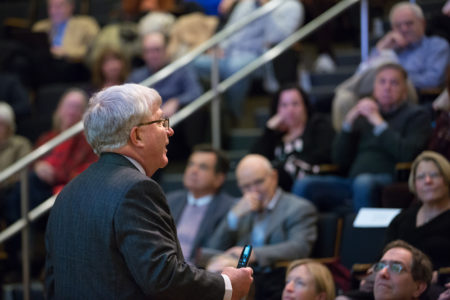
The first of McConnell’s two lectures argued that the actual process of formulating the executive power at the 1787 Constitutional Convention has mostly been overlooked, perhaps because the real work was done by three committees operating behind the scenes. McConnell believed that what they accomplished is more nuanced than either of the two major conflicting views taken today. He also addressed important issues facing the separation of powers today, including the problem of the administrative state. In addition, McConnell presented a new approach to the delegation question, including a presidentialist view of supervision of executive officers and an anti-presidentialist view of non-enforcement.
View the video of the first lecture.
Executive Power at Home & Abroad
McConnell’s second lecture addressed the powers of peace and war, in which he claimed that the president does not have the exclusive power over foreign affairs that the U.S. Supreme Court attributes to it, a defense of a narrow understanding of the commander in chief power, and a moderate interpretation of presidential authority to initiate hostilities.
View the video of the second lecture.
Every Tanner Lecture includes commentary after the lecture is completed. Commentary on McConnell’s lectures was provided by the following:
- Gillian Metzger, Stanley H. Fuld Professor of Law, Columbia Law School
Professor Metzger writes and teaches in the areas of constitutional law, administrative law, and federal courts. - Eric Nelson, Robert M. Beren Professor of Government, Harvard University
Professor Nelson’s research focuses on the history of political thought in early-modern Europe and America, and on the implications of that history for debates in contemporary political theory. - Jeffrey Tulis, Associate Professor, The University of Texas at Austin
Professor Tulis’s interests bridge the fields of political theory and American politics, including more specifically, American political development, constitutional theory, political philosophy and the American presidency. - Amanda Tyler, Professor of Law, University of California, Berkeley School of Law
Professor Tyler’s research and teaching interests include the Supreme Court, federal courts, constitutional law, civil procedure, and statutory interpretation.
About Professor Michael McConnell
Professor McConnell is the Richard and Frances Mallery Professor and Director of the Constitutional Law Center at Stanford Law School, and a Senior Fellow at the Hoover Institution. From 2002 to the summer of 2009, he served as a Circuit Judge on the United States Court of Appeals for the Tenth Circuit. McConnell has held chaired professorships at the University of Chicago and the University of Utah, and visiting professorships at Harvard and NYU. He has published widely in the fields of constitutional law and theory, especially church and state, equal protection, and the founding. In the past decade, his work has been cited in opinions of the Supreme Court second most often of any legal scholar. He is co-editor of three books: “Religion and the Law,” “Christian Perspectives on Legal Thought,” and “The Constitution of the United States.” McConnell has argued fifteen cases in the Supreme Court. He served as law clerk to Supreme Court Justice William J. Brennan, Jr., and is of counsel to the appellate practice of Kirkland & Ellis.
About Stanford Law School
Stanford Law School is one of the nation’s leading institutions for legal scholarship and education. Its alumni are among the most influential decision makers in law, politics, business and high technology. Faculty members argue before the Supreme Court, testify before Congress, produce outstanding legal scholarship and empirical analysis, and contribute regularly to the nation’s press as legal and policy experts. Stanford Law School has established a new model for legal education that provides rigorous interdisciplinary training, hands-on experience, global perspective and focus on public service, spearheading a movement for change.