
U.S. Court of Appeals Judge Carlos Bea to Focus on Religion in Constitution Day Lecture on Monday
STANFORD, Calif. September 12, 2014 – The controversy swirling around the U.S. Supreme Court’s recent Hobby Lobby ruling, which allows for-profit corporations to restrict health care insurance benefits based on religious beliefs, provides a timely backdrop for Stanford Law School’s annual Constitution Day lecture.
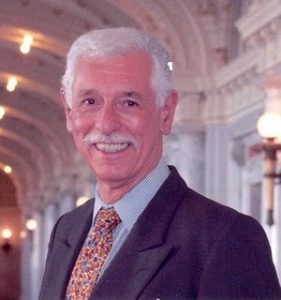
Judge Carlos Bea (BA ’56, JD ’58), a former competitor on the Cuban Olympic basketball team and current judge on the U.S. Court of Appeals for the Ninth Circuit, will speak at 4:45 p.m. Monday in Paul Brest Hall. His talk is open to the public, but registration is required.
The Constitution Day lecture is held each year in honor of “Constitution and Citizenship Day,” which commemorates the signing of the U.S. Constitution on Sept. 17, 1787.
“Judge Bea has led a fascinating life, is an admired jurist and will address the deeply interesting topic of religion in the public square,” said M. Elizabeth Magill, Dean and Richard E. Lang Professor of Law at Stanford Law School.
Describing his Constitution Day lecture, Judge Bea said, “Supreme Court decisions have provided several tests by which to determine the constitutionality of religious displays on public property and the religious content in government actions. … In my talk, I hope to help explain the path the court has taken in making these decisions, and where it might be going in light of its most recent decision, with a view to determining how much religion can be put in or talked about in the public square.”
Born in Spain, he was just 5 years old in 1939 when his mother, a widow, whisked him and his brother out of Europe after learning that the Germans had marched into Poland. They endured a frightening voyage across the Atlantic, worried that German submarines would sink their ship, and landed in Cuba, where his father and grandmother had been born. Then his mother decided to take them to California. He explained in a 2007 address to the Board of Immigration Appeals, “She assured us that with cities named San Diego, Los Angeles and San Francisco, everyone in California spoke Spanish.”
Judge Bea wound up studying at Stanford for his undergraduate and law degrees, where he played on one of the best basketball teams in Stanford’s history, a move that proved to be his saving grace when he was later faced with deportation. Already a strong player as a sophomore, he won a spot on the Cuban Olympic team because of his family background and played in the 1952 summer games at Helsinki, then delayed his return to the U.S. for a year. He held a student visa when he sought U.S. citizenship two years later, and the hearing officer accused him of trying to avoid the draft and issued a deportation order.
Judge Bea got lucky when the chairman of the Board of Immigration Appeals (BIA), Thomas G. Finucane, turned out to be an avid basketball fan and began quizzing him on what position he had played at Stanford. A few months later, the board reinstated Bea’s residency.
Judge Bea credits Carl Spaeth, then Dean of the Law School, and faculty members with giving him a tremendous amount of support during this trying time. “When I finally won in 1958, I threw a party, and a lot of the faculty came,” he recalled in a 1990 interview with Stanford Law magazine.
Mindful of his own difficult path to citizenship, Judge Bea touched on the topic during an address to the Board of Immigration Appeals in 2007. “We are a nation of immigrants and the subject is a vital one for all of us,” he said. “Every time an Albert Einstein invents a theory, an Arnold Schwarzenegger becomes a governor or a rookie Hispanic judge writes a dissent, I am reminded that immigrants aren’t just a previous generation long gone, they are an ever-changing contribution to our society, which really is a melting pot.”
More on Judge Carlos Bea
Judge Carlos Bea was nominated by President George W. Bush to the U.S. Court of Appeals for the Ninth Circuit in 2003 and was unanimously confirmed by the U.S. Senate. Prior to that, he served in private practice for 31 years, specializing in construction and business litigation. In 1990 he was appointed by California Gov. George Deukmejian to the San Francisco County Superior Court bench, where he handled complex litigation cases, including two concerning the use of the gasoline additive MTBE.
While in private practice, Bea taught courses in civil litigation advocacy as an adjunct professor at Hastings College of the Law and as a Lecturer at Law at Stanford Law School. He received the Pro Bono Recognition Award from the State Bar of California in 1989 for his work on pro-bono immigration cases. He was named an Honorary Vice Consul of Spain from 1979 to 1993 and received three decorations from the King of Spain and the Spanish government in recognition of his service.
About Stanford Law School
Stanford Law School is one of the nation’s leading institutions for legal scholarship and education. Its alumni are among the most influential decision makers in law, politics, business and high technology. Faculty members argue before the Supreme Court, testify before Congress, produce outstanding legal scholarship and empirical analysis and contribute regularly to the nation’s press as legal and policy experts. Stanford Law School has established a new model for legal education that provides rigorous interdisciplinary training, hands-on experience, global perspective and focus on public service, spearheading a movement for change.