
What Team USA’s Style Signals About America
(Originally published by The Stanford Report on December 17, 2025.)
Richard Thompson Ford, a Stanford legal scholar who studies the politics of fashion, discusses the messages embedded in Team USA’s recently unveiled uniforms for the 2026 Winter Olympic and Paralympic Games.
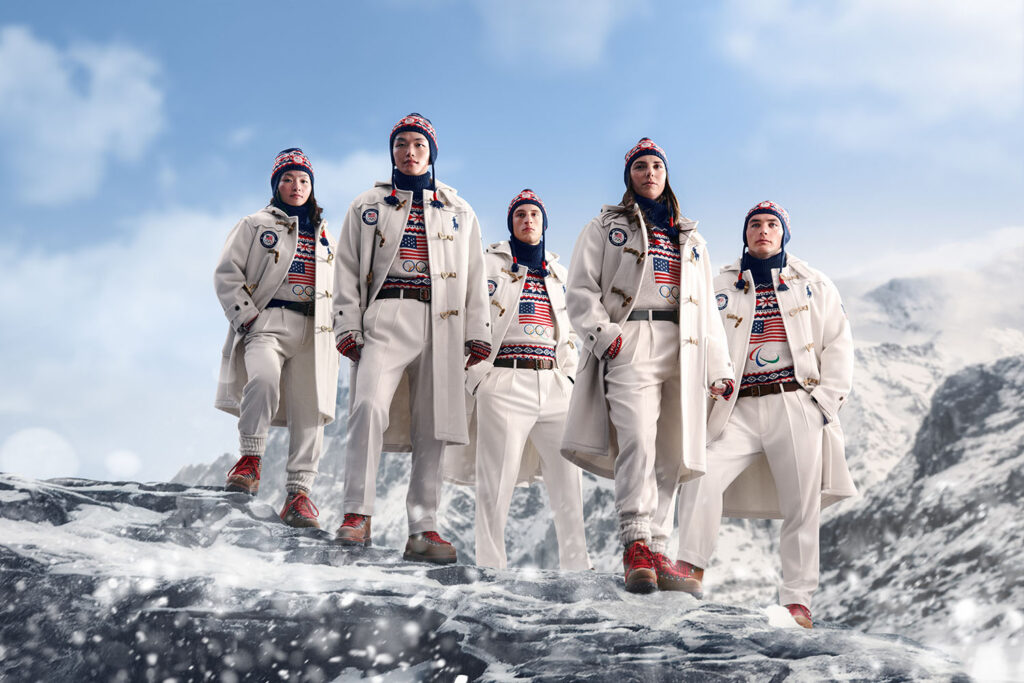
Earlier this month, Team USA’s uniforms for the 2026 Winter Olympic and Paralympic Games were unveiled.
Designed by the iconic American designer Ralph Lauren, the athletes’ uniforms tell a particular story about Americaness: one that is confident and clean-cut on the one hand, preppy and privileged on the other, according to Richard Thompson Ford, a Stanford legal scholar who studies the politics of fashion.
Here, Ford discusses what messages are embedded in the designs; just as important, he also points out what is left out of Lauren’s particular vision of American history.
This interview has been edited for length and clarity.
What cultural symbols are embedded in Team USA’s uniforms? What do they reveal about American identity and values?
Ralph Lauren’s uniforms are, as expected, classic Americana, refined and improved by one of the most talented designers and savviest marketers on the planet. They don’t speak to values; instead, like all of Lauren’s work, whether in clothing, home decor, watches, or restaurants, they speak to aspiration – which may be the most characteristically American value of all.
When Team USA steps onto the world stage, what specific messages about “Americanness” are being projected through their uniforms?
There are two big themes: the Aspen ski lodge and the Ivy League. The puffers are practical and sporty: bold color blocks, simple functional designs, and the hats are classic, rich ski bum. The tailored pants, and especially the polo coats, with hoods and big toggle fasteners, would be at home in the stands of the Harvard-Yale game in 1930 – or in an F. Scott Fitzgerald story.

The uniforms draw inspiration from a vintage ski racing aesthetic. What version of America’s past is being romanticized here?
The classic ski lodge and the Ivy League represent old-money America of the early and mid-20th century. This evokes the height of American confidence and perceived innocence: before our most notorious imperial misadventures and before the dramatic social reckonings of the 1960s. Lauren skillfully treads a tightrope here: There’s racial diversity, which he really leaned into with the recent Martha’s Vineyard and Morehouse and Spelman lines – but there’s no hint of edginess, struggle, or discord. Lauren’s world is comfortable and self-satisfied, a bubble of oblivious privilege.
Ralph Lauren has outfitted Team USA for nearly 20 years. How has this long-standing partnership contributed to the construction of a particular American identity and, indeed, Americaness on the global stage?
Ralph Lauren is the architect of a certain classic American style – romantic, affluent Anglo-America. He does for the U.S. what Downton Abbey or a Merchant Ivory film does for England. In one sense, he shows America at its uncomplicated best: clean-cut, athletic, confident, idealistic, and most of all, ambitious. Lauren’s vision does not include the rebellious, chaotic part of the American character: From Lauren, you’d think America is all elite colleges, oak-paneled board rooms, spacious ranches, magnificent ski slopes – all nice things, mind you, but a fantasy of placid privilege. Also, Lauren’s designs are mainly the direct descendants of styles inherited from the British; his Western/ranch designs are the exception. There’s no mosh pit, no funky night club in a warehouse, no anti-war protests, no civil rights struggle (just the happy aftermath for the lucky elite), no smoke-filled jazz club, no pheromone- and cocaine-fueled disco, no feminist encounter group, no beatnik poetry reading. That’s for other designers with other visions – e.g., Marc Jacobs, Virgil Abloh, Anna Sui – visions that, let’s face it, would not be selected to represent the U.S. in the Olympics.
Ralph Lauren is elegant and refined, but also quite uncomplicated. He is about unapologetic social aspiration and the romance of old money.