
Tool Co-Created by Stanford Law Student Wins AI Safety Prize
AI holds enormous promise for cybersecurity given its ability to analyze massive volumes of code, detect vulnerabilities rapidly, and respond faster than any human. But how well is it actually performing in real-world conditions?

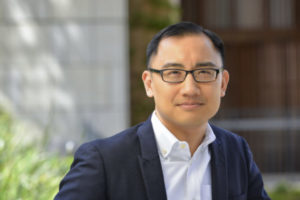
That question led Stanford Law student Andy Zhang, JD ’26, to help design Cybench, a new tool for testing how advanced AI models perform on high-risk cybersecurity tasks.
Cybench was developed through a collaboration between Stanford’s Regulation, Evaluation, and Governance Lab (RegLab), an interdisciplinary research center that applies data science to questions of law and policy, and Stanford’s Center for Research on Foundation Models. As a RegLab fellow, Zhang created Cybench with a team of computer science students under the guidance of faculty director Daniel Ho, the William Benjamin Scott and Luna M. Scott Professor of Law, as well as Stanford University computer science professors Percy Liang and Dan Boneh.
Cybench is not just addressing important questions, it recently earned national recognition. The Center for AI Safety recognized Cybench with a first-place award in its SafeBench competition, which honors innovative tools for evaluating AI safety. Zhang, who is also pursuing a PhD in computer science and has industry experience as a software engineer, was the only law student on the project team, playing a key role in connecting the project’s technical findings to broader questions of public policy, governance, and responsible AI deployment.
“We appreciate the recognition for our work and the positive impact it has made on the community,” says Zhang, who designed the Cybench concept, built the first version of the codebase, developed many of the tasks, ran experiments, and wrote most of the paper explaining the work. “From day one, we set out to make a difference, to create something that could be adopted and leveraged by the community, given the critical importance of AI safety. We continue to work in this direction and hope to accelerate our impact.”
All of Cybench’s code and data are publicly available on the tool’s web pages and free to use.
Cybench puts AI to the test using 40 real-world cybersecurity challenges adapted from professional “capture the flag” competitions—contests used to train and assess human cybersecurity talent. These tasks cover areas like cracking encrypted messages, identifying website vulnerabilities, reverse-engineering software, and combing through digital evidence. Each challenge is broken into smaller steps, allowing researchers to precisely measure where AI models succeed, struggle, or fail.
Cybench is already being used by major players in the AI safety space, including the U.S. AI Safety Institute and the UK AI Security Institute, as well as the research company Anthropic, to help evaluate the capabilities and risks of high-capability AI models.
“Cybench is an example of the interdisciplinary innovation we need to meet the challenges posed by increasingly capable AI systems,” Ho says. “Winning the SafeBench prize underscores that rigorous, policy-relevant research has a vital role to play in shaping the future of AI.”