
Built in a Day: Stanford Law Students Create Award-Winning Copyright Tool at Codex Hackathon
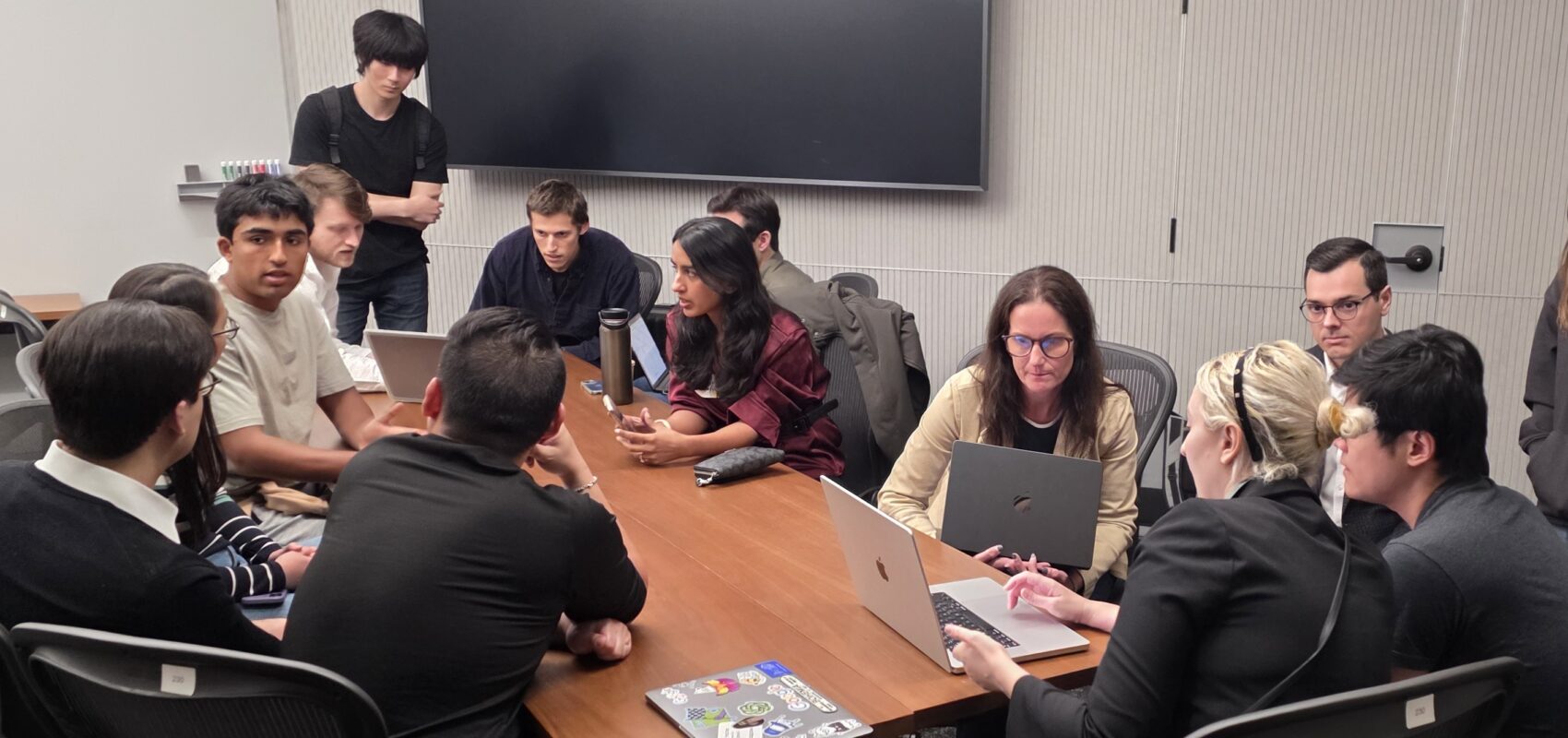
On a recent Sunday at Stanford Law School, the halls were buzzing with the energy of hundreds of ideas hurtling toward working prototypes. Whiteboards were filling up, demos were taking shape, the clock was ticking, and stacks of pizzas arrived to keep everyone going.
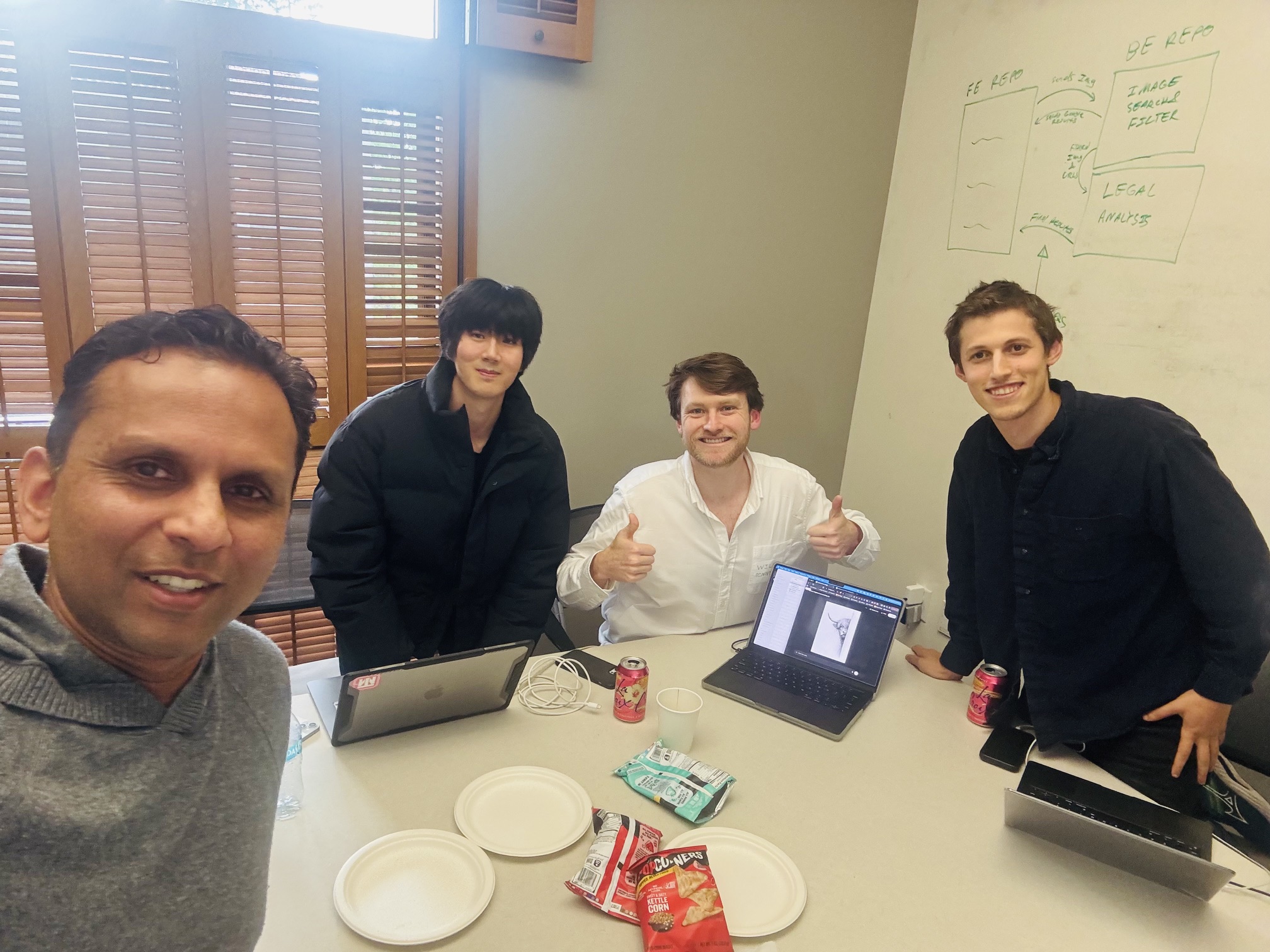
Joshua Waldman, JD ’27, and Will Dinneen, JD ’28, were in the thick of it. Along with their computer scientist-teammates Chris Um from Cornell and Dhanin Wongpanich from UC Berkeley, they were among the more than 300 participants at this year’s CodeX LLM x Law Hackathon. The annual event, part of Codex’s FutureLaw Week, launched in 2023 as the first-ever hackathon at the intersection of large language models and the law. Participants come from across the Stanford campus and the world.
After staking out a third-floor room in Crown, the teammates spent about 12 hours building what they would eventually dub Warhol, an AI tool designed to go beyond existing copyright search apps. While some AI tools can detect exact or near-exact matches, Warhol was built using both vision models and a legal agent to tackle the murkier legal questions that define copyright law. The tool scans the internet for visually similar earlier images and then applies copyright rules and case law to assess the risk of infringement. In other words, Warhol does not just ask “does this image look similar?” It goes deeper, to “does this raise an infringement problem?”
By day’s end, the first-of-its-type tool had won the Harvey Challenge Award, one of several prizes sponsored by the legal tech and AI companies that helped shape the event.
“The whole day had this incredible intensity to it,” says Dinneen. “Everybody around us was building at full speed, testing ideas, talking to judges and mentors, and trying to turn something half-formed into a real working product by the end of the night. It was exhausting, but also really exhilarating.”
“What always inspires me is how quickly the hackathon participants get from a legal question to building a prototype that actually works,” says Jay Mandal, a CodeX Fellow and one of the hackathon organizers. “You could feel that happening all over the building. Teams were not just building quickly, they were thinking deeply about gaps in the legal system and areas where the law is genuinely messy, and finding solutions using AI that could meet the need.” Mandal also noted, “Joshua and Will were among the Stanford students in our Stanford AI Agents in Law Bootcamp before the hackathon, and we were proud to see them take this top prize in the hackathon.”
‘We May Be on to Something’

The idea for Warhol grew out of Stanford Law intellectual property class taught by visiting professor Xiyin Tang, a professor at UCLA School of Law. Waldman and Dinneen met in that class. “Professor Tang really provided the ‘creative spark,’ to use the language of IP law,” says Waldman. “She helped point us toward substantial similarity as a thorny issue in copyright law, and that sent us down this path.”
But this type of high-velocity melding of law, AI, and entrepreneurial instinct was not exactly a first for either student.
Waldman, a Knight-Hennessy Scholar, previously worked in the Biden White House as an economic policy adviser. At Stanford, he is also building out a separate venture, EconStats.org, a tool he is co-designing with AI engineer Jules Becker to help users ask economic questions and get reliable answers from government data. Dinneen, who worked as a data scientist before coming to Stanford Law, is also hard at work running indexia.tech, an AI startup he co-founded during his 1L year with classmate Ben Vagle, JD ’28. The startup is now under the umbrella of Stanford’s StartX Accelerator Program and has hundreds of active users.

“With Warhol, we wanted to build a copyright search tool able to reason through the legal problem of infringement in a more realistic way,” says Dinneen. “The response since the hackathon suggests we may be onto something. We’ve heard from people in legal tech, academia, and practice who are interested in where it could go next. So now the question is whether it becomes a research project, an open-source tool, or a product we build out more fully.”
Current Uses and Next Steps

The tool’s name is, of course, a nod to pop artist Andy Warhol, whose work has been central to modern copyright doctrine. The logo, a silhouette of Warhol’s signature mop top, was one more example of how fully the team had thought the project through, even on a compressed timeline.
For now, the team sees one of the clearest immediate uses for Warhol in the design and marketing world, where AI-generated images are often used in commercial settings with little visibility into potential copyright risk.
“Our archetypal user was a designer creating something for a company and wanting to know whether an AI-generated image might create a copyright problem before it goes live,” says Dinneen.
But the students say the audience for a tool like Warhol could extend well beyond that. In-house legal teams, agencies, and AI image companies themselves could all have reason to want a more sophisticated way to assess substantial similarity and other copyright doctrines. “Once we started building it, we realized the idea might be bigger than our original use case,” Waldman says. “If you can make this kind of analysis more usable and more accessible, there are a lot of directions it could go.”