
Stanford’s FutureLaw Explores What Comes Next as AI Reshapes the Law
Scholars and AI industry leaders gather at Stanford Law School for a week of conferences, workshops, conversations, and competitions; Professor Daniel Ho receives the 2026 Codex Prize for his groundbreaking research
By now, few people in law need to be told that AI is changing the profession. The more urgent conversation is about how to ensure those changes are not just driving efficiency, but fundamentally improving the quality, accessibility, and integrity of legal systems.
FutureLaw Week brought that conversation into sharper focus during the second week of April. Presented by CodeX – the Stanford Center for Legal Informatics, FutureLaw Week convened participants from across law, technology, academia, and industry for a wide-ranging suite of conferences, workshops, competitions, and other events at Stanford Law School.
The main event, the all-day FutureLaw conference, was held April 16 at Paul Brest Hall, featuring discussions on courtroom uses of generative AI, the rise of AI-native legal service providers, computational law, legal education, and the future of legal reasoning, among other topics.
Legal Empowerment Through Information Technology
CodeX, which bridges the law school and Stanford’s computer science department, has, for more than two decades, served as a research hub for computational law, the branch of legal informatics concerned with the mechanization of legal reasoning. CodeX helped lay the groundwork for much of the transformational legal AI technology of today. CodeX is part of Stanford Law’s AI Initiative, which brings together the school’s AI-focused centers, labs, and clinics to advance and coordinate research and scholarship on artificial intelligence.
“Legal empowerment through information technology has been our guiding theme since the outset, long before AI became the center of so many conversations about the future of law,” said Roland Vogl, Executive Director of CodeX and the Stanford Program in Law, Science and Technology. “FutureLaw has long been a place where people across disciplines can come together to think seriously about how technology is changing law and legal institutions. This year’s conversations underscored the enormous AI-driven transformation of the law and the importance of building legal and technical systems that are responsible and grounded in real-world needs.”

Bootcamp and Hackathon
FutureLaw Week kicked off with its annual “bootcamp,” a hands-on class in which teams of law, engineering, computer science, and business students learned how to design and prototype agentic AI applications for legal use. The bootcamp fed into the next day’s LLM x Law Hackathon, which drew more than 600 participants from the Stanford campus and around the world, all competing at a breakneck pace to design new tools for automating and augmenting legal practice.
Among the winners were Will Dinneen, JD ’28, and Joshua Waldman, JD ’27, who, along with their computer science teammates, won the Harvey Challenge Award for their copyright tool, Warhol. The tool scans the internet for visually similar earlier works, then uses a machine learning pipeline to evaluate similarity in a more sophisticated way than simple pixel matching. It also uses agents to analyze copyright doctrine based on real case law.
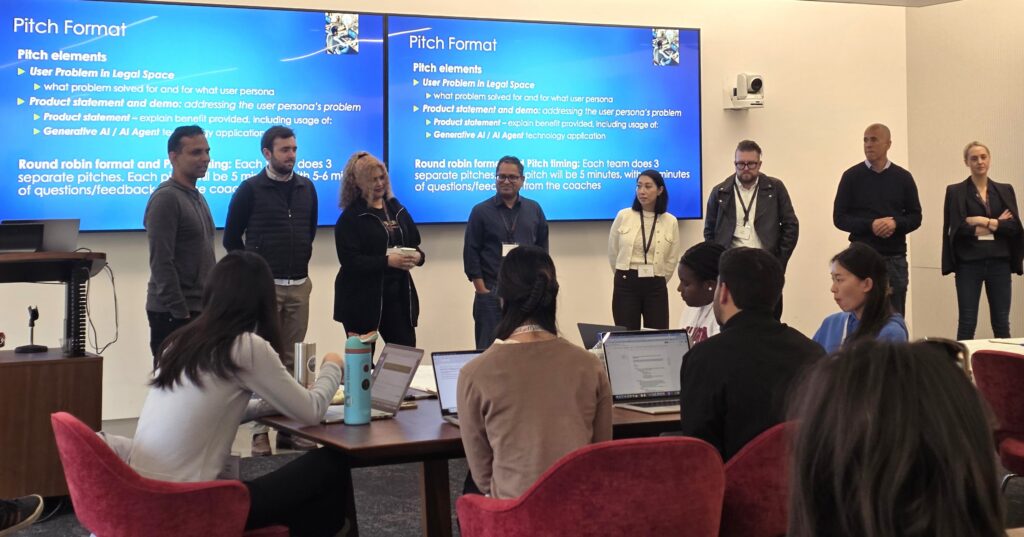
Archit Lohani, LLM ’26, and Adèle Boreau-Potocki, a law exchange student from Sciences Po Paris, were on the interdisciplinary team that won the Midpage Challenge for their tool called Provable, designed to empower victims of online harassment, defamation, and sextortion by using AI to capturing admissible evidence. Taruni Kavuri, LLM ’26, and Emmanuel Daudu, JD ’28, were on the team that won the Thenvoi Challenge for Cura, an agent to ingest and analyze due diligence input and securely respond to checklists for M&A deals.
CodeX launched its first LLM x Law Hackathon in 2023, marking the first time that a hackathon was held, anywhere in the world, at the intersection of LLMs and the law.
The Main Event

The main conference opened with a keynote address on “The Future of the Law Firm” from David Freeman Engstrom, LSVF Professor in Law and Co-Director of the Deborah L. Rhode Center on the Legal Profession, and Natalie Anne Knowlton, the Rhode Center’s associate director for legal innovation. Panels and talks throughout the day examined a range of emerging issues, from how courts can use AI responsibly to whether traditional firms can compete with AI-native legal challengers.
Among the featured sessions was “Beyond Efficiency: Building Reliability into Courtroom Use of Artificial Intelligence,” which focused on the opportunities and risks presented by generative AI in litigation and judicial workflows. Another panel, “The Great Unbundling: Can Traditional Firms Compete with AI-Native Challengers?,” explored how legal services are being reshaped by new business models built around automation and AI.

Later sessions turned to foundational questions about AI reasoning and legal methods. “Computational Law as a Blueprint for AI Reasoning” examined whether so-called reasoning models can truly support the kinds of formal, inspectable analysis that law often requires. The program also included LEX Talks, a series of short presentations on law, education, and experience, followed by a closing keynote from Alex Pentland, a HAI Center Fellow and faculty lead for digital society at Stanford HAI and the Stanford Digital Economy Lab.
Prior to the all-day conference, the second UN AI for Good conference tackled the power of AI to promote sustainable, ethical, and responsible law and legal systems, building on the United Nations’ AI for Good initiative launched in 2017. The AI for Good track was sponsored by CodeX law firm affiliate DLA Piper.
Stanford Law Professor Dan Ho receives 2026 CodeX Prize
A highlight of the April 16 conference was the presentation of the 2026 Stanford CodeX Prize to Daniel E. Ho, the William Benjamin Scott and Luna M. Scott Professor of Law at Stanford Law School and director of the Regulation, Evaluation, and Governance Lab, or RegLab.
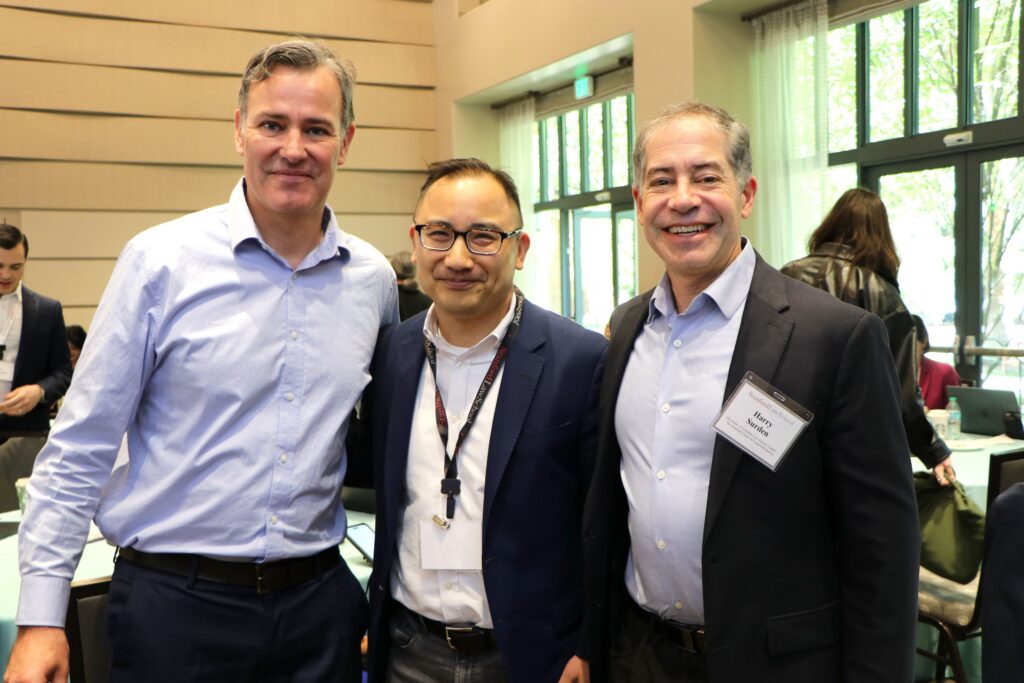
The CodeX Prize is awarded annually to an individual or individuals for a noteworthy contribution to legal informatics that has had a significant and enduring positive impact on the field. Ho was recognized for his work with RegLab and for his extensive scholarship on how technology can help researchers, public institutions, and legal systems better understand and improve the law.

In particular, the prize recognized several of Ho’s foundational papers, including Algorithmic Accountability in the Administrative State, Government by Algorithm: Artificial Intelligence in Federal Administrative Agencies, and Large Legal Fictions. Together, those works have helped shape contemporary thinking about AI, government, legal institutions, and evaluation in legal technology.
“Dan Ho has helped define a field,” said Michael Genesereth, associate professor of computer science and a Codex co-founder. “His work combines technical rigor, legal insight, and public purpose in a way that has deepened our understanding of how technology can improve legal systems and governance.”
Ho’s selection also reflected the broader influence of RegLab, which has become a leading site for interdisciplinary research on how data science and artificial intelligence can be used in public law and governance.
In his remarks, Ho reflected on the responsibility and possibility inherent in using technology to shape the law’s future. “The work of computational law is, at its heart, the work of translation—between legal obligation and code, between technical possibility and human dignity, between the law as it is and the law as it ought to be.” he said. “I am grateful to be part of a community that takes all three seriously, and I can’t wait to see what we build together.”
About Stanford Law School
Stanford Law School is one of the world’s leading institutions for legal scholarship and education. Its alumni are among the most influential decision makers in law, politics, business, and high technology. Faculty members argue before the Supreme Court, testify before Congress, produce outstanding legal scholarship and empirical analysis, and contribute regularly to the nation’s press as legal and policy experts. Stanford Law School has established a model for legal education that provides rigorous interdisciplinary training, hands-on experience, global perspective and a focus on public service.