
Celebrating Crown Quadrangle
Professor Hank Greely marks 50 years since the opening of Stanford Law’s Crown Quad.
Stanford Law School has had four homes. Initially, in 1894, it operated from rooms in Encina Hall, then a men’s dormitory. In 1900, it moved into two buildings on Stanford’s Inner Quad. The space quickly became inadequate. An effort to construct a law school building in the late 1920s was short-circuited by financial woes, but in 1950, Stanford Law School moved into newly remodeled quarters in the 50-year-old Outer Quad. A celebratory dedication took place that July, featuring U.S. Supreme Court Justice Robert Jackson.
The law school kept growing, but its building did not. The space, with one large and two smaller classrooms, a handful of faculty offices, and a library, was soon bursting at the seams.

As this magazine reported in 1968: “The law school has exhausted all available space: The law library’s stack space has long since been filled; the library reading rooms do not have enough seating space to accommodate the number of law students the school now has, for while entering classes are about the same size as they have traditionally been, the attrition rate has dropped sharply. The faculty, which now numbers about 23, is moving toward a projected complement of 35, but all existing office space is occupied.”
Jonathan Kempner, JD ’76, put it succinctly: “In one word, the old law school was ‘cramped.’ It was like a mouse maze moving around, and old-world charm went just so far.”
Prime real estate
Jack Friedenthal (BA ’53), who joined the faculty in 1958 and left in 1988 to become dean at George Washington University Law School, recalled the classroom shortage in a recent email: “Because Room 161J was so frequently used, it sometimes involved conflicting assignments. I vividly recall one of the most embarrassing situations when I entered 161J carrying my blue Civil Procedure text, only to see my colleague, Ed Zimmerman, enter the opposing side carrying a red book. It wasn’t until I saw the students enter, each with a red book, that I knew I was in the wrong place.”
The university responded by making prime real estate available at the southeastern edge of campus, behind the post office and bookstore. Under Dean Bayless Manning, the well-known architectural firm of Skidmore, Owings, and Merrill executed plans. If financing could be secured, construction would start in 1969 and be completed in 1971.
However, when Manning stepped down in 1971, no money had been raised and construction had not begun. Tom Ehrlich, only 35 years old with three years of law school teaching behind him, became dean in 1971. Instead of supervising the move into new space, he had to raise about $12 million to build it. The money came from many sources, with the Crown family, Frederick I. Richman, and the Kresge Foundation providing the largest gifts.
“But much abides … Through four homes and 132 years, the essence of Stanford Law School remains unchanged.”
Hank Greely (BA ’74)
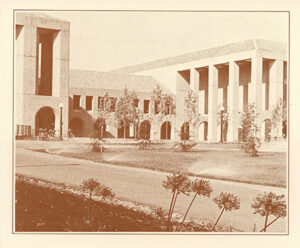
Four and a half years after Ehrlich started, the law school moved into its new home: the four-building Crown Quadrangle. One building housed faculty, staff, and the Robert Crown Law Library; classes took place in the F.I.R. Hall; the James Irvine Gallery linked the first two buildings; and behind them stood Kresge Auditorium.
A Presidential dedication
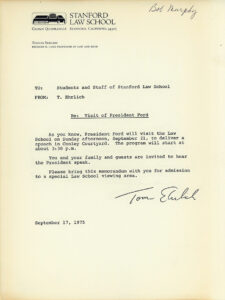
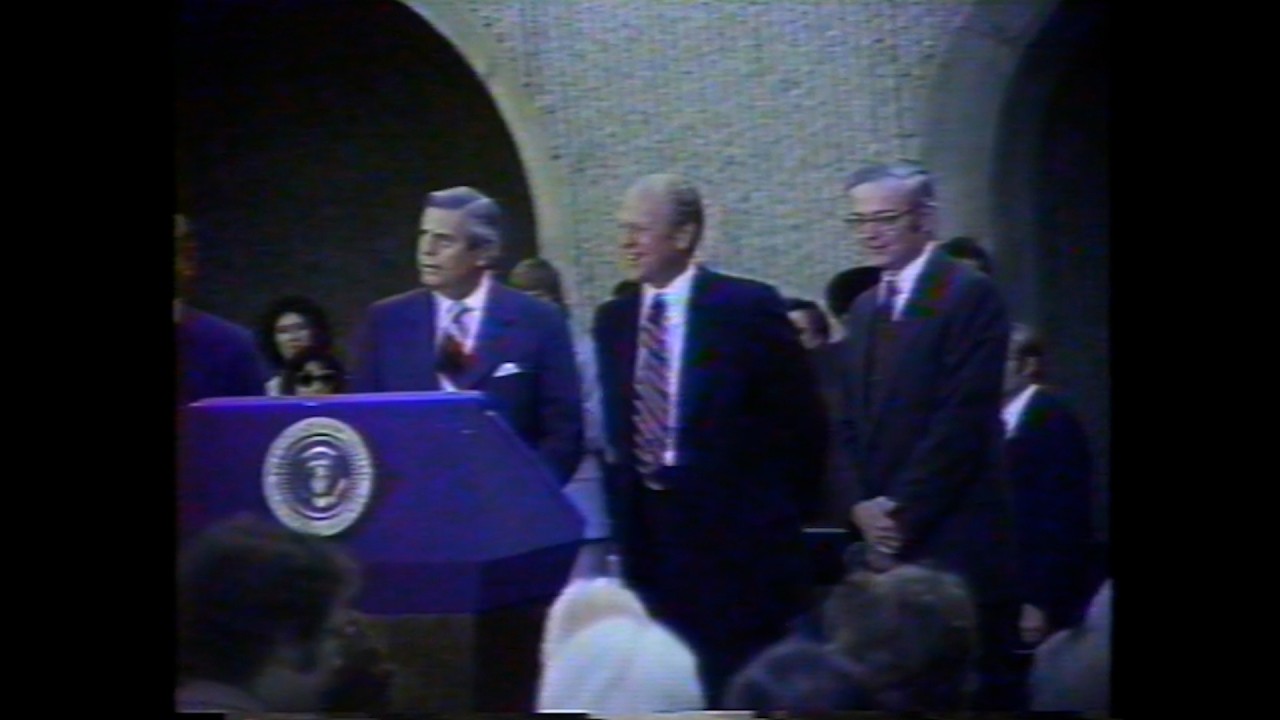
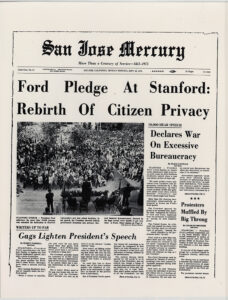
At the formal dedication on September 21, 1975, President Gerald Ford delivered the main address before a crowd estimated at 10,000. This was a good day in a dangerous September for President Ford in California. About two weeks earlier, on September 5, Lynette “Squeaky” Fromme, a member of the Manson Family, had tried to assassinate him in Sacramento. One day after the law school dedication, September 22, Sara Jane Moore tried to kill him in San Francisco. Happily, both failed, though Secret Service sharpshooters were stationed on the roof of a nearby building during the law school ceremony. According to a report in the Stanford Daily, Ford’s speech was received “politely but not enthusiastically,” with several hundred protestors among the attendees.
Roughly 475 law students and 35 faculty moved into a complex with 12 classrooms; a spacious library spanning three floors and the basement; offices for faculty and staff, student journals and organizations; and a beautiful moot court room. There was also a large faculty lounge and Kresge Auditorium, which seated over 600, big enough then for the entire student body, staff, and faculty. The school’s front courtyard was adorned with a loaned modern sculpture—“Four-Square (Walk Through)” by Barbara Hepworth. (It was replaced by Alexander Calder’s now iconic “Le Faucon” in 1979.)
“Another important feature of the new law school,” recalls Jim Liebman, JD ’77, “was its proximity to a large athletic field, which became a popular touch football and Ultimate Frisbee venue to which we all referred (courtesy of Michael Shepard’s, JD ’77, wry sense of humor) as ‘Justice Field.’”
My own memories
As an undergraduate from 1970 through 1974, I had the pleasure of taking a criminal law course—which met in a very full Dinkelspiel Auditorium—from the inimitable John Kaplan. Research for an assignment took me to the law school’s library in the Outer Quad, where I could barely fit (it had seats for about one quarter of the law student body). I watched the construction fencing go up around the rising Crown Quad—and enjoyed the graffiti that quickly covered it.
I attended law school on the East Coast, beginning in 1974, but I spent all my breaks in and around Stanford (and the Dutch Goose) with many friends in the Stanford Law Class of 1977. I took the BARBRI (bar review) class in the summer of 1977 in Crown, and I’ve spent the 41 years since I returned from exile and joined the Stanford Law faculty in 1985 in and around Crown Quad.
In the half-century since Crown Quad opened, much has changed. The uncomfortable, ugly, and easily breakable plastic swivel chairs in the classrooms were replaced by Aeron chairs; Kresge Auditorium is gone, replaced by the Neukom Building, now home to faculty offices and the vastly expanded clinics; five Munger dorms sprouted to house graduate students; and, most recently, the “garden level” of the library building was transformed to include classroom space.
But much abides. Crown Quadrangle was designed for a law school with a small student body, an excellent staff, and a substantial faculty, a community focused on learning and teaching, on practice and scholarship. The size of the first-year class grew from 150 to 180 with the move to Crown Quad, but there it has stayed, while the faculty has nearly doubled. Through four homes and 132 years, the essence of Stanford Law School remains unchanged. SL
Hank Greely (BA ’74) is the Deane F. and Kate Edelman Johnson Professor of Law and director of the Center for Law and the Biosciences. He was assisted in research for this essay by Henry Asher Segal (BA ’26) and Robert Crown Law Library staff.