
Criminal Justice and the Threat to Democracy
Reform the criminal legal system to safeguard democracy, argues David A. Sklansky in his new book
When he was a federal prosecutor in Los Angeles in the 1990s, David A. Sklansky often participated in the selection of juries. “I would hear potential jurors talk about their views about criminal justice, the police, and about crime in their neighborhoods, and I was repeatedly struck by how complicated and nuanced those views were,” says Sklansky, author of the recently published book Criminal Justice in Divided America: Police, Punishment, and the Future of Our Democracy (Harvard University Press).
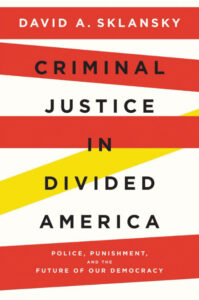
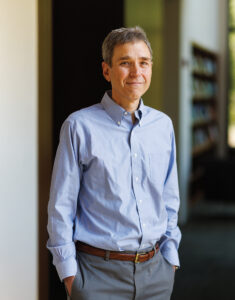
The Stanley Morrison Professor of Law since 2015, Sklansky has long focused his scholarship on the criminal justice system, identifying where the system has gone wrong and advancing ideas for how it can be made right.
“Especially the people who lived in communities that were impacted both by crime and bad policing—and those are often the same communities—they don’t have the luxury of simple ideas about criminal justice,” he says. “Those conversations with jurors have, for me, long underscored the idea that we need to take seriously the complexities of our communities if we want to tackle the challenges facing our criminal system.”
What’s more, as Sklansky argues in his new book, the failures of America’s criminal justice system—from overly harsh sentences and prosecutorial abuses to the underutilization of the jury system—don’t just harm individuals; they erode the very foundations of democratic governance.
“The failures of the criminal justice system and the dangers democracy faces today are strongly linked,” says Sklansky, who serves as the faculty co-director of SLS’s Criminal Justice Center. “Anyone who cares about democracy needs to care about criminal justice.”
This means starting with the understanding that in a divided, highly pluralistic country, criminal justice reform won’t be accomplished through partisan assertions about “defunding the police,” he says.
To achieve pluralism’s twin goals of political equality and social peace, Sklansky says, “we need to start with the recognition that our country is deeply divided, our communities are complex, and for criminal justice policies to succeed, we need to be able to draw support across the political spectrum.”
And the stakes are high: “It’s hard to think of an area of domestic policy other than criminal justice where American democracy has failed as spectacularly over the past several decades, or with worse consequences,” Sklansky wrote in a recent essay in Politics and Rights Review. “It is hard to be upbeat about the country when you lack confidence that government’s bluntest tools—the police and prisons—will be used fairly and in a way that keeps you safe.”
The failures of criminal justice are not the only reason for the poisonous condition of politics in the United States, Sklansky stresses, “but policing, prosecution, and punishment played a large role in creating those politics.”
Renewed Community Policing
Criminal Justice in Divided America is a follow-on to Sklansky’s 2007 book, Democracy and the Police, which addressed the connection between democratic theory and the legal regulation of the police. “The turn of world events over the last decade has made me rethink some of my earlier ideas about democracy in ways that I think it’s made a lot of people rethink some of their earlier ideas about democracy,” he says. “It’s made me more appreciative of the importance of pluralism in any account of democracy. I wanted to return to some of the questions that I had addressed in the earlier book, but also widen the lens.”
“The failures of the criminal justice system and the dangers democracy faces today are strongly linked.”
Criminal Justice in Divided America trains a hard lens on virtually all aspects of the justice system: the politics and history of race and crime, abusive policing, mass incarceration, how judges are selected, the jury system, the rise and fall of community policing, fear of crime—both legitimate and unduly influenced by media coverage—and prosecutorial power, among a swath of other topics.
In the realm of police reform, for example, Sklansky lays out a vision for both supporting law enforcement and providing oversight. “It’s a big mistake to ignore the need to have significantly more oversight of the police and to work energetically to reduce police violence and to reduce bias in policing,” he says. “On the other hand, it’s a great error to suggest that people’s concerns about crime are illegitimate or don’t deserve to be addressed just as energetically.”
Community policing, once widely accepted across the political spectrum, fell out of favor over certain remediable blind spots, Sklansky says. Community policing can succeed though, he says, if it can be more “clear-eyed about the diversity of communities.”
“Many community policing programs listened to older people, to homeowners, and property owners, but not to young people or the unhoused,” he says. And that was a huge mistake.
Stronger Juries
Sklansky also advocates for a revitalization and rethinking of the jury system. Juries are a “powerful instrument of democracy,” he says, in part because they model the kind of reasoning across differences that democracy requires.
He calls for reforms to ensure that jury pools are more diverse and representative, including practical measures like providing child care and offering adequate compensation for service. “We say jury service is important, but we don’t act like it,” he notes. “If we gave jury service the attention we give to improving cell phone service, we’d be in a completely different world.”
Sklansky also advocates for reducing the dominance of plea bargains in favor of increasing the number of jury trials. The processes of criminal justice—including trials, sentencing hearings, and procedures governing probation, parole, and clemency—are at the heart of democratic pluralism, he says, and reforms that strengthen these processes can enjoy support across the political spectrum.
Similarly, he says, we are in a moment when there might be a window for reining in prosecutorial power in a way that draws bipartisan support, “bringing together people on the left who have long been concerned with the way in which excessive prosecutorial power can lead to overcriminalization and to racially disproportionate patterns of prosecution, with people on the right who are concerned about progressive prosecutors engaged in what they see as politicized prosecutions, including the criminal cases against Donald Trump.”
Reason for Optimism
Despite the deep divides in the country and the pressing criminal justice challenges Sklansky has tackled over the course of his career, he says he remains optimistic. He has to be: “If the failures of criminal justice are at the heart of our political divides, then reform is essential for repairing our democracy.”
If we can employ the right models for reforming criminal justice, he says, those efforts could even serve as a model for reforming other parts of government.
“There are actually substantial areas of overlap between people on the left and people on the right with regard to many of the problems of criminal justice,” he says. “For example, there has long been a consensus across the political spectrum that punishment in the United States is often excessively severe. I don’t mean that everybody in the United States believes this. But a majority of Americans believe this, and that belief is shared by many people on both sides of the political spectrum.”
Donald Trump’s signing of the First Step Act during his first administration, which “was a significant step forward in reducing excessive criminalization and mass incarceration,” offers evidence of this, says Sklansky.
“There are lots of reasons to be concerned about our American politics today and in the coming years, but there are also ways in which the current political moment might give us a window for thinking productively about prosecutorial power, the police, the jury system and excessive sentences, and more.” SL