
Former DOJ Lawyers Discuss Duty, Integrity, and Public Service During Stanford Law Panel
How should government lawyers respond when political demands are in tension with legal principles? And what happens when the guardrails meant to protect the Department of Justice’s independence begin to fail? Those questions, among others, drew a standing-room-only crowd for a lunchtime panel on April 2 at Stanford Law School, with more than 300 Stanford alumni also watching by livestream.
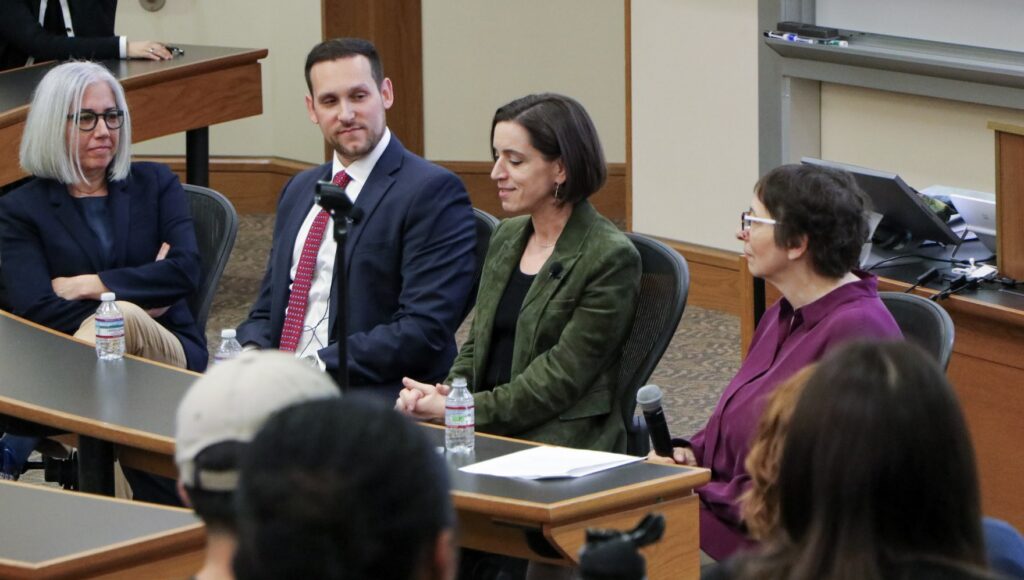
“Principles Under Pressure: Former DOJ Lawyers on Power, Ethics, and Democracy” was presented by the Deborah L. Rhode Center on the Legal Profession and the Neukom Center for the Rule of Law. The event brought together former DOJ lawyers Greg Rosen, Liz Oyer, and Stacey Young in conversation with Pamela Karlan, Kenneth and Harle Montgomery Professor of Public Interest Law who served twice in the DOJ’s Civil Rights Division.
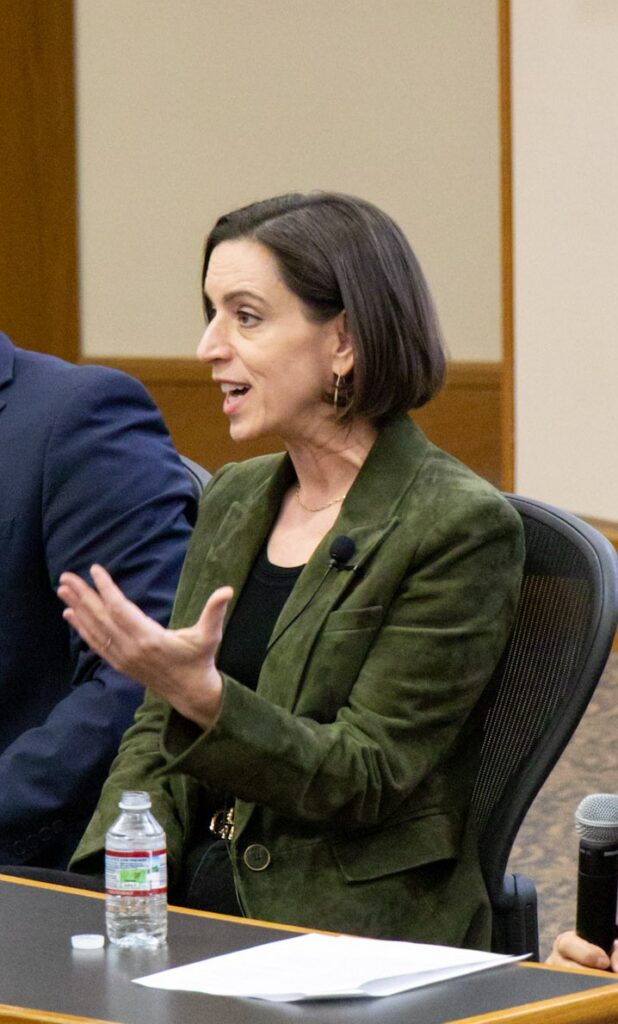
The conversation focused on what the lawyers experienced inside the department from the first Trump administration through the second, and on the decisions that ultimately led each of them to leave or be fired. Rosen, a former assistant U.S. attorney in Washington, D.C., supervised more than 1,000 prosecutions arising from the January 6 attack on the U.S. Capitol. Oyer served as U.S. pardon attorney until she was fired in March 2025. Young spent 18 years at the DOJ, including in the Civil Rights Division, before founding Justice Connection, a network that supports current and former DOJ employees.
Karlan opened by recalling the honor of representing the United States in court, a theme that carried through the conversation. Each panelist began by describing what had drawn them to public service. Oyer spoke about clemency and the need for mercy in the criminal justice system; Rosen described a long-standing pull toward prosecution and government work; Young said she was drawn to the department by the chance to handle complex litigation in service of the public.
Oyer said that when the new administration took office, she initially tried to find ways to continue clemency work, including priorities tied to the First Step Act. Instead, she said, her office was redirected toward restoring gun rights to people disqualified by criminal convictions. The breaking point came, she said, when she was asked to recommend restoring gun rights to actor Mel Gibson, said to be a friend of President Trump. Oyer told the audience she could not make that recommendation based on the information before her, declined an invitation to reconsider, and was escorted out of the building that same day. “Once you compromise your integrity,” she said, “you cannot get it back.”
Rosen described a similar shift from institutional continuity to something far more destabilizing. He said DOJ lawyers understood that the president had the constitutional power to issue the January 6 pardons and implemented that order. What followed, he said, was another matter. Two weeks later, he said, assistant U.S. attorneys who had worked on those cases were fired, and he was demoted. By that point, Rosen said, “the job that I loved no longer existed” in the same way.
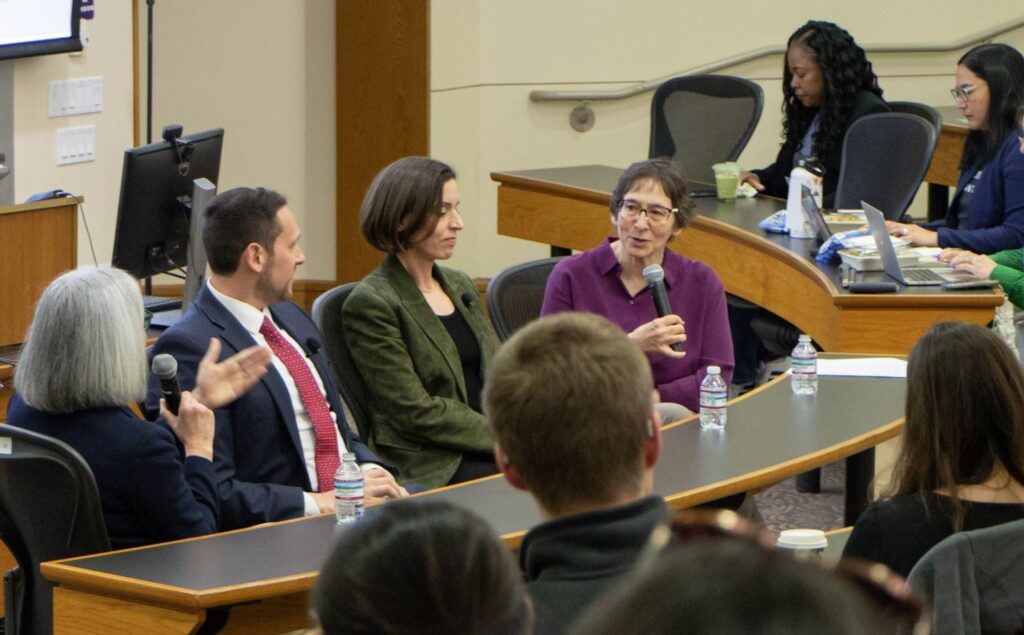
Young focused on the department’s internal guardrails and how vulnerable they are when norms are no longer honored. For decades, she said, the DOJ relied not just on law but on custom, tradition, and the expectations captured in the DOJ’s Justice Manual. “If there’s no adherence to norms, and there’s no enforcement mechanism,” she said, “then of course an institution can just be torn down.” Young said any future rebuilding effort would have to do more than restore old assumptions; it would have to make key protections more durable and enforceable.
Even so, the panelists did not argue that young lawyers should turn away from government service. Young said the department’s “backbone” remains its career workforce, not its political appointees, and stressed that many current employees are doing essential work under difficult conditions. Rosen made a similar point to students in the audience, saying that “good people should join” the DOJ, even if they now need to enter with a clear understanding of how political the institution may have become and where their own red lines may lie.
Listen to the panel recording on the Stanford Legal podcast
About the Deborah L. Rhode Center on the Legal Profession
Through a multidisciplinary approach to teaching, research, and policy, the Rhode Center works to make civil justice more equitable, accessible, and transparent and to promote the legal profession’s commitment to the public interest. To learn more, please visit the Rhode Center website. Sign up for event announcements and follow the Rhode Center on LinkedIn.
About the Neukom Center for the Rule of Law
Building on Stanford Law School’s long-standing leadership in promoting the rule of law, the Neukom Center for the Rule of Law brings together research, teaching, and practical initiatives to strengthen accountable governance, fair laws, and accessible justice worldwide. Established in 2022, the Center serves as an interdisciplinary hub that connects scholars, practitioners, and policymakers. Through research, teaching, and public dialogue, the Center advances understanding of how strong legal institutions and civic engagement sustain the rule of law as the foundation for justice and good governance everywhere.