
When Government Lawyers Draw the Line
Former Justice Department officials reflect on an institution at a crossroads
Former Department of Justice pardon attorney Liz Oyer describes being pulled out of a meeting, told to pack up her belongings, and walked out by security the same day. Her offense, she said, was refusing to recommend that the attorney general restore gun rights to a politically connected celebrity without the information she believed was necessary to make that judgment safely. “Once you compromise your integrity, you cannot get it back,” she said.
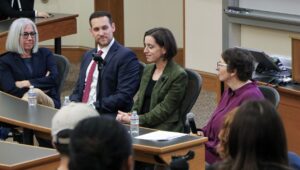
That moment sets the tone for a candid conversation about what it means to serve inside the Department of Justice, and what happens when career lawyers believe the institution they devoted themselves to has changed. Moderated by Stanford Law professor Pam Karlan, this episode brings together Oyer, former Assistant U.S. Attorney Greg Rosen, and former DOJ civil rights lawyer Stacey Young for a discussion of public service, prosecutorial independence, clemency, civil rights, professional ethics, and the difficult questions of when to stay, when to leave, and when to speak out.
The panel, recorded at a live law school event and presented by the Deborah L. Rhode Center on the Legal Profession and the Neukom Center for the Rule of Law, offers a close look at the professional obligations of government lawyers from people who spent years doing the work: Rosen supervising more than 1,000 prosecutions stemming from January 6; Oyer overseeing the federal pardon process and thousands of clemency petitions; and Young working in the Civil Rights Division while also founding the DOJ Gender Equality Network. Karlan, herself a former DOJ official, draws out the deeper questions behind their stories.
This episode originally aired on May 14, 2026.
Transcript
Liz Oyer: I was walked out of the building by security officers. I was pulled out of a meeting with about 25 people from different offices in the Department of Justice and I was told to pack up my things, and I was out the door the same day. It was pretty shocking. Once you compromise your integrity, you cannot get it back. So I wouldn’t have changed how I handled that situation at all.
Pam Karlan: This is Stanford Legal, where we look at the cases, questions, conflicts, and legal stories that affect us all every day. I’m Pam Karlan. Please subscribe or follow this feed on your favorite podcast app. That way you’ll have access to all our new episodes as soon as they’re available.
Welcome. Thanks to the Rhode Center for putting this together because I think we’re going to have a really wonderful panel. In addition to the folks we have in the room, this is a great turnout, especially considering that the third years are not here because they all have to be at their mandatory, “so you want to take the bar and be a lawyer” event. And we also have, I think, about 300 alumni who are watching on Zoom, so we really appreciate it. It is such an honor to get to share this kind of table “dais,” lectern or whatever with Greg and Stacey and Liz—people who left DOJ with honor.
For me, one of the proudest times I got to spend in my entire legal career was getting to work at the Department of Justice. I think there’s really nothing like getting to stand up in court and say, “Pam Karlan for the United States of America.” And I know you especially got huge numbers of opportunities to do that over the years. And the opportunity to do that is something I hope all of you get a chance to do at some point in your career. And we’re going to talk about those careers here today.
Greg Rosen was an Assistant U.S. Attorney in the U.S. Attorney’s Office in the District of Columbia for years and years. Before that, he was actually a state prosecutor in Loudoun County. He supervised more than 1,000 prosecutions that came out of the January 6th events, and it was the largest single prosecution effort in U.S. history. And earlier in his career, he also tried fraud and embezzlement cases, as well as violent crime cases in the U.S. Attorney’s Office.
Liz Oyer was a public servant at the other node of the federal government for many years. After starting her career at Mayer Brown, she spent 10 years as a federal public defender in the District of Maryland. And then in 2022, she was appointed as the pardon attorney at the United States Department of Justice, which is an incredibly important position, or I guess it should say, “used to be” an incredibly important position when there was actually a process for deciding who was going to get pardons. And that was her job overseeing that process.
And finally, Stacey Young was at the Department of Justice, at Main Justice. She spent a number of years initially in the Civil Division where she defended the government’s immigration laws and policies. And then she moved over to the Civil Rights Division, which is where I knew her from, where she worked in what was called the IER, but is actually Immigrant and Employee Rights section. And it’s a section that deals with the employment rights of people who are legally entitled to work in the United States to prevent discrimination either against or in favor of people with work authorization relative to citizens, and an incredibly important job. And I think probably of the sections in civil rights, the one that punched highest above its weight because it was so small and yet it did such important work.
So, I wanted to start by asking you, because we’re going to be talking about you’re leaving the Department of Justice, I wanted to start by asking you what drew you to your DOJ jobs? Because I think to understand why you left, people have to understand a lot of why you went into these jobs in the first place. So maybe we’ll just go down the row and have you all tell the folks here in the audience what drew you to those jobs initially.
Liz Oyer: So mine is probably a little different from the others because I had been a public defender litigating against the Justice Department for a very large part of my career. But I sincerely believe that there is, and must be, a place for mercy in the criminal justice system and sometimes the justice system produces results that are quite harsh, sometimes deservedly so, and sometimes perhaps excessively so. And I believe that virtually every person is capable of redemption and earning the opportunity to have a second chance. And so I really believe in this prerogative of mercy that is vested with the president through the pardon power, and I wanted to be part of the team of people that advise the president on how to use that power to its maximum effect.
There are thousands of people right now who are incarcerated, who’ve been incarcerated for decades, and have really demonstrated persuasive rehabilitation, who ought to be considered for second chances through clemency. And that’s what drew me to the work of pardon attorney, being able to advise from within the Justice Department, which is the most powerful law enforcement agency in the country, about how to be merciful in dispensing criminal justice.
Pam Karlan: And how did you get the job?
Liz Oyer: That’s actually a great question. I think people often assume that the pardon attorney is a political appointment because you’re advising the president, but it’s actually not.
It’s a career position in the Justice Department. I applied for a posting on USA Jobs. For those of you who are familiar with federal employment, that’s like the central repository for all of it. I sent in my resume, heard nothing for six months, and assumed that I had zero chance of being considered for this position, as somebody who had made a number of … I won’t say “enemies,” but I’d been toe-to-toe with a lot of people in the Justice Department over the years and I didn’t think there was any chance that I would be hired. And I was frankly shocked when six months after submitting my application, I was called in for a series of interviews and was given the job.
Greg Rosen: So, my father is a retired federal law enforcement agent. My mom was a nurse, is now a nurse practitioner. And I watched my parents give and give to either local communities or public service. And so, I always knew that I wanted to go into government work. When I came out of law school, I was desperate to go into prosecution and the thought process that I had, ignoring the fact that I really just wanted to go into trials and just do a lot of in-court work, one of the things that drew me was, to your point, the power that the prosecutor has in achieving justice. It’s a lot of discretion. It can be abused. And so, the idea of using that power in a way that, frankly seemed righteous, seemed good, something as simple as that, really gravitated me towards the profession.
And then when I did it, I was a prosecutor in Loudoun County, Virginia, Northern Virginia, if you’re familiar. And I really enjoyed my time there, but I had always…the calling to work on behalf of the United States is something that, really, it’s like in the heartbeat. And I frankly thought I was going to be a government guy my whole life.
Stacey Young: So I worked in the reproductive rights field for a couple of years after law school, and after doing that for a while, I decided that I really wanted to try to do something that involved more hard-hitting litigation and DOJ made perfect sense for that. I never wanted to work for a law firm, and the idea of working for the government, at DOJ, was just very appealing to me. And I specifically wanted to work in the Civil Rights Division, but I wasn’t fancy enough to get in. So, I applied to a number of different jobs and took the first one I got and thought I’d really try to get to the Civil Rights Division. And it took 13 years to do that, but eventually I did get there.
But like Pam is saying, there really is nothing like standing in court and saying, “Stacey Young for the United States.” It’s such an honor. There’s so much gravity to that and you just can’t do that anywhere else.
Pam Karlan: One of the things that I wanted to ask you about is, especially in our clinics here, we often talk about “client centered lawyering.” And one of the things I wanted to ask you about is how you fought about who your client was in the various cases that you had in front of you? How did you think about to whom your obligations ran? And maybe we can come down the opposite way. Because one thing interestingly about your career at DOJ, Stacey, is you started off in a position where you were defending the government and then you moved into a position which was really litigating against other people as the government. Did that change your thinking about who your client was and how to approach that client?
Stacey Young: Practically speaking, it felt very different—defending the government and representing the interests of individuals who were experiencing, who had experienced, civil rights violations, it, there was a different feeling to it. But in both jobs, I really did feel like I was representing the United States. I always meant that when I said it or wrote it. And there were times, certainly, when I did not agree with what I was defending, and that’s a part of the job. These jobs are apolitical jobs and that really means something.
DOJ lawyers don’t just leave when they just have a policy disagreement with the cases they handle. That very rarely happens. You have to really be willing to defend the government in cases where you may find that some of what you’re defending is morally reprehensible. And you want people with a conscience, with a moral compass, with an allegiance to upholding ethics handling, difficult cases. I always felt like I was representing the people, the government, regardless of what side of the “v” was on and what kinds of cases I was handling.
Greg Rosen: I certainly didn’t think the…
Stacey Young: Beat that answer, Greg.
Greg Rosen: I didn’t think it was the president, how’s that? I agree with you. I thought it was the United States or maybe the community that I was representing. So, for me it was the District of Columbia. It was, frankly, to use your words again, it was an honor, but it was also something that, up until sort of recent memory, was not something I had to think very hard about. When I said, “Greg Rosen on behalf of the United States,” it was about the United States, and it wasn’t about whoever was poetically in charge. It wasn’t even about who the attorney general was or who my direct supervisor was. And I think that a lot of the norms that we now take—or we had taken for granted, which are now playing out in real time, are something that was somewhat like a priori knowledge. We just instinctively knew who we were representing up until that point.
Pam Karlan: One thing that strikes me about this is that both Stacey and Greg both worked for a lot of different administrations over the course of their careers. How much difference did it make to the work you were doing, who the administration was? I still think back to the first case that I argued when I was arguing cases for the NAACP Legal Defense Fund.
We had the George H.W. Bush administration sharing time with us. They intervened in the case on our side, and I ended up holding the oral argument time, with of all people, Ken Starr. And so there wasn’t this sense … there was a sense that things changed in some ways the big priorities, but the day-to-day work didn’t change that much. Was that your experience?
Greg Rosen: Yes, so I was hired in 2015, under the last few years of the Obama administration. When Trump came in, there were a lot of policy shifts. Jeff Sessions came in and implemented a number of changes when it came to proving the most or charging the most readily provable offense.
I was working both in superior court and district court because DC is a unique jurisdiction, where we prosecute both local and federal crime. But the day-to-day did not change. The policies changed and I, as an American citizen, had feelings on those policies, but we implemented it. In the same way that frankly, when Trump 2.0 came in, in the first order was … I guess now I look back on it, not surprisingly, but the executive order relating to the J6th pardons, the team looked at it, determined it was … what however we felt it was a lawful order. It was a constitutional order. The president has the constitutional prerogative to pardon and we implemented.
Pam Karlan: How did you discuss this with the team of people? You had a huge number of prosecutors that you were working with here.
Greg Rosen: Yes, without getting into how the sausage is made and the attorney-client privilege components of it, we obviously, you look at … you look at the face of the order and you determine whether or not it is in fact unconstitutional or inconsistent with ethics or values. At the end of the day, you sometimes advocate in ways that you don’t necessarily personally agree with. And that was clearly the case on day one. And we knew that going in—not quite how expansive it would be.
Pam Karlan: Yes, it, one of the questions that comes out of this is, your account is: you got an order, whether we agree with it or not, it’s a lawful order from the president, who gets to make these decisions. We’ll come back to you on the pardoning part of this in a moment. And did it surprise you that the administration didn’t view that essentially as the end of the business—that is the people in the U.S. Attorney’s office are going to follow this order and now we just move on to whatever our next thing is? Because that I think is the more surprising piece of this from, at least as an outside observer.
Greg Rosen: I have said this to many people. I cannot believe in some ways that we’re still talking about some of these issues. Not because they’re not important to me or they’re not to any person in the audience, but because they keep going back to these like very controversial things that are not particularly helpful to justice or the American people.
And so yes, to your point, there was a naive part of me that thought it would be implemented and then move on to the next thing and DOJ continues plugging along and that’s not what happens.
Pam Karlan: You might want to tell people what actually did happen because I think not everybody here is aware of that aspect. I think everybody here knows about the pardons, but then there’s also what happened to the assistant U.S. attorneys who’d been working on the cases.
Greg Rosen: Yes, so 15 probationary employees, meaning they were within their first two years of service, which means that they can be fired a lot easier, they were terminated pursuant to the then-acting Attorney General James McHenry, who’s still within the department.
They were given a letter that essentially said that because they had been part of, again, to parrot the phrase of the pardons, a “national injustice,” they were being let go. These were people who came from big law, small law, prosecutors’ offices—everywhere—who committed themselves to a particular cause in an apical fashion, and they were basically tossed to the side. Which is ironic because the administration has talked about how it cares about violent crime and all of those individuals were slated to go help prosecute cases in DC Superior Court, which was the “make DC safe again” mantra. So, it’s all very inconsistent. And then, it just the hits keep coming.
Stacey Young: I think most lawyers at DOJ really don’t notice much of a shift across administrations and that’s how it should be, because you’re there to enforce the law. You’re not there to enforce the president’s political agenda. So very few people really feel much of a change.
I felt more of a change than most because of the nature of my work while I was there. President Trump’s immigration policies are, I think…draconian. So, and they needed to be defended by the Department of Justice. So when I was there, our work really ramped up, as a result, but that was unusual. And then, I was in the Civil Rights Division and the President isn’t a huge fan of civil rights. So the way it works…
Pam Karlan: What do you mean? He is created a whole new section of the Civil Rights division that never existed before.
Stacey Young: Do you want to share what that section addresses?
Pam Karlan: The Second Amendment.
Stacey Young: The Second Amendments?
Pam Karlan: Yes. We now have a Second Amendment section…
Stacey Young: Yes. Which that second…
Pam Karlan: of the Civil Rights Division.
Stacey Young: Yes. Which the Civil Rights Division now believes is the first, the most important amendment. So they’re trying to rename it “the First Amendment.” That’s about…
Pam Karlan: No, they’re not really, are they?
Stacey Young: No.
Pam Karlan: Okay. Because the first time I saw that they created this…
Stacey Young: it’s a dumb joke.
Pam Karlan: I mean, the first time I saw that they had created the Second Amendment section, I thought it was actually the Borowitz Report. And so I went to the official DOJ CRT website to see what was actually there because…
Stacey Young: It was good, he’s been on fire recently.
Pam Karlan: Yeah. But I, I was of…but the Civil Rights Division actually does change, I think at least certain parts, of the Civil Rights Division are probably the parts of DOJ that change the most from administration to administration.
Stacey Young: That’s right, especially the Voting Rights section changes dramatically from administration to administration, but actually a lot of the work doesn’t change all that much.
Pam Karlan: But the people stayed during ….. One of the things that surprised me when I came back in January of 2021 to the department where I was running the civil rights division until we got a confirmed head, was just how many of the people who were senior people had stayed. A lot of the very junior people had left during the Trump administration, but, the managers of most of the sections were the same people. Alberto was still there and the like. And they had not found it intolerable the first time around.
Stacey Young: Yeah. And they did a lot of work to make sure that the division maintained its integrity. They did a lot of behind-the-scenes work. So yes, you don’t see a lot of civil rights lawyers leave depending on who is in the White House. And again, like the voting rights work definitely slows down during Republican administrations, but most of the offices aren’t that affected. A lot of the education work…
Pam Karlan: … and the criminal…
Stacey Young: … employment discrimination work
Pam Karlan: doesn’t change.
Stacey Young: Most of the criminal work doesn’t change.
Pam Karlan: Special litigation does, which is the special—that’s the institutional reform part of the Civil Rights Division. They change, but…
Stacey Young: Disability Rights Work doesn’t really change… But the managers are so committed to the mission that they know that just leaving because of somebody you know, not prioritizing their particular work, is going to leave their jobs open to people who are not as experienced and competent.
So yeah, you don’t see a lot of turnover really anywhere. You, before this administration, you really didn’t see much turnover at all across administrations.
Pam Karlan: Yes and in addition to, I should say, in addition to the work you were doing as your kind of day job inside of DOJ, you had another job inside of DOJ involving gender equity. Do you want to say a little bit about that job and how that job evolved over time?
Stacey Young: Yes … it wasn’t a job, it was just volunteer. And this was this was, by far, the highlight of my DOJ career. In 2016, after Trump was elected the first time, I started an organization called the DOJ Gender Equality Network because they knew that there were serious gender equity issues in the Department of Justice that had been around for many years.
There was a very serious sexual misconduct problem that went largely unaddressed. There were pay inequities that were not addressed properly. There was no paid parental leave for DOJ or any federal employees. There were very few women in upper leadership positions, and I realized that there was a lot of chatter at the time about these and other issues concerning gender equity because we had just selected a president who made it clear that gender equity was not a priority of his, to put it mildly. So, I decided to try to harness a lot of the energy that I was feeling at the department and I started an organization and it just took off and we became a really effective policy advocacy organization.
We changed the sexual misconduct policy at DOJ and got a new unit created that now centralizes DOJs response to sexual misconduct. We advocated for paid parental leave that resulted in federal legislation that now provides federal employees with three months. We got OPM to promulgate a salary history ban, so now you can’t ask prospective federal employees about what they used to make at prior jobs.
Pam Karlan: You might want to explain why that’s actually important to…
Stacey Young: Yeah, so until …. there were 21 states, at the time when we were advocating for this ban that had prohibited employers from asking for past salary when people were applying for jobs because, traditionally women, there’s a pay gap. Traditionally, women make less money than men and those pay inequities carry over when employers base salary on what you used to make. And this was very … to me, and I thought, the federal government really leads the way in many cases when it comes to it’s the largest employer and it leads the way when it comes to, employment practices.
And I thought the federal government should absolutely be leading the way on this. It is preposterous that, at the time, even the Civil Rights Division asked for past salary. So I was like, this is bullshit—we need to change it. And we approached OPM and lobbied for months and months for the salary history ban and under the Biden administration, they promulgated it. And the ban even goes further than what states had done by prohibiting, even considering past salary history, not just a solicitation ban. So it was a really important measure. And more states since then have followed that path.
So anyway, we did a whole lot of stuff around a whole lot of issues. And, I’ll say, we also became an organization that people would go to when they were experiencing problems in their own offices. If they wanted to get breast milk shipping services covered, they came to us to advocate to their managers to make that happen.
They came to us when they weren’t getting the paid parental leave that the law required. They came to us if they were being sexually harassed by their manager and didn’t know who to go to. And we became really, in addition to a policy advocacy shop, a direct services provider. And I knew that the second Trump administration was going to shut us down. They tried to in the first administration and they did, and that’s why I decided to leave the department and start a new organization called Justice Connection. That kind of is an expansion of DOJ GEN and provides direct support to DOJ employees who are still there.
Yes, so Liz, when you became Pardon attorney, what were your priorities? How did you pick the priorities you were going to have?
Liz Oyer: So the priority was largely on the commutation side in terms of numbers. We had when I became pardon attorney, about, over 18,000 applications pending from people around the country seeking clemency from the president. And most of those were people who were incarcerated, serving very lengthy sentences—in many thousands of cases, people serving life sentences—and clemency was really the only possibility for release from incarceration, before these folks died. And we got stacks and stacks of mail every single day from people in prisons, from their families, from sometimes counselors in prison facilities, really advocating for these folks in many cases. And the priority was to be able to address as many cases as possible and make as many recommendations for relief to deserving people as possible. That generally the focus was on people who were serving sentences that were longer than the sentence they would likely receive today, which due to some criminal justice reform legislation passed during Trump’s first presidency, is many people. He passed a law called the First Step Act, which significantly reduced mandatory minimums for recidivist drug offenses, as well as for certain types of offenses involving the possession of firearms. And there are thousands of people applying for relief because they would not be sentenced to life in prison today, but there they were subjected to a mandatory life sentence years ago. They’ve served decades of that sentence. They’ve demonstrated rehabilitation and they really have no avenue of relief through the courts because this law was not retroactive. So that was a huge priority for us, addressing as many of those cases as possible. It turned out that it was a bigger priority for me and my office and it was for the president under President Biden.
And it was not a priority at all for the Trump administration when they came into office. My tenure lasted about seven weeks into Donald Trump’s second term before I was very abruptly fired. But by the time I was fired, the nature of the office and the mission that we were tasked with has changed completely and really shifted entirely away from making clemency recommendations to the president.
Pam Karlan: I think it might be useful before I ask you a follow up question on that—for you to explain the difference between a commutation and a pardon?
Liz Oyer: Yeah, that’s a great question. So, a commutation is a reduction in sentence, and it’s typically a reduction in the imprisonment portion of a sentence only. A pardon is essentially forgiveness for a crime that has been committed. So, commutations are usually granted to people whoare still serving their sentence and they don’t erase the crime from your record. They don’t forgive or excuse the crime, they just let you out of prison early. A pardon has the connotation of being forgiven for a crime, but that also does not expunge it from your record.
Most people who are considered for pardons under the DOJs longstanding guidelines are people who have served their entire sentence, paid all of their debts to society, including any debts that they might owe to victims of their crimes, and demonstrated very persuasive rehabilitation over a lengthy period of time in the community.
So, most people who get pardons have been out of prison and completed their sentence for at least a decade, in many cases, significantly longer than that. And the collateral consequences that people continue to face, even when they’re 20 years out from a criminal conviction, are very serious. People who are parents and grandparents often can’t go to school events because the criminal conviction prohibits it.
There are barriers to housing, to employment, to professional licensing. In many states, you can’t be a barber or a cosmetologist, if you have a criminal conviction. Really all manner of employment can be affected. So, for many people, a pardon is the only way of moving past some of those enduring collateral consequences from their conviction.
Pam Karlan: Yes, and I just want to highlight a couple of things there that you said. One of which is that generally people who were pardoned would have paid their debt to society. So, for example, if you were a white collar criminal and you had defrauded a bunch of people, the pardon wouldn’t come to you until after you had repaid the people who you had defrauded.
Liz Oyer: Yes, that’s right. Usually, pardons are reserved for people who’ve committed lower-level offenses as well. So historically, I am not aware of any examples of people who’ve committed massive white collar fraud schemes receiving pardons. We’ve seen a lot of that under the second Trump administration and some under his first administration as well. But typically, the profile of a person seeking a pardon would be somebody who committed a small-dollar financial crime or a low-level drug offense, a nonviolent type of crime, and not a crime that caused significant financial losses to any victims.
Pam Karlan: Yes, one of the things that’s been so striking, there have been a couple of stories in the both the Washington Post and the Times about this is the number of people who got pardons after January 6th, who have subsequently been arrested again for violent crimes or who are now arguing that the pardon should extend to crimes committed not exactly on January 6th … I think that’s a big change.
Liz Oyer: Yeah. The lack of any individualized vetting is a very big change. Historically, vetting has been an incredibly important part of the process. And in pardon cases, we would actually refer the case out to the FBI, so they could conduct a full background investigation to ensure that this was really somebody who was suitable for that relief. That vetting is not happening anymore. And I’ve been keeping close tabs on what has happened with some of these folks who’ve received pardons and then committed new crimes. Many of them are individuals who are pardoned as a result of the January 6th pardon. And just in March of 2026, just last month, we saw three people back in court for very serious new crimes.
There’s one who was sentenced to prison for possessing over 100,000 images of child pornography. There’s another who was sentenced to life in prison for sexually abusing two minors and then trying to bribe them to keep quiet about the abuse. There was a third who was arrested for assaulting women on the DC Metro system by…he was filming himself stroking their hair from behind. It was very creepy.
I’m sure we’ve only seen the tip of the iceberg because this is three people in a single month out of that group that we’re seeing back in court. And that is a real consequence that comes from not vetting the individuals who are getting pardoned.
Pam Karlan: Yeah, some of the people were even pardoned before they were convicted, I mean because it was…I think that was a surprise. The last time we had a blanket pardon of that kind of sweep must have been after the Civil War.
Liz Oyer: There…
Pam Karlan: and even there it was a sort of smaller group of people.
Liz Oyer: There have been pardon proclamations that other presidents have issued. There was one issued…
Pam Karlan: …was the amnesty, there was the amnesty as well.
Liz Oyer: Amnesty for those who evaded the draft was one after the Vietnam War. And then President Biden issued a pardon proclamation that pardoned possession of marijuana offenses—federal marijuana possession offenses. But that’s a very different type of offense because in those cases, there was literally not a single person at the time who was incarcerated for a marijuana possession offense.
In most cases, those were offenses that involved citations that were given for possessing marijuana on federal property. So it’s not unprecedented to have a blanket pardon, but what was different about this one was the fact that it grouped together disparate types of conduct, including conduct that involved violence, conduct that involved assaults against police officers, people who were at very different stages of legal proceedings, and it just pardoned everybody without any consideration of the victims of their crimes, the damage that they caused, or the danger that they would potentially pose to the community going forward based on their historical conduct. And that is something that we have not seen before.
Pam Karlan: So I wanted to turn now to a kind of tension that runs through the stories that you’ve all told here, which is about how do you decide whether to stay inside an institution, or to leave an institution, or to speak up inside an institution when you disagree with where it’s going?
Liz Oyer: Where would you like to start?
Pam Karlan: I mean, to some extent you didn’t have a choice of deciding whether to stay inside or not, but if you … if as you were thinking about that at, in the first, in the seven weeks, in the…
Liz Oyer: I did have some choices and I made some choices along the way and the choices that I made resulted in me getting fired and I would make all the same choices today if I had to do it over again. When the new administration came into office, I was delusionally preparing to work with them on clemency priorities. I had come up with a lot of lists and priorities and memos of things that I thought they might be interested in—trying to continue the work of The First Step Act, which was enacted under Donald Trump’s first presidency, through clemency.
And it all fell by the wayside very quickly. My office was essentially asked to shift focus to a program to restore firearm rights to individuals who had lost their right to own a firearm because of a criminal conviction.
A criminal conviction, a felony conviction, or a misdemeanor domestic violence conviction disqualifies you under federal law from owning a gun.
So, we were asked to shift focus and start working on this project, and it wasn’t, what I … my preference of what I wanted to be working on, but I was asked to do it and I was willing to do it. And my team was very worried at that time about keeping their jobs because we had DOGE in the background and people are getting laid off left and right.
And I was responsible for a team of about 45 people who were terrified about losing their jobs. So, I looked at it as an opportunity to continue to demonstrate our relevance to the work of the Department of Justice and to be team players, do what was asked of us, and carry on. And we were working on that, but I was then asked to do something that I really just could not, in good conscience, recommend and my refusal to do that resulted in me getting fired. I was asked to recommend that the Attorney General reinstate the gun ownership rights of a friend of the president, the actor Mel Gibson, who hopefully some of you are too young to remember.
He lost his right to own a gun because he was convicted of a very serious domestic assault incident involving his ex-girlfriend and mother of his child. And I was asked, essentially on the basis that he’s a friend of the president and was seeking this relief and is a famous celebrity, who actually was appointed Ambassador to Hollywood by Donald Trump, to recommend that he get his gun rights back.
And I simply did not have the type of information in front of me that would allow me to make the recommendation that he could safely be entrusted with a firearm. And I communicated to the Attorney General staff that I couldn’t make that recommendation based on the information that was available to me.
I was invited to reconsider my recommendation, reconsider my position. I declined to do that, and literally hours later, I was walked out of the building by security officers. I was pulled out of a meeting with about 25 people from different offices in the Department of Justice, and I was told to pack up my things, and I was out the door the same day. It was pretty shocking, but once you compromise your integrity, you cannot get it back. So I wouldn’t have changed how I handled that situation at all, in retrospect.
Greg Rosen: So I did want to say one thing about the pardons that you were talking about. Just because this is a very common misconception. A lot of people talk about the distinction between those who are convicted of trespass or misdemeanors in the January 6th context, and then those who are convicted of like assaults on police officers. And what a lot of people don’t realize is that on day one, those pardons, which were indiscriminate in nature and didn’t take into account all of the individualized characteristics that you just described, the people, they largely, if not 100% benefited, were the ones who were serving long sentences for assaulting police officers.
And so I can’t say that with a hundred percent certainty, but the people who benefited were not the … what you hear on the news of people, quote, “walking through the capitol on a tourist tour.” Ignoring the fact that did not happen. That but like those were the least culpable people, were not the beneficiaries of those pardons. To answer the direct question, I also naively thought we’re going to do our job, transition from one administration to the other.
I received a call on the night of the inauguration indicating that the executive order would be forthcoming relating to the pardons and commutations and that we would have to implement it. We had two juries going on at that time as well as, I believe, a bench trial. So that had to be like, basically stopped in the moment. Because we also didn’t want citizens of the District of Columbia who were serving jury service to have to come in, only to be told leave. So it became pretty clear, even with that part and in commutation order, like how the next few weeks would go. I was supposed to be transitioning with the closeout of the capital scene section, which is what our section was called.
I was supposed to be transitioning to be a supervisor within our violent crimes and narcotics trafficking section, which is actually my bread and butter of what I did before, and I was told that was going to be put on hold. And then two weeks later, the AUSAs who had worked for me were fired.
And then on February 28th I was demoted to a misdemeanor, what we call “papering” at the U.S. Attorney’s Office—so the intake warrants, charging cases, which frankly, is actually a pretty important job if you’re in the office, but obviously Mr. Ed Martin did not think it was because that’s where he put all of us. We have a really nice email where he said that this change was not temporary. And it was pretty clear to me at that point that there just wasn’t … I don’t know if there wasn’t a place for me, but the job that I loved and the job that kept my blood going through the years, didn’t exist anymore.
And I can’t say, I know it’s easy to distill it down to some simple phrase. I can’t say actually that the January 6th pardons were like the, “but for” reason. It was, there were so many things happening and it just became clear to me that it was time to explore options. And then, I was searching and doing all of my interviewing and then the Perkins Coie order dropped, the executive order basically vindictively going after law firms for having taken up causes that disagreed with the president. And it was an eye-opening moment in terms of how the legal field reacted. And I realized I needed to find a place that sort of, that I enjoyed, embraced me for me and the like.
Pam Karlan: One thing just to say to people is that a number of the executive orders went after the law firms explicitly saying, for example, that a firm had a lawyer at it who had been involved in the special counsel’s office or prosecutions, or the like. And I know that you’ve gone to a very well respected boutique firm in DC.
Greg Rosen: Actually, San Francisco, they’re based out of San Francisco.
Pam Karlan: Oh, okay, but I You were in DC for them.
Greg Rosen: Yeah. So if folks are looking…
Pam Karlan: But it, it raises this question—one of the things I saw in watching in the Civil Rights Division, where about three quarters of the lawyers, I think it’s safe to say now, left, is the ones who left almost immediately found it much easier to get jobs, than the folks who stayed slightly longer and who have had a little more difficulty getting the right kind of job coming out. Do you think that had an effect on people inside of the U.S. Attorney’s office, that they could see that if you had a problem and you left now, it would be easier than if you were the one turning off the lights as you left.
Greg Rosen: To the people who stayed, who actually enjoy doing what they do, the recommendation that I have to people who are constantly struggling with that is, if you enjoy what you do, keep doing it. That being said, the people who left early landed on their feet in a very different form and fashion than the people who have been struggling over the last year. The legal market has had this influx of lawyers, these incredibly credentialed, experienced, just wonderful people and public servants who are now trying to figure out what to do next. And there’s this dearth of opportunity and so many people in the market.
Pam Karlan: A glut of talent.
Greg Rosen: Yeah, a glut of talent and people trying to figure out like, where do I land? What do I want to do? And I am personally, to the people who were part of our team, a lot of people who have left the department on their own terms have landed really well. And I’m like really just incredibly proud of where they’ve landed and what they’re doing. But there’s still a lot of people who are still within the department who I’m sure would say if there were different options out there, but what am I going to do?
Liz Oyer: That does create a really hard dilemma for people who are thinking about “should I stay or should I go?” And I try to be really empathetic with the people who are choosing to stay and many of them are doing it for the right reasons, but it’s hard when I run crosswise with those people in the fallout from my own firing, and that has been a challenge for me. I am litigating, I’m appealing my firing, which was clearly illegal under all of the federal service laws. But there are lawyers at the Department of Justice who I worked very closely with on employment matters when I was the pardon attorney, who are now defending my firing in court. And it’s very painful, actually. Like every time I see their name on a filing that’s arguing that my appeal is frivolous and that I should be denied and get nothing, it really pisses me off. So it’s a struggle. People have families to support, they have a lack of options and people are choosing to stay and many people are choosing to stay and finding opportunities to continue to do good. People are towing the line of the administration and it is coming at a cost to people like me in some cases.
Pam Karlan: Yeah, I want to just read a little passage from … Liz has a great Substack, and she’s lucky to have the last name Oyer. So that’s called Lawyer Oyer. And I just want to read a little passage from it that I read, which is you said, “My work as a lawyer has always been more than a job. It’s given me meaning, purpose, and identity. The sense of loss I still feel six months later is immense. I know I’m not alone in this. Public servants pour their hearts and souls into their work, not for the money, but for the mission. And I’m sure that there are many other feds who’ve been fired or displaced who can relate.”
I mean, Stacey, what’s been your experience?
Stacey Young: I wasn’t pushed out of the department. I left after four days of this administration.
Pam Karlan: I would count that, in some sense, as being pushed out. Let me ask you the counterfactual, which is, if Donald Trump had lost, would you have been leave thinking about leaving the department four days into January?
Stacey Young: Yeah. I don’t say I was—no. The answer is no. I don’t say I was pushed out because so many people were really pushed out, either because they were fired or they were coerced into leaving. I wasn’t in that boat. I would’ve been fired. I wrote an op-ed shortly before the inauguration in the New York Times that was very critical of this administration and urged people to support federal and DOJ employees, in particular. So, I was setting myself up to be fired, but that was, that was voluntary. So, I don’t want to put myself in that boat.
And a lot of people really thought that they survived the first Trump administration, they could do it again. I’m just like a deep like Cassandra, like I am a doomsayer. Like I absolutely expect the worst in all situations. And I’m not saying everybody else was naive, they weren’t. Like, I’m very rarely right about how bleak my general world outlook is, but in this case I was right. I was like, this is going to be catastrophic at DOJ. There’s only one department that investigated and prosecuted this president—he is going to go after them. I need to get out. I thought that I would be more, could be more valuable on the outside, starting an organization to support people on the inside. That said, we support people on the inside because it’s really important that people stay, like it is really important that people stay. The rule of law can’t survive without the institution that enforces it.
Without DOJ … you need good people in DOJ. The backbone of DOJ is its career workforce. It’s not the several hundred political appointees who come in and out. It’s the more than 100,000 career employees at DOJ. And most of them have stayed. 16,000 have been purged. Most of them are still there, and they’re under attack by this administration and it’s been brutal. And this administration has put them in the trauma that they literally said they would. They said during the transition, we are going to put them in trauma. Those are demonic things, or they did it, they said it and they’ve done it. People are staying for many different reasons. It’s very complicated, but many people are staying because they know that they’re staying is helping to uphold the rule of law. And in many cases, they’re leaving when they’re being given unethical or illegal or unconstitutional orders. But leading under those circumstances is actually really important.
Those departures have brought, shed light on, the lawlessness at the department. It is really important to have people there who are going to stand up for the right thing. We’re going to do the right thing. They’re going to blow the whistle quietly or loudly. The people who are still there are doing incredibly important work and we try to celebrate them as much as we can.
Pam Karlan: And would you go back to DOJ at some point and what would lead you to go back to DOJ?
Liz Oyer: I very much hope to be part of the rebuilding. It is badly needed. As somebody who came into DOJ from the outside, I had notes to begin with about things that could be done better or differently. And I think there are a lot of ways that the institution could be made more resilient and more durable. I hope to be part of that.
Pam Karlan: What would be something that would make for a kind of resilience? I would’ve thought, until this administration, that the civil service protections created the opportunity for a lot of resilience.
And it seems the administration, between Schedule F — or whatever they want to call it now — and the fact that they’re just firing people right and left… I’m thinking about the attorney who went out to Minneapolis and, in the habeas, and said, “The system sucks, my job sucks. Please hold me in contempt…”
Stacey Young: She’s running for Congress now. Did you hear that?
Pam Karlan: I know. Yes, I saw that. But before that, I would’ve thought that the civil service protections and the general respect that I think politicals have had institutionally for career lawyers for most of DOJ’s history, would allow for a kind of resilience, but what did we do to create that resilience given what we’ve now seen happen?
Liz Oyer: I think you just described the problem is that they’ve had a respect for certain ways of doing things, and when it just comes down to norms, it really, at the end of the day, is unenforceable if you’ve got somebody who’s willing to blow through all the norms, brings in a bunch of people who’ve never worked in the organization before, don’t even know what the norms are, let alone respect them, and then just decide to do everything completely differently with total disregard for norms and conventions and things that we’ve all come to agree are socially acceptable.
I think that part of the reason that was able to happen so quickly and so thoroughly, is because DOJ historically has been a pretty insular institution, and I think that communications are a weakness for the Department of Justice or a weakness historically. I think that much of the public doesn’t understand how DOJ is supposed to work, so they don’t immediately understand why everything that’s happening now is out of bounds and abnormal. It’s hard to, in the same time, put out the fire while also educating the public about why the fire is bad, because, we just have not historically had a Justice Department that has been good at making communities understand its value, understand the purpose that it serves, understand the important work that the people in the Justice Department are doing.
And we haven’t had a Justice Department that is as transparent, as I think it could be about how things work inside DOJ. So there are communities out there that view the Justice Department as a place where only bad things happen. It’s where, if DOJ gets involved, your son is probably going to prison for the rest of their life, or something bad is going to happen in your community.
And that perception could be addressed by a Justice Department being more present in communities and proactive in communicating with the public by meeting people where they are. I think that would start with having a much bigger press operation inside DOJ. There were only a couple of dozen people under the Biden administration working on communications in DOJ.
They weren’t flooding social media with information like this administration is doing. And I think that what this administration is doing is the opposite extreme end of the spectrum. But there’s some medium in between where DOJ really needs to sell itself to the people it serves in a way that it hasn’t historically.
Stacey Young: That’s right. I think it’s one of the few things this administration at DOJ well. It does it gets the word out about what it’s doing and DOJ always viewed itself as above the fray. It was very…
Greg Rosen: Speak through your pleadings.
Stacey Young: Yeah, exactly. When somebody would win a case, they would, the department would issue the most kind of anodyne, boring press release that very few people would pick up. It’s no, DOJ does amazing things and its work touches on every facet of every American’s life. Like, it should have been boasting about the incredible work it was doing on behalf of the American public and it just always failed to do that.
And, to your point about norms, DOJ also survived for as many years as it did, based not on laws that governed it, it survived on norms and traditions. The norms were basically codified in what’s called the Justice Manual, but there’s no enforcement mechanism.
If you violate the Justice Manual, you’re not going to go to prison. You’re not even going to get fired, in most cases. And this administration has run roughshod over the Justice Manual and all norms that every single administration until this one, followed in good faith. If there’s no adherence to norms and there’s no enforcement mechanism, then, of course they can just be something … an institution can just be like torn down like DOJ has been. Moving forward, if we’re able, if we’re lucky enough to get out of this quagmire, we need to reimagine DOJ and not just trust the people in charge.
We need to codify what’s contained in the Justice Manual and make sure that, there, there are real consequences to not obeying ethical requirements and laws in the Constitution. Because right now, there’s not much preventing what’s going on.
Pam Karlan: And in the criminal prosecution area, in particular, there were two very big norms that seemed to have disappeared, and I wonder how we bring those back. One was the “just no contact with the White House about individual prosecutions” or even individual lawsuits.
I was, I was the Deputy Assistant Attorney General, I couldn’t talk to somebody in the White House without having somebody from the senior leadership staff. There were like 10 people inside the entire Department of Justice who could speak to the White House and the White House, never once, in either of the two administrations I worked in, came and told us what to do in a case, or to bring a case. They certainly never came to us on that. And this administration, of course, the president in probably most notorious one is the “mistaken” tweet to Pam Bondi, who is now going off to “much needed private jobs,” is what the … needed by whom we can leave out for the moment. But directing her like, “I wanna see these people prosecuted. And if you don’t prosecute these people, you’re going to be fired” and firing a bunch of people. And then the other thing is the Ed Martin thing about, if we can’t indict somebody, then rather than just saying “well, we don’t have probable cause, or we don’t think we can get a conviction, so we’re not going to indict them,” we will shame them. We will name them and shame them instead. That just seems totally unlike anything we’ve seen before. How do we deal with that?
Greg Rosen I’m going to try to talk out both sides of my mouth. Which is one: I think DOJ in some ways is irreparably broken. I don’t know how you… the norms that have been crossed and run roughshod over. I agree with both of them that the way you fix it, in part, is to institutionalize a lot of those norms through statute. But again, all of that assumes that a future administration isn’t going to say “hashtag Article II, we win.” Which is basically what happens now.
I mean the Unitary Executive Theory is, in fact, that. And I worry about a lot of the … I worry a lot about a lot of those changes basically being tossed by the wayside. It’s already been tossed, but whether or not they can actually be recodified or reinstitutionalized … I do think that there is a future of rebuilding. I’m just not sure it’s rebuilding … To use your analogy, there’s not one fire in the house—there’s like fires everywhere and, you’ve got to put out the fire first. And once you put out the fires, you’re not like building bits and pieces of the house. You’re probably raised down to its studs and then you have to completely build a new institution. And I think that’s what probably has to happen. And I don’t know what, I mean, there’s a lot of different ideas that people have, to include a, a constitutional amendment to repeal Trump v. the United States.
Citizens United still has played a tremendous role in how sort of the political environment functions. And I think there are policymakers who are considering that. But to your point, how do we get elected officials, or politicians, or supervisors who come in who don’t just want to be “name and shame, right?
Like that is so anathema to the way I think about our job and the job that existed. When we were doing the January 6th prosecutions and, I believe, then-President Biden issued his he was going to run for reelection and I think it was like February, January of 2022 or 2023. I don’t remember exactly the date, but he did it at Mount Vernon and he gave a whole speech and a lot of the speech was about J6th.
And I’m obviously proud, and I know the team’s proud of the work that we did. But I was not particularly in love with the fact that the sitting president of the United States was talking about my active, criminal prosecution and that it’s because of that independence that we traditionally had, where there wasn’t that interference. And to see it play out, as everybody knows now, pretty overtly and politically undermined the strength of the prosecution undermined what we were trying to do. So it’s going to take people, like students who come in and new lawyers and people with a sort of refound commitment to ethics to get that done.
Pam Karlan: Speaking of students, we have time for some questions.
Q1: Thank you all so much for coming to speak with us. You’ve talked a little about rebuilding the department. And I guess how would you think about from where we’re coming, where students who’ve been denied the opportunity to start our careers at DOJ or at other places in the federal government, it’s like, how should we be positioning ourselves to be a part of that rebuilding?
Greg Rosen: Now you can. Now you can go right from law school to… I think, Stacey’s point is apt—good people need to go into the Department of Justice and for the right reasons and for the right interest. And I don’t mean that like you need to come in with this lofty ideal at all times, living your life, but you do need to focus on what your mission is and you need to enjoy that mission because happy people make productive people and productive people help the communities in this country.
And so, to answer your question directly I don’t think people should necessarily stray away from the Department of Justice. I think good people should join. I think people need to understand how political the institution has become and understand where the guardrails are. And for each of you, there’s going to be different … There’s going to be different red lines.
Q2: It seems to me like there’s like a general norm against prosecuting previous administrations, which we saw change during the Biden administration. I think it would be fair to say that’s somewhat untenable now with kind of the scale crimes that we’re seeing the Trump administration commit. So, I guess, what could criminal accountability for the Trump administration look like and what would the role of the DOJ be in just accountability generally for the last few years?
Stacey Young: I suspect that President Trump and many and his administration are going to be pardoned. So, I think criminal accountability in terms of federal laws will be difficult, but there are possibilities at the state level.
And there, there are many different types of accountability. There’re going to be a gazillion think pieces written about this over the next few years, most of which I think will be written by Liz and Greg. So I look forward to reading all of that.
Q3: My question is so much to what you were talking about in terms of red lines. For us, as we think about entering into our careers, whether it’s firms or government—what is your advice on formulating those red lines or knowing them when we see them as they come up? How did you guys think about those things?
Greg Rosen: I guess what I would say is, I think it depends. I think there’s some fluidity to the situation. Everybody has red lines until they don’t have red lines, right? And that’s not necessarily to say that because you no longer have a red line, you’ve compromised your integrity, but situations change. So I think you have to be comfortable with a changing ground. For me, I thought something was going to happen on J6th and there was a part of me that was like, “yeah, they pardon people, I’m gonna leave. That’s my red line.” And it wasn’t, and there were a lot of complex reasons for why that was internally. But I also think that I would hope that I walked away with my integrity intact and that was the most important thing for me. And to make sure that my family and my kids understood what I was doing and why I was doing it.
Stacey Young: I will say that DOJ lawyers are just an inherently ethical rule-following nerdy bunch, and it just comes naturally. Like we never used to have to think about red lines, but just … I can tell you anecdotally, like a lot of people… lawyers at DOJ have really been studying state bar rules and government ethics rules in a way they never really had because it they just understood them before and they were never really tested.
They, the line, the lines they’re facing have been tested in just an unprecedented way and people really do think about that line-drawing more than they ever had to in the past.
Q4: How would you recommend current or upcoming DOJ employees handle Congress’s law on the Epstein files?
Greg Rosen: Look, the, the whole Epstein saga is such an interesting thing because in many ways, it is out of the norms of DOJ to even talk about cases that are either concluded or are ancillary to the initial target, right? Because Epstein passed away—that case is largely done. And now there’s this tremendous interest in releasing these files, which as many of us have seen, if you go online, include some very sensitive information about victims of pretty heinous offenses. And so, there’s this struggle between transparency and the traditional norms of secrecy for the department, which made sense at one time.
And I guess to answer your question: obviously you have to comply with the law. So, Congress passed the statute, there needs to be accountability in that regard. And frankly, one of the astounding things that I think I’ve seen and didn’t quite appreciate, was: this thing had been ticking for so long, and when Congress finally pulled the trigger and passed the legislation, and it was signed by the president, the department … there’s usually a process, right? Process is why we go to law school, right? Like process is it—due process is why we are lawyers. And the lack of process that existed in the Epstein file disclosures was frankly astounding to me. Like that the department wasn’t prepared, and is relying on pulling AUSAs and trial attorneys from main Justice and from SDNY and DC, and everybody to review files, where no one’s giving what seems to be any direction as to what is getting redacted, what is covered, what’s the review process look like?
And it doesn’t seem like anybody’s really learned their lesson and it creates collateral consequences. Lawsuits that are springing up because of that. I guess the hope would be that trial attorneys and AUSAs in the department, who are no longer working on that because they’re devoted to the day-to-day mission of the department. But if they do get sucked into that, not only do you have to follow Congress’s mandate, you have to make sure the department has rules internally that they’re complying with, otherwise, it’s just made up.
Pam Karlan: This is Stanford Legal. If you’re enjoying the show, please tell a friend and leave us a rating or review on your favorite podcast app. Your feedback improves our show and helps new listeners to discover us. I’m Pam Karlan, see you next time.