
Leading the AI Frontier: Danielle Benecke on Legal Risk, Technical Feasibility, and Commercial Reality
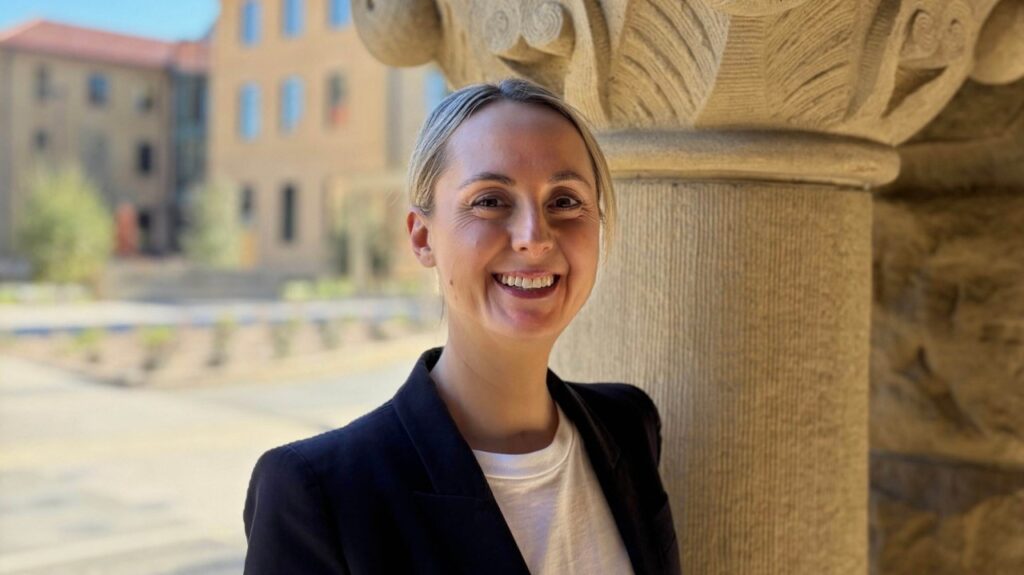
Danielle Benecke, LLM ’15 is founder and global head of Baker McKenzie‘s Applied AI practice, which designs and delivers AI-native legal and compliance services for complex, high-stakes matters. One pundit declared it “one of the coolest jobs in legal” today. Benecke was previously a Legal Design Lab fellow at SLS and has served as venture coach in CodeX’s AI and Law program.
You talk a lot about existential threats for your clients. What are your current thoughts about existential threats for certain corners of the legal profession?
I tend to think about existential risk primarily through the lens of our clients and the challenges they are facing – often in a much broader way than traditional conversations about the legal industry or legal services alone. A lot of the market right now is focused on using AI to make existing legal services faster and more efficient, and that work really matters and is necessary.
But what I find more interesting—and more urgent—is a different question: how do you use AI to solve new or previously unsolvable problems faced by our clients?
When I think about what actually keeps my firm’s clients up at night—and in our work, we speak with many GCs, CLOs, and other senior legal and compliance leaders—it’s not things like contract redlining. It’s the challenge of making decisions amid geopolitical uncertainty, supply chain instability, cybersecurity risk, and an increasingly fragmented global regulatory landscape.
In a lot of these conversations, what clients are really expressing is uncertainty—not about the law itself, but about how to see risk clearly enough to act in time.
And those are complex, cross-border, cross-practice, interdisciplinary risks that do not fit neatly into traditional service categories. They require new ways of integrating legal judgment, data, and decision-making into how institutions actually operate. That kind of systems thinking is where I see the most exciting and meaningful opportunity for the legal industry.
So it sounds like to current students you would advise being as interdisciplinary as possible and seeking guidance and learning from outside the legal courses you take.
Absolutely. I genuinely think this is one of the most consequential moments to be entering the legal profession. This is our opportunity to solve regulatory and risk problems that we simply haven’t been able to solve before.
To take an example, one of the AI-enabled services my team delivers with our practices is compliance audits for large, global organizations. These services use modular workflows to analyze large volumes of data against multi-jurisdictional compliance frameworks—spanning different regulatory domains and industry sectors. This combination of practice expertise and applied AI capability enables speed, depth of insight, and strategic clarity that wouldn’t be achievable through either alone.
The lawyers who will shape the next phase of the profession are those willing to work across disciplines—not just to learn new tools, but to understand how law, technology, data, and decision-making come together inside real institutions.
Talk about your continued participation in CodeX as an alum, serving as a conference speaker and volunteer mentor.
CodeX is a huge reason why I’m in this field today. I’m a technology lawyer by background and have spent most of my career working with clients who are themselves building or commercializing AI. In the early 2010s, as machine learning capabilities started to accelerate—and Stanford’s own research was an enormous part of that—I had a front row seat to how quickly these systems were evolving and coming into industry, not just technically, but institutionally and commercially.
One thing that became clear early on was that applying AI in high-stakes environments requires a deep understanding of how legal risk, technical feasibility, and commercial reality intersect. That realization is what ultimately drew me to Stanford and the Law, Science, and Technology program in particular.
That mix of law, engineering, and business—with a focus on real-world impact—still shapes how I approach every applied AI problem I work on today, and the ongoing work with CodeX reinforces it.
My time at Stanford completely shaped where my career is now. After graduating, I joined others across our firm – particularly our chief innovation officer – in thinking seriously about what an AI-enabled future could look like for the legal and professional services industry. We started actively exploring how AI-driven service models might operate in practice. This work kicked off right around the time of the “Attention is all you need” paper, and remarkably, a lot of the early thinking and experimenting we were doing back in 2017 turned out to be pretty on point.
Do you consider yourself a practicing attorney nowadays? How much of your law school coursework do you use in your current role?
Yes, I am still a lawyer—this is just a different way of practicing. My team and I work in an AI-native way with practice experts to solve client problems end-to-end. By AI-native, I mean we design workflows that integrate legal judgment with model outputs and domain data from the ground up.
AI has become part of how legal expertise is applied at scale. It allows us to help clients anticipate and navigate risks that can’t be addressed through traditional approaches alone.
Stanford really rewired how I think about all of this. I come from a part of the industry focused on outcomes for large enterprise clients—and Stanford pushed that further, exposing me to what was technically possible, sharpening my systems thinking, and deepening my understanding of how scalable solutions actually get built and delivered.
I’m not naive enough to think that Stanford did it all for you. Do you credit the schools where you earned your first degrees too?
I went to the University of Sydney in Australia, where I combined my first law degree with economics and political science. That foundation in markets, policy, and institutions has really shaped how I think about the evolution of legal structures alongside economic and technology change.
You’re married to Sam Schroeder, LLM ’15. Did you meet at SLS?
We met in Australia, though he’s Canadian, and we applied to Stanford separately. He’s also active in the CodeX community, and a graduate of the Corporate Governance program.
You cite Daniel Katz‘s research as a source of inspiration. What else might you recommend to fellow alums who want to think about AI’s potential in big law?
There’s a lot of excellent thinking out there, but the most valuable thing you can do right now is get close to where the problems are actually showing up—not in theory, but inside legal, compliance, and risk teams trying to navigate real complexity using AI for the first time.
Every service we’ve built has come directly from a client pain point—a real decision bottleneck, a regulatory exposure, a workflow that broke down at scale. That’s where the most useful ideas are coming from—specific problems that demand a new kind of response.
There are many people in the CodeX community doing important work in this space. Roland Vogl‘s leadership in building and sustaining it has shaped the field in lasting ways. Pablo Arredondo and Jake Heller’s groundbreaking work at Casetext, Part of Thomson Reuters, and more recently Dr. Megan Ma‘s establishment of SLS’s frontier models lab, have each pushed the field forward. Mark Lemley of course continues to bring deep clarity to both the law of technology and the technology of law. There are far too many to name, and much of what excites me about this field is how much there still is to learn.
According to LinkedIn Baker McKenzie is not yet in the top 20 law firms employing SLS alumni. How will you change that?
Great question. We’re actively hiring, and I’m also coming to campus as part of our firm’s wider recruitment efforts. We’d love to see more SLS alumni join us—especially as we keep applying AI to real legal and compliance work, and learning what it takes to do that at scale. The combination of systems thinking, legal judgment, technical curiosity, and practical insight that Stanford fosters is exactly what this moment demands. And it still feels like we’re just getting started.