
Legal Tech Hackathon
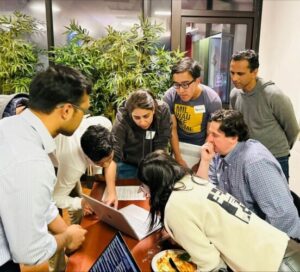
Disabled veterans seeking to file claims with the Veterans Administration are faced with multiple hurdles and reams of paperwork. Many vets resort to paying third-party companies thousands of dollars to help them with the process. What if there were a way to streamline the claims process? How long would it take to roll out a tool that could accomplish that?
The answer: about 48 hours—at least for an interdisciplinary team of students from Stanford University’s schools of law, business, and computer science collaborating feverishly during CodeX’s Large Language Model (LLM) Hackathon held recently on campus.
The team’s LLM tool, which they named Vet’s Claim, took the award for “Best Overall” at the third CodeX Hackathon, held in conjunction with the 11th annual FutureLaw conference in mid-April. CodeX, co-directed by SLS and the Stanford Computer Science Department, focuses on the research and development of computational law, the branch of legal informatics concerned with the mechanization of legal reasoning.
Vet’s Claim co-creator Camila Chabayta, JD ’25, was one of two SLS students who were part of award-winning teams at the hackathon. Kevin Yan, JD ’26, won the “Best First Build” award along with his business, engineering, and linguistics teammates. His team’s generative AI tool, dubbed DueDiligent AI, automates M&A due diligence related to key contracts and business value assumptions.
In seconds, DueDiligent AI can identify excessively risky contract provisions, such as short termination clauses and provisions that could permit large fluctuations in cost. It also flags current events that could undermine a business’s financial outlook, such as a manufacturing plant’s closure recently reported in the news.
Yan, who is on leave from medical school at the University of Pennsylvania while he pursues his law degree, signed up for the hackathon to further his interest in how AI is impacting law and technology—despite a pending research paper deadline. “I slept some, but not a lot,” says Yan, who plans to practice psychiatry and address health policy issues after SLS.
Approximately 400 people from four continents participated in the LLM Hackathon, including law students and other students from across the Stanford campus. Over two days, including a bootcamp with hands-on training, interdisciplinary teams competed in technical and nontechnical tracks to come up with new ideas for streamlining, automating, and augmenting legal practice through the use of LLMs like ChatGPT. CodeX Associate Director and Fellow Megan Ma and CodeX Fellow and former SAP Chief Operating Officer Jay Mandal co-led the bootcamp and hackathon. SL