
In 17 Days: FutureLaw Conference 2015
This is the second of a series of previews about the FutureLaw Conference 2015 on Thursday, April 30, presented at Paul Brest Hall on the Stanford campus. If you are new to this conference, here’s a quick update: The FutureLaw Conference is in its third year, organized by CodeX: The Stanford Center for Legal Informatics (which is operated jointly by the Stanford Law School and the Computer Science Department). Roland Vogl is the executive director and Michael Genesereth is the research director. Friday, I previewed the opening keynote, “The State of the Art of Legal Technology Circa 2015,” which will be presented by Professor Oliver Goodenough (CodeX; Vermont Law School).
“The Latest Advances in Big Data Law and Analytics”
The first panel will run from 10:15 a.m.-11:15 a.m. “The Latest Advances in Big Data Law and Analytics” will focus on machine learning, natural language processing (aka NLP) and Big Data analytics, all very hot topics in legal. (For example, IBM Watson ROSS; “Select While You Collect;” “Content Analyst CAAT 3.17.”)
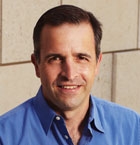
The panel will be moderated by Professor George Triantis, who is the James and Patricia Kowel Professor of Law; Associate Dean for Strategic Planning; and Associate Dean of Research for Stanford University. In 2011, Triantis joined Stanford from Harvard University; he focuses on contracts, commercial law, business law and bankruptcy. Triantis also chairs the Stanford Cyber Initative. It was started to bring together “experts from a wide swatch of disciplines—including computer science, law, engineering, the social sciences and education—together in order to focus on this important topic and related issues,” he said in a press release announcing the “White House Summit on Cybersecurity and Consumer Protection,” held in February at Stanford.
Panelists
The speakers include:
• Pablo Arredondo, an Entrepreneurial Fellow at CodeX, and vice president of legal research at Casetext. He focuses his work on “civil litigation in common law jurisdictions, with emphasis on how litigators access and assemble the law,” he notes. Arredondo co-founded Occam, created after he practiced law in New York and California.
• Josh Becker, CEO of Lex Machina—it provides intellectual property litigation data an analytics to companies and law firms to help them “formulate data-driven IP business strategies that win lawsuits and maximize IP value,”he said on Linkedin. Becker also founded The Full Circle Fund, “an alliance of emerging business leaders who help solve public problems through engaged philanthropy and public policy advocacy.” In 2014, Becker was named by ALM as one of the 25 leading innovators in California (The Recorder) and as a Top 50 Litigation Trailblazers & Pioneers (The National Law Journal).
• Professor Daniel Martin Katz is transitioning from Michigan State University, where he is an associate professor of law, to IIT-Chicago Kent College of Law in August. He is an Affiliated Faculty member at CodeX. Katz and Professor Renee Newman Knake created the high profile “ReInvent Law Laboratory;” both were named “Legal Rebels” by the American Bar Association’s ABA Journal. He also served on my Law Technology News Editorial Advisory Board .
• Khalid al Kofahi is vice president, research and development, at Thomson Reuters, based in the Minneapolis area. His team of research scientists and software professionals perform applied research, design algorithms and develop tools to support business needs, he said on his Linkedin profile. “I am passionate about building products that improve how people find, understand, interact with and react to information,” he said. “I enjoy the journey of product development and … design as much as I enjoy the finished products.”
• Daniel Lewis, CEO of Ravel Law, is also a Fellow at CodeX. The tag line for the company is, “We Unravel the Law.” Lewis describes it as a new search, analytics and visualization platform for lawyers,” he explains on Linkedin. The company was started at Stanford, via the law school, Computer Science Department, d.school (Institute of Design at Stanford) and with the support of CodeX. Forbes selected Lewis for its “2015 30 Under 30″ feature. Check out Robert Ambrogi’s May, 2014 ABA Journal cover story about Ravel here.
• Paul Lippe is CEO of Legal OnRamp, which he says “integrates process, technology and people for law departments and law firms.” OnRamp was developed in cooperation with Cisco Systems Inc. Lippe previously worked at Synopsys, an electronic design automation company, and was CEO of Stanford SKOLAR, a “medical digital libarary and e-learning company spun off from Stanford Medical School.” Lippe is also a columnist at the ABA Journal.
Click for:
• Registration info
• Agenda
• Speakers
• Last year: FutureLaw Conference 2014
Reach Monica Bay at mbay@stanford.edu.