
Democratizing Knowledge: Explaining State Criminal Prosecutions of Police Officers
Democratizing Knowledge is a regular series produced by the Stanford Center for Racial Justice (SCRJ), breaking down complex racial justice issues to make information clearer and more understandable for everyone. Elias Rodriguez, a Research and Policy Fellow, examines state criminal prosecutions of police officers and why it can be so difficult to charge and convict under state law for excessive uses of force.
In 2020, a series of high-profile incidents reignited the long-standing issue of police use of excessive force. For starters:
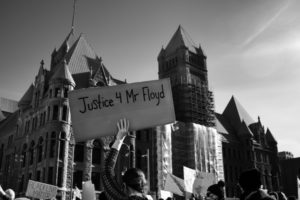
- In Minneapolis, officers killed George Floyd when an officer dug his knee into the back of Floyd’s neck.
- In Louisville, Ky., officers killed Breonna Taylor when they indiscriminately shot into her apartment building while carrying out a no-knock warrant.
- In Atlanta, officers killed Rayshard Brooks as the 27-year-old ran away with an officer’s Taser.
Prosecutors elected to charge the officers with state law crimes in the deaths of Taylor and Floyd. Out of the three tragedies, Minnesota was the only state able to successfully charge and convict officers for their uses of force. These three cases help illustrate the difficulty in charging and convicting officers with a crime under state law for excessive uses of force.
This small sample size is also reflective of nationwide data on how infrequently prosecutors charge officers for duty-related uses of force. Furthermore, these prosecutions are often unsuccessful. For instance, in a seven-year span of 600 police shootings in Arizona, all but one of the shootings reviewed resulted in prosecutors bringing charges—and that prosecution ended in an acquittal by a jury.
Prosecuting officers for using excessive force is difficult for one obvious reason: police are authorized to use force. Undoubtedly, officers regularly use force legally. But for the instances where officers use excessive force, why is it so difficult to charge officers with a crime?
In this essay, we explain how local and state prosecutors charge officers’ uses of force—and what obstacles lay in their path. We also outline how state use of force statutes and police department use of force policies affect these prosecutions.
When can a prosecutor charge a police officer with a state crime?
Prosecutors have a range of criminal charges they can bring against officers for their alleged excessive use of force—including assault, battery, or homicide. However, state law explicitly authorizes officers to use force. Through state authorization laws, citizens delegate the power of the state to deploy forceful and violent methods to achieve legitimate governmental interests, like law enforcement. These authorization laws mean that officers—under certain circumstances—may justifiably commit what would otherwise be deemed as assault, battery, or murder in the course of an arrest.
Consequently, prosecutors must not only prove the elements of any crime in which they allege the officer engaged—assault, battery, homicide, etc.—they must also establish that the officer exceeded the force authorized under the state’s authorization statute. If the officer’s conduct was within the authority granted by law, no crime has occurred.
In the trial of Minneapolis police officer Derek Chauvin, state attorney general Keith Ellison charged Chauvin—and other officers involved with Floyd’s killing—with state crimes. These included second and third degree murder and second degree manslaughter. Not only did Ellison have to prove the elements of these murder and manslaughter charges to proceed with indicting and convicting Chauvin, Ellison also had to prove that Chauvin exceeded the force authorized under the Minnesota use of force statute.
How much force do states authorize?
Individual states have the power to decide how much force officers may use in a variety of situations. At a minimum, states’ authorization language must meet the standards of the U.S. Constitution. The U.S Constitution, and cases subsequently interpreting it, have stated that officers can use force as long as it is “objectively reasonable in light of the facts and circumstances confronting them.” This “reasonable officer” standard, outlined in Graham v. Connor, guides the assessment of whether the amount of force officers use in an encounter is constitutionally reasonable.
However, states and municipalities can go beyond—or be more comprehensive and provide more rights than—the federal “reasonable officer” standard minimum. Going beyond the federal minimum standard would permit states to define more precisely what force the state allows and does not allow; it can also limit when and how much force officers may use.
Nevertheless, many states’ laws closely resemble federal law for determining whether an officer’s force was lawful. Federal law, following Graham, requires courts to look at the “facts and circumstances of each particular case” to determine reasonableness. The particular “facts and circumstances” include the severity of a crime, the risk of serious injury or death to the officers or the public, and the flight risk and resistance of the individual, among other things. These circumstances and the force used must be judged from the perspective of a “reasonable officer on the scene.”
In the case of Chauvin, prosecutors introduced jury instructions that reflected Minnesota law. The instructions advised the jury that “[n]o crime is committed if a police officer’s actions were justified by the police officer’s use of reasonable force.” In other words, as explained above, the force an officer uses within the realm of reasonableness is not a crime.
The jury instructions further stated that the “kind and degree” of force is limited by what a “reasonable police officer in the same situation would believe to be necessary.” This language is consistent with the federal law standard following Graham. To determine reasonableness, the instructions advised the jury to “look at those facts which a reasonable police officer would have known at the precise moment the officer acted with force.”
The language used, both in Graham and the Minnesota jury instructions, illustrate that courts following federal law concepts measure reasonableness from the hypothetical “reasonable officer’s” perspective. One may argue that the Minnesota jury instructions went beyond Graham by requiring that the amount of force used must also be necessary. However, like Graham, the instructions judge what is necessary from a “reasonable police officer in the same situation.” In turn, when determining whether to bring charges, prosecutors will have to disprove the officer’s authorization defense by demonstrating that the officer acted unreasonably—again, from the perspective of a reasonable officer.
How do prosecutors prove an officer acted unreasonably?
To file charges against any defendant, prosecutors must have a good faith belief that the “admissible evidence” is sufficient to prove to a unanimous jury beyond a reasonable doubt that the defendant acted—and had the requisite mindset—in a way the statute deemed criminal. Additionally, the prosecutor must have the same belief that they can disprove any defense raised by the defendant. In circumstances where the prosecutor does not conclude the proof meets these standards, they have an absolute ethical obligation not to file charges.
Focusing on the latter requirement—that the prosecutor must disprove the officer’s defense—the prosecutor would need sufficient “admissible evidence” to develop their “good faith belief” and to prove to a jury that the officer acted unreasonably. But evidence of reasonableness is challenging for prosecutors to show to juries when scholars criticize the standard as “indeterminate.”
Two problems primarily arise when attempting to prove an officer acted unreasonably. First, because reasonableness is judged from the perspective of a reasonable officer, a prosecutor may need to put another officer on the stand. Presumably, that officer would have undergone similar training to the officer alleged to have committed a crime. Naturally, the officer most equipped to speak on the defendant-officer’s actions would be an officer or supervisor in the defendant-officer’s own department. But what officer would be willing to testify against their fellow defendant-officer and cross the blue line/wall of silence, an unwritten code that says police cannot turn on other police?
The Chauvin case appears to be an extraordinarily exceptional case. In the trial, prosecutors were willing to call over 50 officers from the Minneapolis Police Department (MPD) to testify against Chauvin—including the then-acting Chief of the MPD. However, in a case that does not garner international protests and a nationwide movement for civil rights, would a prosecutor still be willing to put officers on the stand to testify against a fellow officer? Local prosecutors work closely with police departments, often calling officers on the stand to testify against civilian defendants. Would the prosecutor risk an important relationship with the police department in deciding to ask an officer to testify against a fellow officer?
Second, as one scholar notes, the reasonable officer standard “necessarily incorporates how police officers process the facts and circumstances around them.” And how officers process facts and circumstances around them informs their perceived threat level in various scenarios. For example, officers are often taught to display “situational awareness” which instructs officers to assess threat levels on a color coded scale, thereby “treat[ing] every individual they interact with as an armed threat and every situation as a deadly force encounter in the making.” This “warrior mentality. . . makes policing less safe for both officers and civilians”—and in turn, this mentality often permeates the testimony of an officer who testifies on the stand.
In Chauvin’s case, defense attorneys found a former California police officer, Barry Brodd, who testified that kneeling on Floyd’s neck for nine minutes while he lay, face-down and handcuffed, was justified and an act of “objective reasonableness.” Brodd also stated that Chauvin appeared fearful of bystanders who were advocating for Floyd as he struggled to breathe on the ground.
This suggests that Chauvin’s heightened perceived threat level from those witnesses justified Chauvin’s restraint on Floyd—because, in Brodd’s words—the witnesses were “part of an officer’s situational awareness.”
Arguably, charging and convicting Chauvin required a perfect storm of factors: the external public pressure of nationwide protests; a willingness of a prosecutor to charge him; and the testimony of multiple police officers in Chauvin’s own department—including the Police Chief. Without the confidence of all three, it can demonstrate how a prosecutor, prior to charging the officer, may not have a good faith belief that they have sufficient “admissible evidence” to prove that an officer acted unreasonably.
Do use of force policies help prove reasonableness?
In Chauvin’s case, Brodd also stated that the officer’s actions “follow[ed] Minneapolis Police Department policy and current standards of law enforcement.” Conversely, the then-acting Chief of the MPD stated that Chauvin’s actions were “in no way shape or form [compliant with] policy.” One might expect that if an officer violates their department policy, that this would help prove that the actions were unreasonable—and therefore not authorized by law, leading to criminal culpability. However, in countless cases, despite an officer violating their department’s policy, prosecutors or grand juries decided against charging an officer with a crime—Eric Garner, Tashii Farmer, and Anthony Alvarez, to name a few.
Whether a prosecutor can admit department policy or training as evidence in a criminal trial against an officer is heavily dependent on the state in which the trial occurs. State courts can make their own procedural rules on whether to admit use of force policies or training materials. Some state courts, specifically Connecticut and New Mexico, have admitted department policy or training as part of their analysis in a criminal trial concerning whether the defendant-officer acted reasonably.
But mere admission of the department policy or training does not guarantee that department policy violations will determine a police officer’s criminal culpability. How much weight the admitted policy or training has on determining whether an officer acted reasonably depends on federal law and higher courts’ binding and persuasive precedent. In the Connecticut and New Mexico cases cited above, each state court referenced federal law in deciding how to weigh department policy violations.
Further, the U.S. Supreme Court has stated that an officer will not lose their governmental immunity solely because of violating statutory or administrative provisions, like police use of force policies. Additionally, in an appeal of a federal criminal trial against an officer, the appellate court stated that expert police testimony regarding police standards is sometimes “unhelpful and thus irrelevant” in determining whether an officer acted reasonably. In other words, an officer can violate their department policy and still be found to have acted reasonably by a jury.
Why do use of force policies matter?
Prosecutors face an uphill battle in charging and convicting officers of excessive uses of force. Along the journey, they face obstacles like codes of silence, complicated relationships with officers, and an elusive authorization standard. Intervening before prosecutors climb this uphill battle—by outlining clear guidelines of how a community expects officers to conduct themselves—may reduce instances of police violence, as well as the difficult decisions of whether to prosecute officers for excessive force.
Whether using our Model Use of Force Policy or similar guidelines, police agencies and communities should work together to form a common understanding of their visions for public safety.
Disclaimer: The facts cited above were assumed to be true based upon public news and academic literature sources and have not been evaluated for accuracy. The above analysis reflects the opinions of our staff and is intended for educational purposes and policy discussions.
Photo credits: New York Times screenshot, NPR screenshot, Wikimedia Commons/Lorie Shaull