
Stanford CodeX Legal AI Maturity Study
Research Objective
- Characterize the spectrum of AI use at top US Law Firms
- Outline qualitative factors affecting AI maturity and value realization
- Benchmark AI use and spend by practice area and legal workflow
- Estimate ROI for the top practice areas and workflows
- Track trends over time across AI models, Agents and LegalAI platforms
Student application open now
Background / Motivation
Use of AI in law has grown rapidly (74% of legal professionals now use AI multiple times a week, yet only 35% say an active strategy is visible in daily work), but there is significant variance in adoption maturity across law firms based on a variety of factors including firm size, practice areas, workflow, technical expertise, and systems readiness.
Law firms are also using AI in more sophisticated ways – from beginners using off-the-shelf general-purpose models and tools, to the growing adoption of legal AI platforms like Harvey and Legora, to more advanced firms leveraging in-house technical teams to build custom AI harnesses, fine-tune AI models and procure specialized infrastructure. Maturity depends on how tools are integrated, developed, and governed, regardless of whether they are bought or built.
Tracking these shifts by practice area and workflow is critical to establish best practices and quantify outcomes, ROI, and cost profiles creating a definitive benchmark for AI maturity and value in law. This work on creating a baseline is particularly important now because AI usage in all sectors including Law is expected to increase dramatically as both human-directed chatbot use and automated agentic workflows expand.
Goldman Sachs research projects global monthly token consumption to increase from roughly 5 quadrillion tokens in 2026 to 120 quadrillion tokens by 2030, a 24-fold increase driven mostly by agentic workflows. These global cross-industry indicators suggest that AI activity, cost, and complexity will scale faster than seat counts, making it urgent for law firms and legal departments to understand usage, cost, complexity, ROI, and outcomes at the workflow level.
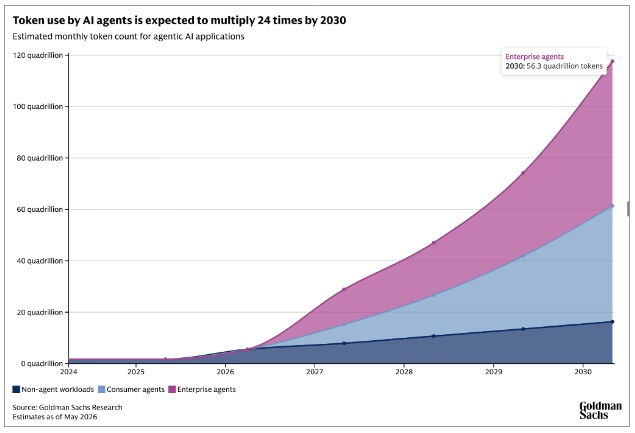
Source: Goldman Sachs Research, May 2026.
Methodology & Approach
This study will establish a vendor-neutral AI maturity and taxonomy for Legal AI, cataloging the use of foundation model chatbots, general-purpose agents, custom skills, legal AI platforms, and firm-specific in-house harnesses. A separate maturity framework will assess workflow integration, measurement, quality assurance, and operating model readiness. We will measure AI usage over time and study the relationship of AI maturity to firm size, practice area, legal workflow, and qualitative factors such as technical expertise, data maturity, and cloud adoption.
Each participating firm will collect its own operational data through the use of a secure toolkit published by the CodeX team. Anonymized, aggregate data will be shared with permission for research analysis and publication by Stanford CodeX. The study will collect results on an ongoing quarterly basis and disseminate insights to all participating members and the broader research community.
Project Plan
Phase 1: Interviews & Study Scoping
- Present study objectives, participation benefits and technical guardrails to cohort of CodeX approved law firms. Confirm 3-5 participant firms.
- Conduct survey with IT teams of participating firms to confirm AI usage – detailing providers, use cases and available metrics
- Publish measurement toolkit, AI taxonomy, maturity framework
- Select practice areas and priority workflows per firm.
Phase 2: Installation & Measurement Setup
- Private, secure installation of measurement toolkit as needed by each participating firm
- Refine CodeX categorization of AI Maturity, Legal Processes and Workflow taxonomy to ensure accurate internal benchmarking within and across firms
- Classify historical data and forward data collection on a continuous basis
Phase 3: Analysis & Recommendations
- Analyze historical data, identify initial trends by practice and workflows within each firm for internal benchmarking, provide report to each firm
- Determine firm specific ROI metrics where reliable data is available
- Develop recommendations for cost optimization by firm
Aggregate, anonymized results will be shared with CodeX for research and teaching based on permissions granted by participating firms.
Project Team



Research Opportunities
- BigLaw AI Benchmarking (Law School Students)
- Partner with AI and Practice Leaders across 3-5 top AmLaw firms participating in the study
- Apply the CodeX AI Taxonomy and Maturity Framework to selected legal practices and provide thought leadership to refine and standardize the methodology across various law firms
- Measure the impact from the adoption of AI tools across key metrics like human effort, billable hours
- Translate anonymized cross-firm insights into CodeX research and case studies
- Legal AI Telemetry Benchmarking (Engineering students)
- Partner with top AmLaw firms to put into place Telemetry tools to measure AI usages across real-world deployments
- Build a multi-firm data pipeline to collect, clean and normalize telemetry logs across diverse environments into a unified, privacy compliant dataset for cross-firm analysis
- Analyze AI usage to identify trends and benchmark tool performance across workflows, and determine cost optimization and efficiency metrics for each firm.