
Daniel E. Ho Receives Roland Prize for Public Service in Law and Policy
(Originally published by the Haas Center for Public Service on March 4, 2026.)
When California passed a law requiring counties to identify and redact racist language embedded in millions of property deeds, the task seemed daunting. Santa Clara County alone needed to process more than 80 million pages of historical records. Working with students and county partners, Stanford Law professor Daniel E. Ho partnered with the County to develop a machine-learning tool that made the project feasible in both cost and time. What might have taken years and millions of dollars was completed in days, and the model is now available and used by other counties across the state.
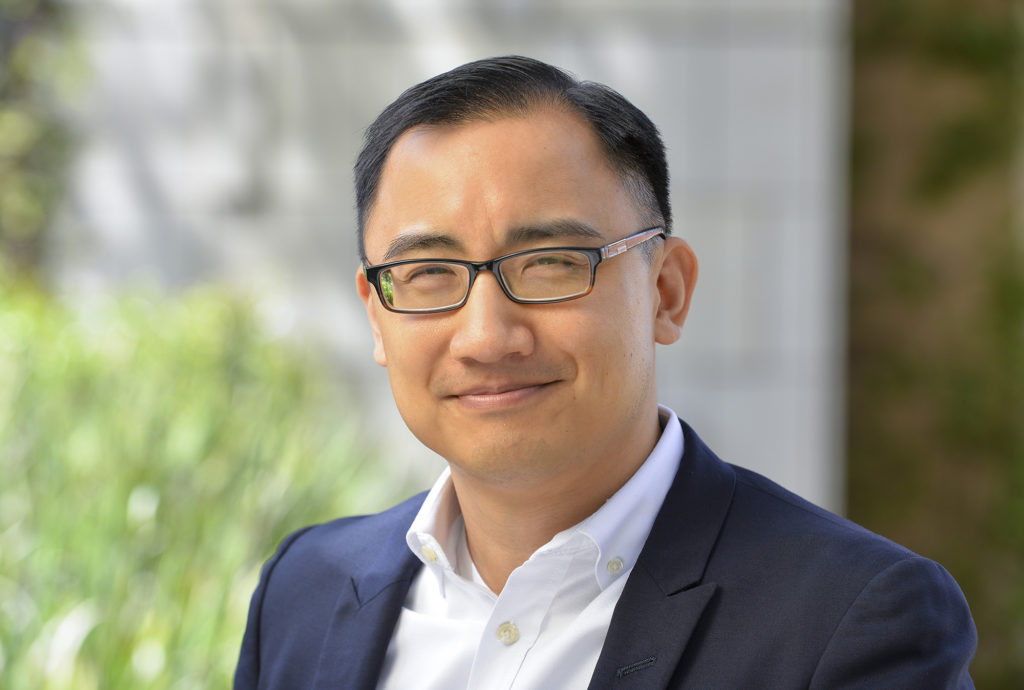
This project to help implement AB 1466 is one of several that led to Ho being named the recipient of the Miriam Aaron Roland Volunteer Service Prize, the Haas Center’s award recognizing faculty who engage students in meaningful public service.
Ho directs the Regulation, Evaluation, and Governance Lab (RegLab), which blends academic research with real-world public service while mentoring students to do the same. He launched RegLab six years ago, as Stanford was reflecting on how it could engage more meaningfully in public policy without a school of public policy. Drawing on his own experience, he saw that some of the most meaningful academic work had come through partnerships with government agencies.
RegLab was designed to address common frictions in government projects such as contracting costs, data access, and technical capacity, while supporting longer-term projects with the potential for lasting change. The lab prioritizes projects based on public benefit, partner readiness, and fit with the lab’s expertise in regulatory policy and machine learning.
“RegLab was built on the frustration that the most powerful advances in data science and AI were happening at a distance from the programs that shape people’s lives most,” said Ho. “The purposeful university isn’t just one that produces knowledge. It’s one that insists knowledge find its way home.”
Across these projects, students contribute directly to the work, prototyping tools in class and helping translate research into practice. Alumni have gone on to roles in public service, including work on AI policy in the White House’s Office of Management and Budget and at the then-U.S. Digital Service.
“Professor Ho shows what it looks like when faculty and students partner with government to address real public challenges,” said Yi-Ching Ong, the Haas Center’s executive director. “His work reflects the values at the heart of the Roland Prize—rigorous scholarship in service of the public, and students learning by doing.”
Ho is especially proud of the work his team has done on regulatory reform and streamlining, including AB 1466 and collaboration with the San Francisco City Attorney’s Office to modernize the municipal code. These projects brought together students, staff, and government partners to turn the law’s intent into practical, scalable results and now serve as a model for using AI in legal reform. RegLab’s tools have broader implications for modernizing government through technology, and the AB 1466 work originated as a class project, highlighting how learning and service are intertwined at RegLab.
RegLab has applied similar approaches to other government challenges. Ho has led a multi-year collaboration with the IRS to address the nation’s estimated $500 billion tax gap, and to help the agency understand demographic disparities in tax audits. He currently serves on California’s Gubernatorial Innovation Council to advance such modernization in the state. During the COVID-19 pandemic, the lab partnered with Santa Clara County Public Health to support local response efforts, developing tools and processes that directly informed public health operations.
Sarah Rudman is the public health officer and director of the County of Santa Clara Public Health Department. “I had the distinct pleasure of working closely with Professor Daniel Ho on multiple research and operational collaborations that were integral to our County’s COVID-19 pandemic response,” she said. “Without his leadership, insight, and nuanced understanding of governmental operations and technological resources to improve them, we would not have seen many of our most successful ventures to prevent disease and harm in our community. Professor Ho and his RegLab team have demonstrated how a resource-intensive approach to co-production achieves the greatest benefits for communities, academia, and the many students whose professional growth has been accelerated through this work.”
“Academics can sometimes conceive of government primarily as a sponsor of work, but at RegLab we try to model true partnership with government agencies and a collaborative ethos,” said Ho. “The key to the success of these projects is a fantastic group of people—undergraduate students, pre-doctoral fellows, staff, post-docs, and faculty working together to solve problems for our government partners.”
Ho was recognized at an awards luncheon on March 3 alongside recipients of Stanford’s Community Partnership Awards. The partnership between RegLab and Santa Clara County’s Mapping and Redacting Racial Covenants project was a finalist for this award. This year’s awardees are:
College of San Mateo–Community College Outreach Program at Stanford University
Food for Health Equity Lab and San Mateo Medical Center: Vida Sana y Completa Study
Santa Clara Unified–Stanford Research Practice Learning Partnership
In honoring Ho with the Roland Prize, Stanford recognizes a model of faculty public service that brings research, teaching, and community partnership together and shows students how academic work can help solve some of government’s most pressing challenges.
– – –
Ho is the William Benjamin Scott and Luna M. Scott Professor of Law; Professor of Political Science; Professor of Computer Science (by courtesy); Senior Fellow at the Stanford Institute for Human-Centered Artificial Intelligence (HAI); Senior Fellow at the Stanford Institute for Economic Policy Research; and Director of the Regulation, Evaluation, and Governance Lab (RegLab).
The Miriam Aaron Roland Volunteer Service Prize recognizes Stanford faculty whose public service work meaningfully advances teaching, learning, and community partnership. Unique among Stanford awards, the prize highlights how faculty engagement with nonprofits, NGOs, government agencies, and philanthropies benefits students, communities, and faculty alike. The prize includes a cash award in recognition of exemplary service.