
Stanford RegLab and Colorado Labor Department Receive Award for AI Adjudication Tool
Resolving an unemployment claim often turns on asking the right questions. Adjudicators must determine which facts matter, identify what is missing or disputed, and decide what to ask claimants and employers next, often while managing a heavy caseload and pressure to reach accurate decisions quickly.
To help adjudicators navigate that process, Stanford Law School’s Regulation, Evaluation, and Governance Lab (RegLab) and the Colorado Department of Labor and Employment (CDLE) developed, piloted, and evaluated an AI-assisted tool that recently received an inaugural AI in Action Award from the Center for Civic Futures. The project was selected as the winner in the “Rising AI Pilot” category.
RegLab, whose work sits at the intersection of law, data science, and public policy, designed the tool to keep human judgment front and center while guiding adjudicators from the facts of a particular claim to relevant follow-up topics and questions.
The AI in Action Awards recognize promising uses of artificial intelligence in government, with an emphasis on practical implementation, responsible adoption, and lessons that can be shared across jurisdictions. The Center for Civic Futures is a nonpartisan nonprofit focused on responsible AI and emerging technology in government. RegLab also received an honorable mention for its work with the Santa Clara County Office of the Clerk-Recorder on a racial covenant identification tool.
What distinguished the Colorado-RegLab project, according to the Center for Civic Futures, was its commitment to evidence and evaluation. The team conducted a randomized controlled trial using real adjudicators and historical cases, then published its findings so other government agencies could learn from the results.

“Government agencies are being asked to solve extraordinarily hard problems, from delivering benefits to protecting public health and the environment, often without access to the scientific and technical capacity those challenges require,” said Daniel E. Ho, the William Benjamin Scott and Luna M. Scott Professor of Law, professor of political science and, by courtesy, computer science, and faculty director of RegLab and associate director of Stanford’s Institute for Human Centered AI (HAI). “This project shows what can happen when government and academic partners work together to bring modern data science to core public systems in ways that are careful, measurable, and grounded in the realities of public service.”
“It’s wonderful to see this Colorado-RegLab collaboration around responsible AI for benefits adjudication recognized,” said Amanda Neal, Strategic Business Technology Director at CDLE. “We are excited about this model of responsible AI to modernize a system that provides critical support for so many.”
The Colorado pilot is part of RegLab’s broader collaboration-based work to modernize government, supported in part by Arnold Ventures, Stanford Impact Labs, and Stanford HAI.
RegLab develops partnerships with government agencies and nonprofit organizations to conduct demonstration projects in core governance functions, strengthen public-sector capacity, and help ensure that advances in data science and machine learning are directed toward consequential public problems. Its work spans areas including public benefits and adjudication, tax administration, regulatory compliance, and AI governance.
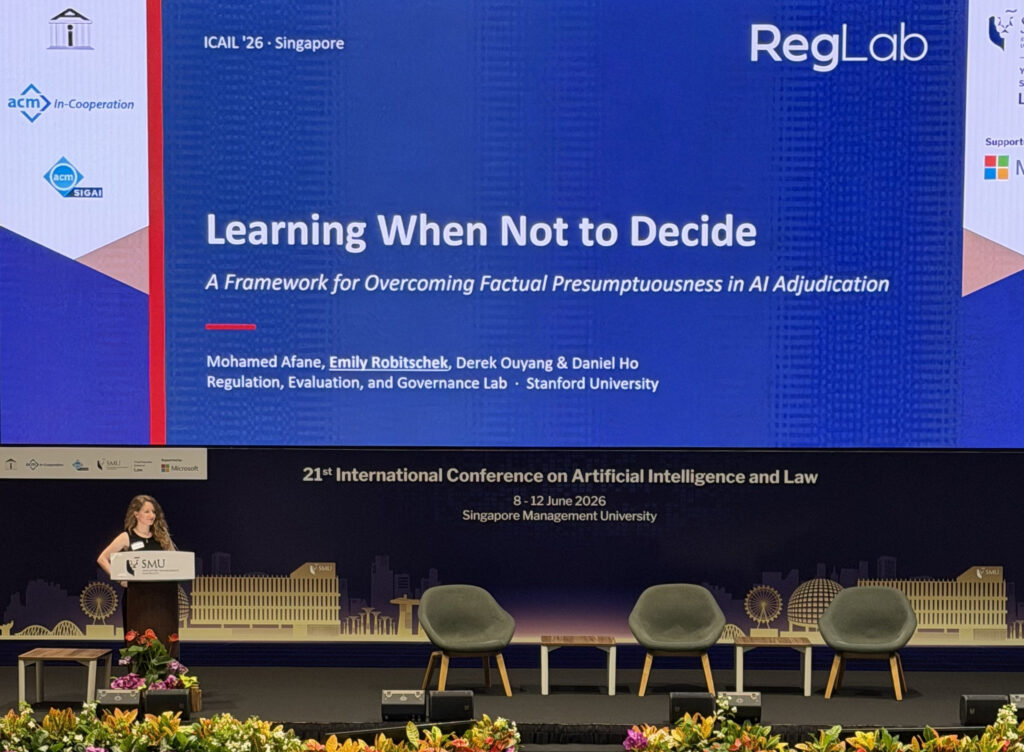
The Colorado project was one of several public-sector AI efforts recognized in the inaugural awards. RegLab’s work on AI assistance in benefits adjudication also recently received awards at the CS&Law Symposium and the International Conference on Law and AI.
About Stanford Law School
Stanford Law School is one of the world’s leading institutions for legal scholarship and education. Its alumni are among the most influential decision makers in law, politics, business, and high technology. Faculty members argue before the Supreme Court, testify before Congress, produce outstanding legal scholarship and empirical analysis, and contribute regularly to the nation’s press as legal and policy experts. Stanford Law School has established a model for legal education that provides rigorous interdisciplinary training, hands-on experience, global perspective and a focus on public service.
About RegLab
Stanford’s RegLab builds the evidence base and technology for effective government. Our interdisciplinary team of engineers, data scientists, social scientists, and legal experts partners with agencies at every level—from federal departments to states, counties, and cities—bringing frontier AI, machine learning, and causal inference to the public sector. RegLab’s work has prompted an overhaul of tax auditing, mapped racial covenants across millions of records, and enabled streamlining of statutes and regulations.