Stanford Law School’s 2025 End-of-Year Faculty Reading List
Looking for a good book or two to dig into during the holidays? The Stanford Law School End-of-Year Faculty Reading List offers up some of our professors’ favorite reads.
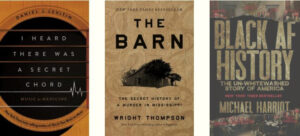
Ralph Richard Banks, Jackson Eli Reynolds Professor of Law, recommends Black AF History by Michael Harriott, The Barn by Wright Thompson, and I Heard There Was a Secret Chord by Daniel Levitin
Black AF History by Michael Harriott, an extraordinary retelling of American history, that places Black people at its center, both in terms of the history itself, and in terms of the style of the narrator’s tales.
The Barn by Wright Thompson, a recounting of the tragedy and the afterlife of the murder of Emmett Till that sets the story in the context of the history of Mississippi and the history of the nation—a revelation, even for someone who thought they knew the story of Emmett Till.
I Heard There Was a Secret Chord by Daniel Levitin, an exploration by someone who is both a scientist and a musician of the many uses of music in healing the body and soul, built on the foundational if overlooked premise that all of life is rhythmical.
Richard Thompson Ford, George E. Osborne Professor of Law, recommends The Rose Field by Philip Pullman, Dark Renaissance by Stephen Greenblatt, Marble Hall Murders by Anthony Horowitz, and Imbibe by David Wondrich
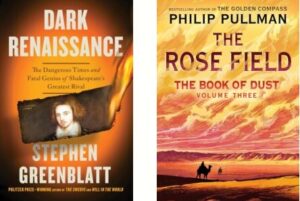
The Rose Field by Philip Pullman. A fantasy epic for the 21st century, Pullman does for our era what Tolkien did for his, imagining an entire world both familiar and strange and commenting on our present situation while never letting social criticism overshadow great storytelling and evocative writing. That said, Pullman skewers religious zealotry and hypocrisy, narrow-minded empiricism, and vulgar postmodernism with equally devastating effect.
Dark Renaissance by Stephen Greenblatt. The preeminent scholar of Renaissance letters and author of the magisterial “Will in the World,” Greenblatt explores the fascinating life and works of Shakespeare’s contemporary, playwright (and most likely international spy) Christopher Marlowe. No, Marlowe did not write Shakespeare’s plays, but the two borrowed from common sources and influenced each other’s work.
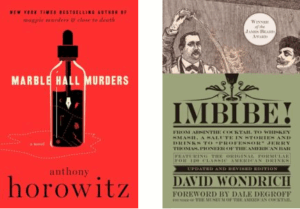
Marble Hall Murders by Anthony Horowitz. Another fun, mystery-within-a-mystery from a master of the genre. If you are new to the series, start with Magpie Murders.
Imbibe by David Wondrich. If cocktails have a historian laureate, it’s Wondrich, who gives us the definite history of one of America’s most profound contributions to civilization. Includes a few recipes just in time for holiday parties.
Lawrence Friedman, Marion Rice Kirkwood Professor of Law, recommends The Trial of the Assassin Guiteau by Charles Rosenberg
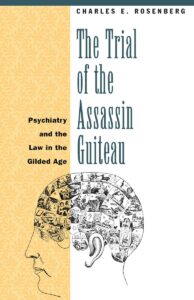
I’d like to recommend Charles Rosenberg, The Trial of the Assassin Guiteau — recent interest in the assassination of President Garfield makes this classic study particularly interesting.
Robert W. Gordon, Professor of Law, Emeritus, recommends The Radical Fund by John Fabian Witt
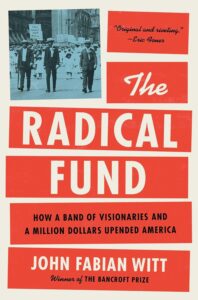
John Fabian Witt, The Radical Fund: How a Band of Visionaries and a Million Dollars Upended America.
John Witt is a legal historian at Yale Law School. One of his previous books, Lincoln’s Code, explored the origins of the modern law of war in a code adopted by the Union Army in the American Civil War. That book won for Witt the Bancroft Prize in American History. His new book is more ambitious still. It has a modest purpose: to uncover the history of the American Fund for Public Service often called the “Garland Fund,” after the eccentric heir to millions who chose to give his money away. He entrusted it to Roger Baldwin, the founder of the American Civil Liberties Union, to be used for progressive causes.
If anyone now remembers the Fund, it’s for one of its minor grants to Nathan Margold to study educational inequality between the races in the South. Margold’s equalization strategy led eventually to the landmark decision in Brown v. Board of Education. Witt had the inspired idea of finding out what else the Fund helped pay for. It turns out that the Fund gave small amounts of money to virtually every progressive—liberal, left-liberal, social democratic, socialist, communist, racial equality, and labor—causes of the first third of the twentieth century. It funded litigation; it funded labor organizing; it funded worker education; it funded among many others Clarence Darrow, Charles Hamilton Houston, James Weldon Johnson, W.E.B. Du Bois, the literature of the Harlem Renaissance, A. Philip Randolph, Morris Ernst, Felix Frankfurter, Carol Weiss King, John Dewey, Sidney Hillman, Morris Hillquit, the Reuther Brothers, the International Workers of the World, Scott Nearing, Elizabeth Gurley Flynn, A.J. Muste, and Pauli Murray. One of its main beneficiaries was Brookwood College, a small school for teaching the theory and practice of labor organizing, whose lessons bore fruit in the great sit-down strikes of the 1930s.
In this monumental but extremely readable book, whatever cause the Fund touched, however briefly, receives a full and detailed history. It is a guided tour through the efforts of tiny groups of progressive thinkers and activists to upend the going rules of the social and political games to remake their worlds. They had many failures but also many remarkable successes. Reading it today evokes the melancholy thought that almost all the valuable social changes they aspired to and helped bring about are now labeled “woke” and targeted for destruction. Perhaps their example will inspire people who believe that no change is possible to follow their example.
Henry T. Greely, Deane F. and Kate Edelman Johnson Professor of Law, recommends Slouching Toward Bethlehem by Joan Didion, Lower than the Angels by Diarmaid MacCulloch, 1929 by Andrew Ross Sorkin, The Tainted Cup by Robert Jackson Bennett, and A Christmas Carol by Charles Dickens
From my last six months, I’m recommending a book of essays, two histories, and a science fiction mystery novel, and a spoken version of a classic. I re-read, for the first time in 50 years, Joan Didion’s Slouching Toward Bethlehem, a collection of essays about California in the second half of the 1960s. What a voice! I was surprised at how much I enjoyed Diarmaid MacCulloch, Lower than the Angels, A History of Sex and Christianity. It surveys over 2,000 years in scholarly but fascinating—and mainly not about the recent controversies about same sex behavior or the roles of women, but the tensions between marriage and virginity. Most recently, I listened to Andrew Ross Sorkin, 1929, about the Great Crash and the people who made it. The author (and I) see disturbing parallels. For (speculative) fiction, I’m recommending Robert Jackson Bennett, The Tainted Cup. It’s a mystery with its own (even more peculiar) Holmes and Watson, in an intriguing world with ubiquitous biotech. Finally, we continued a Thanksgiving tradition by listening to Patrick Stewart’s solo reading of Charles Dickens’s A Christmas Carol on the trip to and from my mother’s house in Aptos (just the right length). “Some people laughed to see the alteration in him, but he let them laugh…His own heart laughed: and that was quite enough for him.”
Deborah R. Hensler, Judge John W. Ford Professor of Dispute Resolution, recommends Perestroika in Paris by Jane Smiley, The Friend by Sigrid Nunez, Horse by Geraldine Brooks, and Sam by Allegra Goodman

Perestroika in Paris by Jane Smiley is an odd novel where virtually all the characters are animals who come together in Paris to survive on their own. I was never sure what the novel is about, perhaps simply the power and joys of community.
The Friend by Sigrid Nunez. About life, death, and love in its many manifestations especially love of doggy friends. Also about the lives of writers and writing about life.
Horse by Geraldine Brooks. About slavery and racism and the role of Black jockeys in the history of thoroughbred racing in the U.S. But also about love of horses.
I would add Sam, by Allegra Goodman, about the childhood and adolescence of a quirky young woman who survived and thrives despite a family that is damaged as well as poor. Throughout, she sustains herself by bouldering, finding a way up and dusting herself off when she falls. Although obviously metaphorical, it was also fascinating to learn about this real sport.
Mark Lemley, William H. Neukom Professor of Law, recommends The Will of the Many by James Islington

The Will of the Many by James Islington. A truly original fantasy world that builds interesting characters and doesn’t always take you in the directions you expect.
Grande Lum, Senior Lecturer in Law, recommends The Righteous Mind by Jonathan Haidt, Why We are Polarized by Ezra Klein, and Talking to Strangers by Malcolm Gladwell
Curtis J. Milhaupt, William F. Baxter-Visa International Professor of Law, recommends Behind the Beautiful Forevers by Katherine Boo, A Fever in the Heartland by Timothy Egan, and Fahrenheit 451 by Ray Bradbury
Behind the Beautiful Forevers by Katherine Boo. A remarkable, intimate chronicle of life in a Mumbai slum amidst a rapidly modernizing India.
A Fever in the Heartland: The Ku Klux Klan’s Plot to Take Over America and the Woman Who Stopped Them by Timothy Egan. Not an uplifting read, but an engrossing account of racism in 1920s America.
Fahrenheit 451 by Ray Bradbury. An oldie but goodie—still so relevant to our times. Worth rereading.

David Mills, Professor of the Practice of Law, recommends Giovanni’s Room by James Baldwin, On Becoming a Person by Carl Rogers, and What We Can Know by Ian McEwan
Lisa Larrimore Ouellette, Deane F. Johnson Professor of Law, recommends The Power Broker by Robert Caro, The Amazing Adventures of Kavalier & Clay by Michael Chabon, and Just Kids by Patti Smith
My favorite reads this fall are all somewhat older books that still speak directly to problems that feel very current.
Robert Caro’s The Power Broker: Robert Moses and the Fall of New York (1975 Pulitzer Prize winner) may not be quite as magnificent as his LBJ series, but it is still one of the best biographies I’ve read, and it feels newly relevant to debates over the “abundance” agenda.
Michael Chabon’s The Amazing Adventures of Kavalier & Clay (2001 Pulitzer Prize winner) is historical fiction about two Jewish cousins in NYC during WWII (one of whom escaped Nazi Europe) who become pioneering comic book creators. It explores themes like survivor’s guilt, artistic integrity, antisemitism, homophobia, and confinement and escape, all while maintaining a page-turning and often wildly entertaining plot.
Patti Smith’s Just Kids (2010 National Book Award winner) is a memoir about Smith’s relationship with photographer Robert Mapplethorpe and their coming-of-age as artists in 1960s and 1970s NYC. I was barely familiar with either artist before reading it, but still found it a moving portrait of artistic ambition and chosen family amid poverty and social unrest.
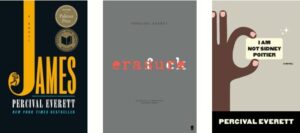
A. Mitchell Polinsky, Josephine Scott Crocker Professor of Law and Economics, recommends James, Erasure, and I am Not Sidney Poitier by Percival Everett
I have recently become a huge fan of the fiction writing of Percival Everett. I read his highly-regarded James (2024 National Book Award for Fiction, short-listed for the 2024 Booker Prize) a year or so ago and loved it, and I’ve recently completed Erasure and I am Not Sidney Poitier. In these latter books Everett writes with great compassion and humor about the foibles of his characters, and his stories exhibit a cleverness that is almost over the top. I can’t believe that it took me so long to discover him!
Robert L. Rabin, A. Calder Mackay Professor of Law, recommends The Art Thief and The Stranger in the Woods by Michael Finkel
David A. Sklansky, Stanley Morrison Professor of Law, recommends What We Can Know by Ian McEwan
This is a fantastically entertaining adventure story and a deeply moving novel of ideas. It’s about love, loss, betrayal, memory, history, and literature. Also climate change and our relationship with the natural world.
Mila Sohoni, Professor of Law, recommends The Golden Road by William Dalrymple, Spinning Silver by Naomi Novik
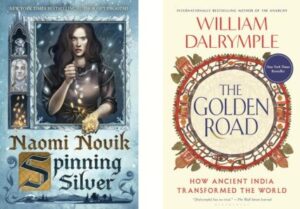
William Dalrymple’s The Golden Road traces the remarkable radiation of ideas from ancient India across the globe, tracking everything from Buddhist philosophy to trigonometry. I’ve read histories of India before, but never one that focused on ideas rather than events.
For something from an entirely different world, I enthusiastically recommend Naomi Novik’s Spinning Silver. Part fairy tale, part adventure, part romance, it’s the perfect book to read if you have the luck to be someplace snowy during the holidays.
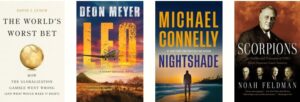
Barton H. “Buzz” Thompson, Jr., Robert E. Paradise Professor of Natural Resources Law, recommends The World’s Worst Bet by David J. Lynch, Leo by Deon Meyer, Nightshade by Michael Connelly, and Scorpions by Noah Feldman
Am currently reading The World’s Worst Bet, by David J. Lynch (financial reporter for the Washington Post). Lynch explains through a series of stories and profiles how the United States went from favoring free trade in the Clinton administration to promoting tariffs under the current president. A useful set of lessons for what went wrong and how to ease trade restrictions more successfully in the future. Also on my recent reading list have been Leo (the most recent detective novel by South African Deon Meyer), Nightshade (introducing Michael Connelly’s newest detective hero), and Scorpions (Noah Feldman’s narrative regarding the major FDR Supreme Court appointees).