
The Intellectual Biathlete
Nate Persily Tackles Democracy and Technology in a New Volume on AI
Just one year after joining Stanford Law School in 2013, Nate Persily, JD ’98, brought together a group of strange bedfellows—officials from the Federal Election Commission, data gurus from both political parties, and senior employees at Facebook, Google, and Twitter—to discuss how technology was affecting campaigning and elections.
At the time, many people were bullish on technology’s role as a facilitator of democracy. President Barack Obama and his tech-savvy campaign had won two elections in no small part because they used social media to engage younger voters. But Persily was already concerned about how the internet could reshape our politics. In 2015, he published “The Campaign Revolution Will Not Be Televised” in The American Interest, arguing that the Citizens United case that deemed corporations to be “people” with a right to free speech was actually about “issues of evolving communication technology,” such as personalized political ads, online content moderation, and the challenge of regulating campaign finance when traditional legal categories such as who counts as “the media” turn murky.
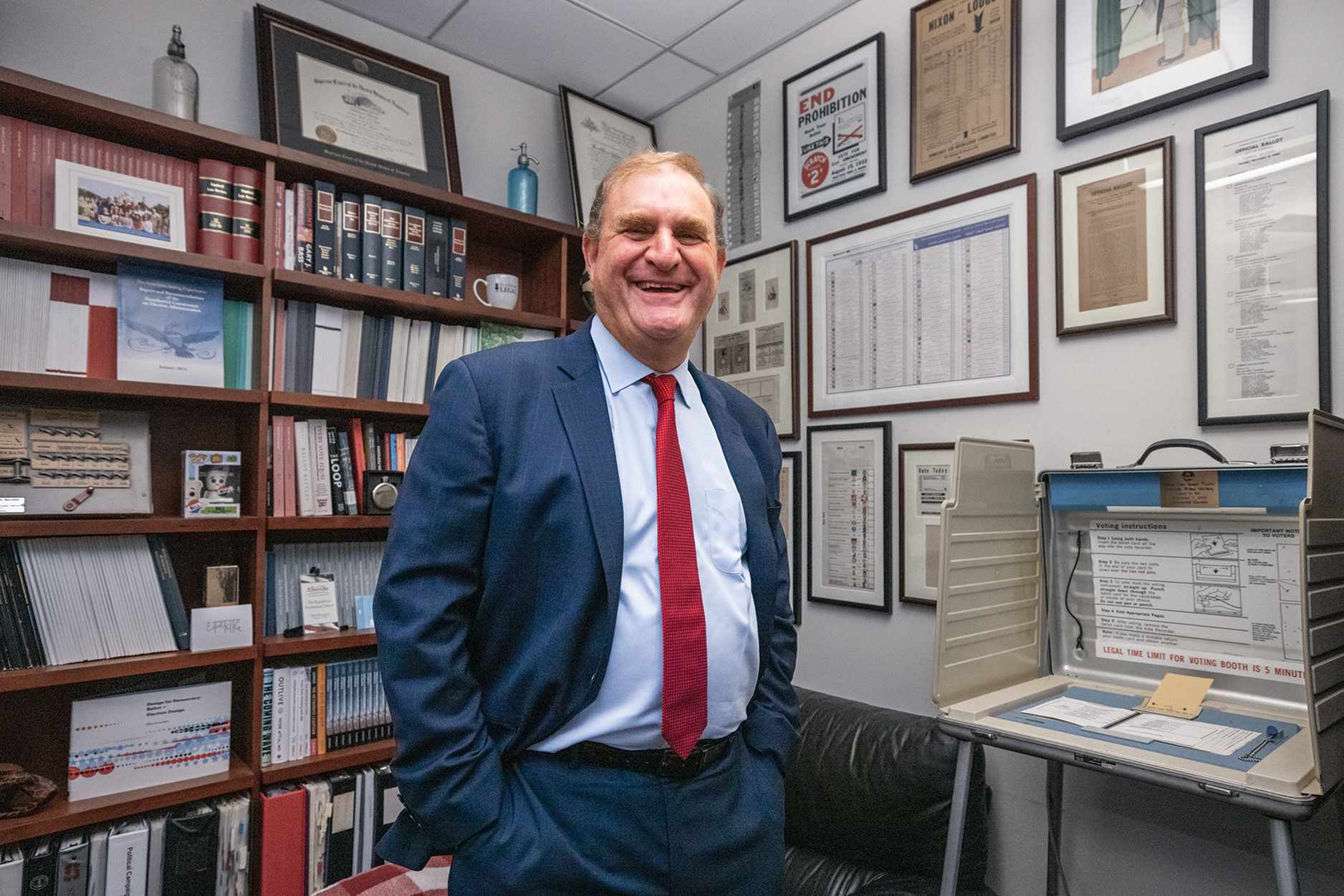
Fast-forward to 2016, when, as Persily puts it, “All hell breaks loose.” The internet, home to Donald Trump’s tweetstorms, was the epicenter of political communication. “It was clear that the positive spin people had placed on the internet and campaigning took a dark turn,” he says. And yet, compared with today’s fast-moving AI era, those days of Macedonian troll farms and Russian disinformation campaigns look almost quaint, says Persily, James B. McClatchy Professor of Law.
“Whatever worries one might have had about Facebook, no one thought that it was going to lead to massive unemployment or the extinction of the human species,” he says. “That’s what we’re dealing with when we’re talking about AI—the scale of the problems and benefits are just so much more significant, and the pace of change is unlike anything we’ve ever seen.”
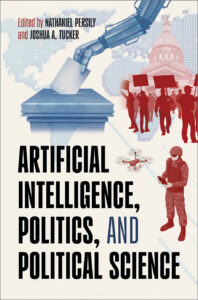
In Artificial Intelligence, Politics, and Political Science, a new volume Persily co-edited with New York University Professor Joshua A. Tucker, with whom he chairs the APSA Presidential Task Force on AI, Politics, and Political Science, teams of political scientists and legal scholars tackle how AI could transform our politics and the discipline of political science itself. As they note in their introduction: “AI is already affecting the practice and study of politics in identifiable ways.”
The contributors touch on a number of topics, including the ways artificial intelligence has been deployed in everything from public service delivery to warfare, its labor-displacing potential, and its structural biases along axes of race and gender. One article asks what it means to study public opinion in an AI age and whether surveying “silicon samples”—AI representations that mirror the American population—can produce meaningful knowledge.
“We’re trying to figure out how to remedy the current errors that we see in public opinion surveys and trying to do it cheaply with these AI systems.” But, as the authors of the article make clear, the use of AI-based samples sharpens the epistemic questions at the heart of their field. “What exactly is public opinion, and what counts as evidence of it?” Persily asks.
“AI will transform democracy just as it will transform all other social systems.”
Professor Nate Persily, JD ’98
Tucker, who also co-edited the 2020 volume Social Media and Democracy with Persily, describes him as a gifted collaborator, who brings “amazing subject matter knowledge and a real courage of his convictions.”
The breadth of the contributions highlights how much is missing from the standard conversation about AI and democracy that tends to focus on disinformation and deepfakes. “That is a small, small share of the democracy-affecting aspects of the technology,” Persily says. “AI will transform democracy just as it will transform all other social systems.”
The right law topic at the right time
Ever since he was on the debate team at Palmetto High School in Miami (along with his friend and future Supreme Court Justice Ketanji Brown Jackson), Persily has been interested in questions of constitutional design, comparative politics, and democracy. After receiving his bachelor’s and master’s degrees in political science from Yale, he spent a year in Israel at Hebrew University studying political science.
At UC Berkeley, which offered him a full ride for his doctorate, he fell in with the political scientist Nelson Polsby, whom Persily describes as a “giant planetary figure” orbited by a cadre of grad students. Every day, Polsby would gather his students for tea and to debate.
“It was the best academic training I ever got, because we would sit there at this seminar table every day, and he would tell us how wrong we were. It was great,” Persily says. “And people like Bob Woodward or Christopher Patten, the last British governor of Hong Kong, would come through and just walk in.”
During his second year of graduate school, he realized he didn’t just want to teach—he wanted to do. Persily enrolled at Stanford Law School, where he took The Law of Democracy class with Pamela Karlan, who was a visiting professor in the fall of 1996. Now the Kenneth and Harle Montgomery Professor of Public Interest Law, Karlan remembers Persily as a “standout student” who boasted that “doctrinal firepower, interdisciplinary knowledge, and practical savvy were the future of the legal field.” Twenty years later, as Stanford colleagues, he joined Karlan (and co-authors Rick Pildes and Samuel Issacharoff) on the fifth edition of the casebook The Law of Democracy: Legal Structure of the Political Process. “I think of Nate as being an intellectual biathlete,” Karlan says, referring to his expertise in both democracy and technology.
While some of his Bay Area friends dropped out of graduate programs to make millions founding tech companies, Persily moved to New York in the late 1990s to work at the Brennan Center for Justice while finishing his doctoral thesis on the rights of political parties. He helped on a few high-profile cases—such as getting Senator John McCain on the New York primary ballot during the 2000 presidential campaign—and entered the job market that fall, just as Persily’s specialty, election law, dominated national headlines.
The day after the 2000 election, which hinged on whether Florida would recount its ballots in the tightly contested race between George W. Bush and Al Gore, Persily had his first job interview at Cardozo Law School. “At the time, election law had not been a big area of interest, so I had this whole speech prepared about the rising importance of the law of elections, and there I am giving this talk when we literally don’t know who the president will be. I said to the folks at Cardozo, ‘Look, I have 10 minutes about the importance of election laws, but I don’t think I need to tell you at this point.’”
He eventually landed at the University of Pennsylvania, only to be summoned back to New York to help a federal court redraw the state’s congressional map following the 2000 census. “Everybody in the country who seemed to have expertise in this process was conflicted; either they were affiliated with the Democrats or the Republicans,” says Persily, who to this day has never been a member of any political party.
Though the plan he proposed was ultimately overturned—likely because it threatened too many incumbents by creating competitive districts—the experience was “fascinating,” Persily says.
The New York gig led to similar opportunities in Maryland, Georgia, Connecticut, Pennsylvania, North Carolina, and New Hampshire. Then, in 2012, he received an invitation from Mitt Romney’s lawyer Benjamin Ginsberg and from Robert Bauer, White House counsel under Barack Obama, to serve as senior research director for the Presidential Commission on Election Administration. “This was really the last bipartisan effort to reform American elections,” says Persily, adding that the resulting report has since been removed from government websites by the Trump administration.
By the time he arrived at Stanford in 2013, redistricting technology had changed and so had his concerns about technology’s impact on democracy. In addition to his fears about how the internet would change campaigns and elections, Persily worried that technology was contributing to political polarization. When he met with officials at the Federal Election Commission to plan a 2014 conference, he recalls that “they couldn’t even agree on whether to have bagels or donuts in the break room; they were that divided along partisan lines.”
Several years later, Persily, together with Francis Fukuyama, senior fellow at Stanford University’s Freeman Spogli Institute for International Studies, and Rob Reich (MA/PhD ’98), professor at Stanford’s School of Humanities and Sciences, started the Program on Democracy and the Internet to examine the impact of digital technologies on democratic institutions. Persily wrote one of his most widely read articles, “Can Democracy Survive the Internet?” for the Journal of Democracy, and the following year was approached by Facebook and a set of nonprofit foundations to work with Harvard political scientist Gary King to develop a strategy that would give scholars access to the company’s data. Ultimately, privacy concerns kept the effort from yielding the granular data Persily had hoped for, but it did produce what may have been the largest social media dataset ever made public at the time. “I learned a lot about what it would take to hold these companies accountable,” Persily says. “And I became convinced that legislation was necessary in order to do that.”
Persily then drafted the legislation. The Platform Accountability and Transparency Act, a bipartisan bill, is “still languishing in Congress,” he says, but its objective—requiring tech companies to grant outside researchers access to their data—lies at the core of the Digital Services Act of the EU.
Research informed by the real world
In 2025, Persily became the faculty co-director of the Stanford Law AI Initiative, working alongside his co-chair, Professor Julian Nyarko, and executive director Irene Liu.
Persily sees the initiative as an opportunity to promote and to build upon all the pathbreaking work related to AI going on at Stanford Law School. “Even though we’re small, we have more people working on AI at Stanford than any other law school by a factor of two,” he says. In particular, he notes the work of Professor Dan Ho and the RegLab, which has established itself as a leading academic center doing research on AI regulation and government deployment of AI. The AI Initiative, however, has a dual focus on both the law of AI and AI for law. In that second category, he highlights the work of his colleagues on the faculty, David and Nora Engstrom, both JD ’02, who lead the Deborah L. Rhode Center on the Legal Profession, which has undertaken important projects on how AI will transform courts and law firms, and of his co-director, Nyarko, whose “liftlab” is studying the effect of AI on legal services and legal education.
Persily also draws attention to Stanford’s star faculty in intellectual property, Professors Mark Lemley (BA ’88), Lisa Ouellette, and Paul Goldstein, who have been at the forefront of debates over AI and copyright, and Michelle Mello (BA ’93), who is the leading legal academic on the intersection of AI and the health care system.
Colleagues say that Persily’s cross-disciplinary approach, which brings students and scholars into contact with companies, law firms, and the government, is a natural fit for the initiative—and a must-have for working on something as big as AI. “Nate is a social butterfly; he really enjoys connecting with people,” Nyarko says. “This is a huge boon for the initiative because one of our stated goals—and necessities in AI—is for our research to be deeply informed by what happens out in the real world.”
Persily’s first class on AI, Governing Artificial Intelligence: Law, Policy, and Institutions, exemplifies that approach. First offered in 2024, and co-taught with Reich and computer scientist Anka Reuel (PhD ’28), the course is open to anyone at the university. It has drawn as many as 180 students, making it the biggest course he’s ever taught.
Reich describes Persily as “a masterful and energetic teacher who communicates complex ideas across a wide variety of domains with ease and a delightful, often self-deprecating, wit.” Reich also praises his ability to bring together a diverse mix of students, which results in “an electric classroom.”
The mix of students is critical to filling in gaps for one another. “The engineers are often not thinking about safety concerns in the same way that lawyers are, and we lawyers consider individual rights questions related to AI in ways the engineers find foreign. And the lawyers who don’t understand the technology are in class with the students at Stanford who are already some of the best AI experts in the world, which can help prepare them to work with the kind of technical people and entrepreneurs whom they will represent once they are lawyers,” he says.
When it comes to students using AI in his class, Persily is a realist. “My general rule is they can use AI, but they need to disclose how they used AI. If there’s one hallucination, they fail.”
A whole-of-society approach
While Persily can set AI policy for his classroom, he believes AI policy in the real world is not simply a matter of legislation. Government efforts to regulate AI face unprecedented challenges, given the rapid pace at which the technology is evolving and the knowledge gap between tech companies and regulatory bodies. (European Union officials had to rewrite the EU AI Act because ChatGPT launched as the legislation was being drafted.) “When we think about governance of AI, we think about government regulation and a command-and-control model where we say, ‘AI models can do this; they can’t do that,’” Persily says. “But few governments have the requisite expertise in-house in order to deal with it, so it is going to be extremely difficult for us to come up with a comprehensive legislative scheme.”
“We need to think about governance as an entire AI accountability ecosystem, which includes lawyers, sure, but it also includes insurance companies and auditors and NGOs and religious institutions.”
Capital markets, for example, can “play a disciplining function” if investors are willing to assume that role. Persily cites SoftBank, whose investment arm has backed some of the biggest tech companies of our time. When SoftBank executives recently visited Stanford for one of the AI Initiative’s Thursday AI policy lunches, they described requiring governance terms in their contracts not only with companies developing AI models but with certain companies that deploy AI.
Contractual terms may help to guide or prevent certain behaviors, but Persily says the deeper questions that AI raises about human consciousness, dignity, and purpose as more people form relationships with AI companions or lose jobs to automation demand answers from those who have grappled with these existential issues, such as philosophers and faith leaders.
“It’s an essential tenet of many of the world’s religions that you can define what is human and what is not, and it’s actually going to become increasingly difficult in the AI era to draw that line between where humanity ends and something artificial begins,” he says. What’s more, the answer to that question is not consistent across cultures or faiths. Persily spent a week teaching AI governance at Kyoto University in Japan, where he was exposed to Buddhist and Shinto perspectives. “They vest certain kinds of meaning and dignity in inanimate objects, so their relationship to robotics is very different,” he notes.
Earlier this year, Persily invited the Orthodox rabbi from Emek Beracha in Palo Alto and Jewish employees at various tech firms to lunch at the law school. Drawing a parallel to AI, he told the story of the golem, in which a rabbi forms a figure out of clay and watches as it suddenly comes to life. “Ultimately,” he says, “there is a kill switch on the golem,” a set of Hebrew letters that, when spoken, will drive the golem out of existence. “That gives you a sense of how scholars and religious leaders have always recognized the importance of human control over these artificial entities.”
In June, the month after Pope Leo unveiled an encyclical on “safeguarding the human person in the time of artificial intelligence,” Persily participated in a conference at the Vatican, joined by other scholars, AI company founders and high-level officers, investors, and representatives of the Vatican and various governments. He also sits on the board of the recently formed Foundation for AI, Ethics and Governance, which will work with the Vatican on grappling with the hard ethical and policy questions related to AI.
It is Persily’s hope that these powerful non-state actors can exert influence that governments cannot. “One of the things we learned from the social media age is that if we leave the companies to run free, it could lead to some socially destructive ends,” he says. “Part of the reason I want to work with these religious institutions is so that they pressure and convince the companies to go in particular directions.” That does not mean that Persily believes Pope Leo can order some AI company to stop making harmful deepfake images, but rather that faith leaders—as well as psychologists, lawyers, journalists, teachers, and myriad others—can help people both inside and outside of AI companies to consider how they engage with these tools. “I’m not under any illusion that if religion says one thing and capitalism says the other that somehow religion is going to win out,” he says. “But we’re not just talking about persuading the product designers; we are also talking about the users and how they should think about it.”
Persily spends a lot of time these days considering what the broader accountability ecosystem might look like. “How should parents think about AI with respect to their children? How should schools think about it when they integrate AI into the classroom? All of those things are going to be affected not just by governments and not just by the companies, but by every actor who cares about charting a safe and prosperous AI future.” SL