
Birthright Citizenship: The Ordinary Origins of an American Right
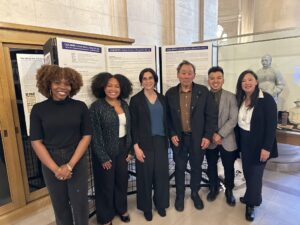
Nkemjika Abad Emenike (JD `28) and Nini Tufon (JD `28) recently traveled to San Francisco to present on birthright citizenship with Center for Racial Justice director of education and opportunity, Hoang Pham—during which they also had a chance to interview the great-grandchildren of Wong Kim Ark. Read more about their work in the Stanford Lawyer magazine. This blog post captures their experiences working on the project.
What Does It Mean to Be an American? | Nkemjika Abad Emenike
The birthright citizenship case recently decided by the Supreme Court, the divided narrative around immigration policy, and the increasingly hostile climate towards immigrants in America all beg the question: What does it mean to be an American?
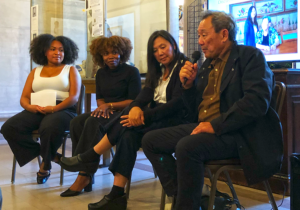
When interviewing California natives Norman and Sandra Wong, it was clear to them that their Japanese and Chinese heritage never made them doubt their American identity. And it was only recently that they discovered that this privilege was fought for them by their own great-grandfather, Wong Kim Ark, whose case settled that any person born in the United States, regardless of race, was an American citizen. In learning about their great-grandfather and the importance his case holds for millions of Americans, what struck them most was how unremarkable his life had been before the case. He was a laborer like most Chinese Americans at the time. He did not come from wealth. He did not come from a politically powerful family. He was ordinary. And it was this ordinariness that we should remember most about him.
Wong Kim Ark’s fight is a testimony that the common person can make an unfathomable difference when he recognizes and fights for his undeniable rights guaranteed to him by our Constitution. As we spoke with Sandra and Norman, it was clear that for them—and for many Americans—to be an American has little to do with lineage or race, and everything to do with resilience.
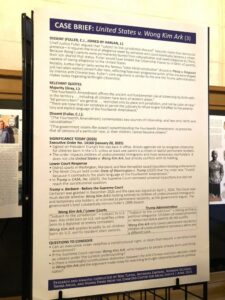
Wong Kim Ark’s legacy and the recent fight for birthright citizenship is incredibly important for me academically as a historian, as a law student, and as the daughter of immigrants from the Philippines and Nigeria. But researching the history of his case also highlights the significance of understanding just how intertwined the histories of racially marginalized communities in America really are. The Reconstruction-era Amendments were passed with the goal of abolishing slavery and expanding civil rights in the United States. The Fourteenth Amendment, ratified in 1868, also served as part of the winning legal argument for the birthright citizenship case brought 30 years later in 1898 by Wong Kim Ark, a Chinese American man.
And more recently, U.S. v. Wong Kim Ark was challenged in order to strip away the rights of first-generation Americans, mainly targeting Latin American immigrants. The Civil War, anti-Chinese violence, and dehumanization of undocumented immigrants could be seen as distinct historical events. Or they can be seen as shaping one another—events tied together in their shared nature of all being turning points in American history, each redefining or challenging ideas of citizenship and race.
The process of researching birthright citizenship and presenting it alongside my colleagues to a public audience reaffirmed the lessons I learned from Wong Kim Ark’s case. Wong Kim Ark’s fight is proof that civil rights wins for one community at one point in time can lead the way for consequent civil rights wins for other communities. And in that same vein, a threat to a fundamental, constitutionally guaranteed right for one group of people, such as the recent challenge to birthright citizenship, is a threat to all constitutional rights for any group of people. Trump v. Barbara was a powerful moment for the public to remember that these fights are continuous, driven by ordinary people, often from different backgrounds but all with ambitions to enjoy life in America as people with fully recognized rights regardless of race or nationality.
Research and Community Engagement to Unpack Birthright Citizenship | Nini Tufon
I have birthright citizenship because I was born in this country, which means my citizenship traces directly back to the right Wong Kim Ark secured in 1898. That fact had always felt distant and abstract until Trump v. Barbara. Watching the case unfold made the stakes impossible to ignore, and as the child of immigrants, it was hard not to think about my own family’s relationship to this country while researching it.
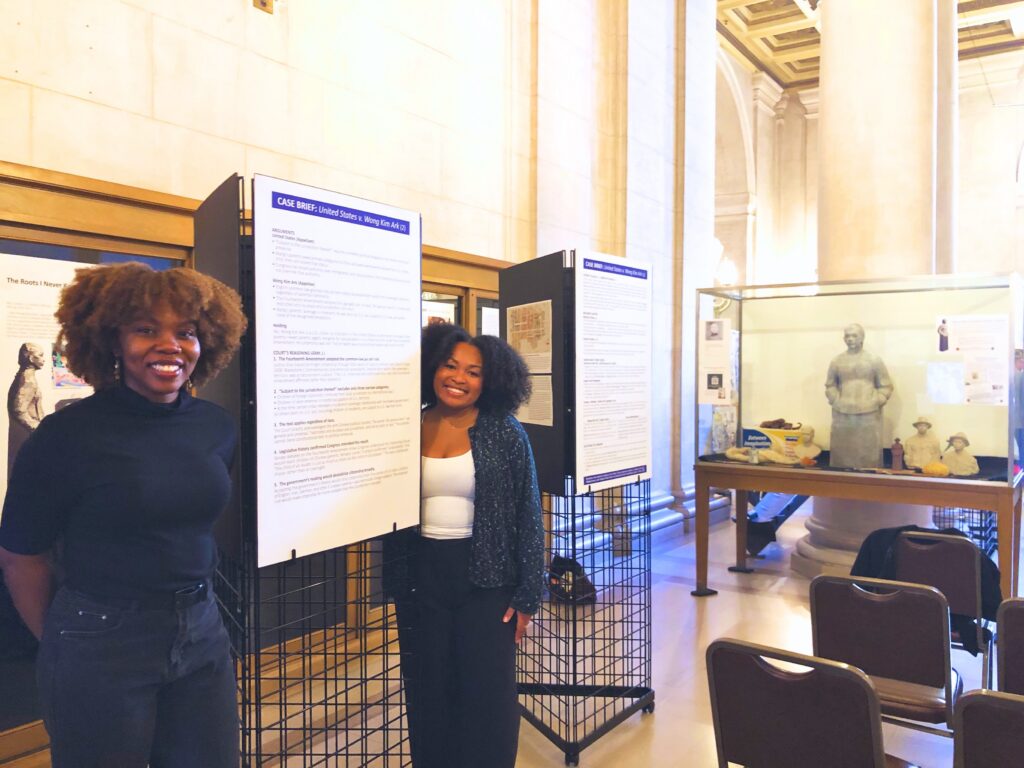
My involvement in the Wong Kim Ark project started with San Francisco sculptor Alicia Ponzio, who is creating a bronze bust of Wong Kim Ark for his native city. She wanted the legal history of his case woven into the project, so she reached out to the Stanford Center for Racial Justice. Like many people, I only recently learned who Wong Kim Ark was and the significance of his case. Researching his story, and the broader story faced by Asian immigrants and immigrants of color during that era, was extremely meaningful to me.
Being a law student shaped the research too. The exhibit and the presentation needed to stay true to constitutional analysis while still being accessible to people without a legal background. That meant being thoughtful about which quotes to keep, which legal terms needed unpacking, and how to phrase things clearly without losing what actually made the case significant. I often thought about what would have made sense to me a year earlier, before law school, and tried to write with that in mind.
Though what I most wanted to understand going into our interview with Sandra and Norman was what it feels like to discover, as an adult, that your family’s private history is also part of the country’s collective one. That kind of discovery doesn’t happen to most people, and when it does, it rarely happens all at once.
Sandra was the one who first came across her great-grandfather’s story, finding a newspaper clipping about him at her father’s funeral in 2011. She told us that researching what she’d found wasn’t something she sat down and finished all at once. She worked through it gradually, picking it back up as life allowed and talking about it as it came up. It didn’t take her especially long, but there also wasn’t a single moment where everything clicked into place. It came together over time. When we asked how Wong Kim Ark managed to keep fighting despite the treatment he faced, both Sandra and Norman pointed to his perseverance. But what Norman wanted people to understand most was that Wong wasn’t extraordinary in any obvious way. He was just a regular guy who refused to stop, with the support of his community behind him.
One thing that struck me throughout this research was that the argument made against birthright citizenship in Trump v. Barbara was largely the same one that lost in 1898. It’s interesting to see it resurface in the way it did, but so has the story of the man it lost to. His perseverance leaves me with a sense of hope during a time with separate and yet all too familiar challenges.
Nkemjika Abad Emenike (JD `28) is a rising 2L at Stanford Law School from Los Angeles, CA, and Las Vegas, NV. Her academic interests focus on civil rights work, community organizing, history, and racial justice. Before coming to Stanford she was a paralegal at a civil rights firm in Chicago working on wrongful conviction cases and sexual harassment cases. Nkemjika graduated from Washington University in St. Louis in 2023, magna cum laude, with a degree in History and minors in Chinese and African and African American Studies. At SLS, she is active in the Stanford Journal of Civil Rights and Civil Liberties, Black Law Students Association, and the Sports and Entertainment Law Students Association. In her free time, she enjoys sitcoms, baking, and running.
Nini Tufon (JD `28) is a rising 2L at Stanford Law School. She grew up in the Atlanta metropolitan area, and her family is originally from Cameroon. Her interests center on international law and access to justice, with a particular focus on how legal systems can better serve marginalized and underserved communities. At Stanford, Nini is involved in pro bono and research initiatives related to human rights and educational equity. Outside of law school, Nini is a co-founder of Bridge 19:17, a faith-based nonprofit that addresses housing insecurity, poverty, and resource access through community-centered initiatives. Her approach to this work is shaped by a commitment to building systems that make it easier for people to find support, feel seen, and succeed regardless of background. In her free time, Nini enjoys reading and writing, staying active, and engaging with creative outlets through movement and dance. She values mentorship and collaboration, and hopes to build a career that combines legal training with meaningful community impact.
Follow the Stanford Center for Racial Justice on LinkedIn and Instagram and subscribe to our newsletter.