
Not Just Law.
Stanford Law.
Research, Scholarship and News
With impact in everything from constitutional law and privacy rights to campaign finance reform and the environment, members of the Stanford Law School community shape law and policy through leading-edge research.




SLS Degree Programs


Join a diverse and inclusive community shaped by a commitment to the future.
Learn more : The JD Program
A hallmark of Stanford University and a distinct strength of Stanford Law, where students can explore the many ways law intersects with other fields.
Learn more : Joint Degree Programs
One-year master's degree programs and a doctoral degree (JSD) for international graduate students who have earned a law degree outside the United States.
Learn more : Advanced DegreesStanford Law Students Share Their Stories





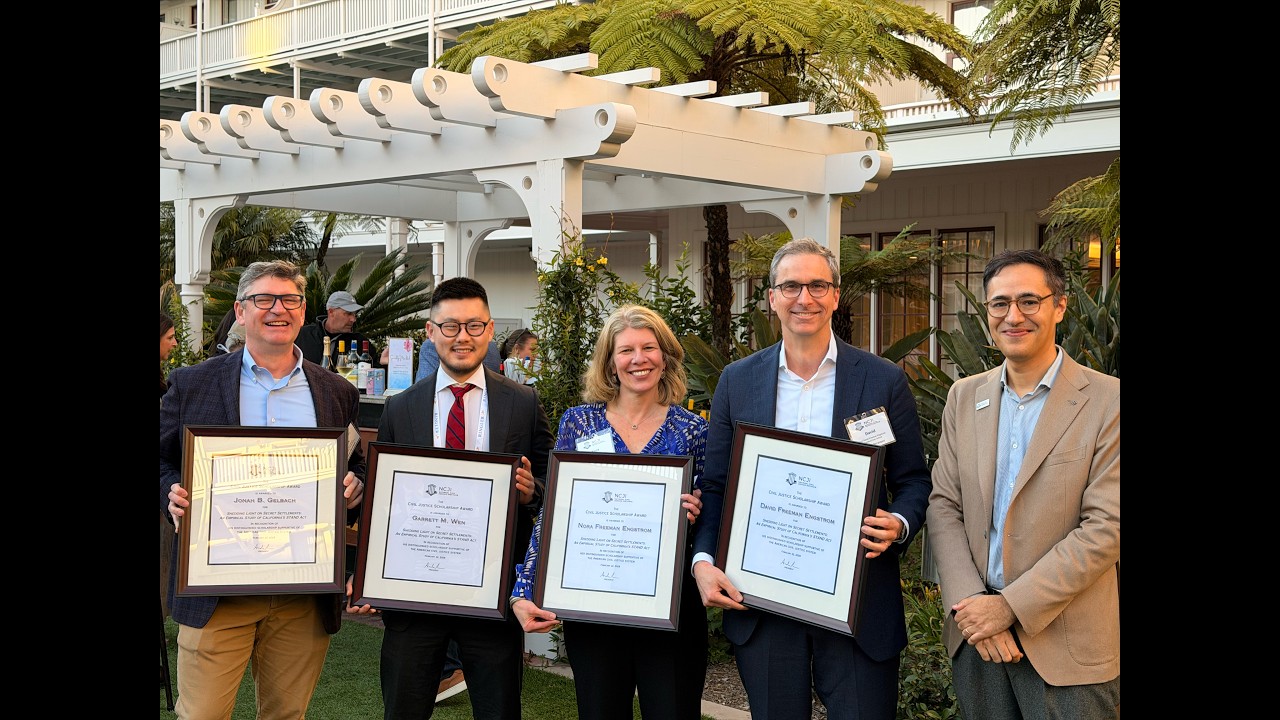
Shedding Light on Secret Settlements: California’s STAND Act
Connect with Us

Stanford researchers are using AI to tackle a growing problem: outdated regulations that slow government and hinder public services.
The Stanford Institute for Human-Centered AI and Stanford RegLab developed an AI tool that scanned 500 million words of state statutes across all 50 U.S. ...states, identifying "policy sludge"—obsolete processes and reporting requirements that trap civil servants in red tape.
"This is a direct example of how AI can benefit millions of people," says Daniel E. Ho, faculty director of the RegLab, associate director at HAI, and a Stanford Law School professor. "These tools can clean up outdated requirements, reduce burdens on civil servants, and enable government to serve regular people."
The research has already prompted action. New York Gov. Kathy Hochul issued an executive order this month directing agencies to conduct a "regulatory reset." RegLab is partnering with New York, California, and Maryland to help streamline their legal codes and improve services for residents navigating business licenses, building permits, and other bureaucratic processes.
Read more:

(Originally published by The Stanford Institute for Human-Centered AI on July 23, 2026.) Bureaucracy moves slowly, and decades of outdated provisions
brnw.ch


Meet Delia Appiah Mensah, JD ’26.
For Delia, the idea of a “dream job” doesn’t quite fit. Instead, she’s focused on pursuing work that advances civil liberties and civil rights, following opportunities that genuinely interest her and trusting where they lead.
This fall, ...she’ll head to Chicago to join the General Litigation practice at Jenner & Block LLP.
One of Delia’s favorite Stanford Law memories came after 1L finals, when she stayed up until 4 a.m. with fellow soon-to-be affinity group presidents. What started as an impromptu late-night gathering became a reminder that some of the best moments happen when you least expect them.

Debt collection lawsuits are surging, and state courts are struggling to keep up.
In a recent New York Times article, Stanford Law Professor David Freeman Engstrom explains how technology has sharply lowered the cost of filing these cases at scale. “It’s incredibly easy, and the ...marginal cost has gone down,” he said. “Courts are choking on these cases.”
Engstrom is faculty co-director of the Deborah L. Rhode Center on the Legal Profession, which studies how high-volume civil litigation affects courts and litigants and works directly with court systems to develop practical reforms.
The article, “It’s Easier Than Ever for Debt Collectors to Take Consumers to Court,” highlights a Rhode Center and Legal Design Lab partnership with the Superior Court of Los Angeles County, the nation’s largest trial court. Stanford researchers are testing whether AI can help court staff review debt collection default judgment requests more accurately and efficiently.
Read the article in The New York Times. Subscription may be required: https://brnw.ch/21x4wFc

SLS Plaintiffs’ Law Association (@sls_pla) students met up in the Windy City this past weekend for the annual American Association for Justice conference. They gathered to greet each other over the summer, heard from inspiring advocates for justice, and learned tips and tricks for trial advocacy....
Thanks to @bridgfordlaw and @shanin.specter @klinespecter for making this opportunity possible.