

New Research Brings High School Student Voices to the Forefront of Education Policy
At Gunderson High School in South San José, California, a group of students gathered last year to talk about what school could be—if it worked better for them. One student wished for more hands-on training to prepare for a job right after graduation. Another wanted more counselors. A third asked for something simpler: more comfortable desks.
Those conversations form the basis of Roses Talk: Elevating At-Promise Student Voices in San José Unified, a body of research produced through Stanford Law School’s Law and Policy Lab and driven by the Stanford Center for Racial Justice and the Stanford Graduate School of Education. The Law and Policy Lab is a cornerstone of Stanford Law’s experiential learning program, offering students the opportunity to conduct rigorous policy research for real-world clients—in this case the San José Unified School District, the largest school district in Silicon Valley.
The project set out to capture the perspectives of students who are typically left out of education policy discussions—a need identified by district leaders—and to translate those insights into district- and school-level recommendations for change.

To do so, Stanford student researchers conducted in-depth interviews with 16 “at-promise” high school students—a deliberate reframing of the term “at-risk.” The interviewees represented a cross-section of marginalized experiences at Gunderson High School in San José, including students with lower GPAs, inconsistent attendance, in special education, and with prior suspensions. To preserve the high school students’ anonymity, the researchers used a rigorous analytical approach developed by education scholars that allows for the creation of “composite characters”—those which synthesize themes from multiple interviews. These anonymized, data-rooted, student characters—Alejandro, Tati, Renzo, and Jasmine—conveyed daily life at Gunderson and the students’ hopes for change.

As the Stanford student-researchers analyzed the interviews, clear themes emerged.
“Many of the high school students described the outsized importance of relationships with trusted adults,” said Hoang Pham, a former teacher and the Center for Racial Justice’s director of education and opportunity, who co-led the project with Professor Subini Annamma of Stanford’s Graduate School of Education. “What mattered most was being seen and supported, whether that was by a teacher, a counselor, or an administrator simply asking how their day was going.” Many students also said they wanted earlier guidance on paths to economic stability after high school, whether by continuing their education or joining the workforce, he said.
Learn More and Read the Full Report
Ralph Richard Banks, the Jackson Eli Reynolds Professor of Law and faculty director of the Center for Racial Justice, said education policy is too often shaped without meaningful input from the students most affected by it. “Roses Talk reflects the center’s commitment to linking policy conversations to the experiences of those touched by the policy. The insights and experiences of students should be viewed as essential evidence for change,” he said.
Annamma added, “Students, particularly at-promise students, are constantly navigating the consequences of policy decisions, and are often harmed by policies that punish instead of offer support. Inviting at-promise students into the conversation leads to more grounded, responsive approaches to teaching and learning.”

‘Something Brilliant Can Emerge’
Policy lab student-researcher Rebecca Han, JD ’26, said she was struck “by the clarity and strength of the student voices, and the eventual challenge in translating their very concrete concerns and suggestions for improvements into policy tools.
“The stories the high school students shared spanned a spectrum of experiences and emotions, from simple acts of resistance or self-assertion, to joy and community, to disappointment and reconciliation, to dreams and future plans, sometimes despite a lack of resources,” she said. “So many of the proposed solutions were common among the students: a suggestion that a program be advertised in ninth instead of tenth grade, adding more counselors, or just making improvements to facilities like adding more water fountains.”
Jodi Lax, associate superintendent of instruction at San José Unified, said that the district wants to establish similar processes in all of its high schools “to make sure we are looking at what our students need.” Lax said the district will work closely with Gunderson to implement the recommendations and then scale successful changes. “What we learn at Gunderson will undoubtedly shape policies that strengthen student outcomes across the district.”
Gunderson High School principal Anisha Dalal said the report highlighted strengths and areas for growth that school leadership would not have identified without Stanford’s research support. Her team has already begun responding to the report’s recommendations, she added, including redesigning the school’s advisory period to expand students’ access to information about college and career pathways. The school will continue working with the Center for Racial Justice on a second phase of the project focused on implementing, assessing, and refining the recommended policy changes.
The policy lab’s name, Roses Talk, was inspired by Tupac Shakur’s poem, “The Rose That Grew from Concrete,” a metaphor that resonated with Pham. “Concrete is a place from which you wouldn’t expect anything beautiful to grow,” he said. “But despite the obstacles, trauma, and barriers, something brilliant can emerge. In this case, it is the students who emerge.”
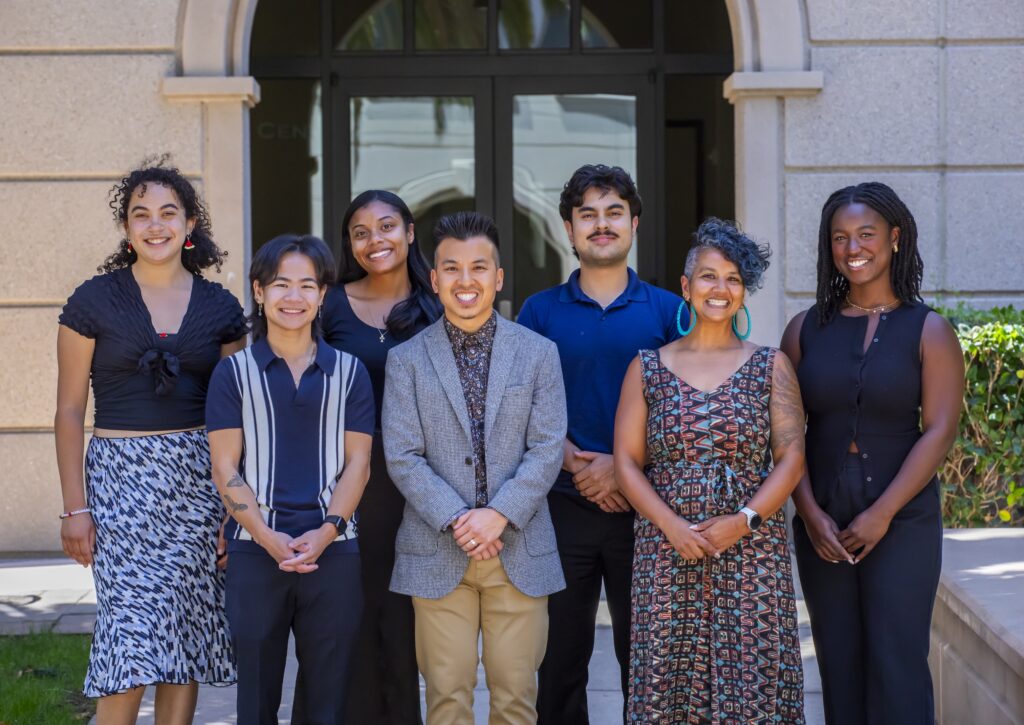
Policy lab student Andrea Akinola, JD ’27, said the poem’s imagery aligned with her experiences with the students. “Each time I listened to the interviews, I was struck by how thoughtful, passionate, and creative these students are. I’ve been so impressed by their ability to be both vulnerable and imaginative as they opened up about their stories and envisioned what a school system that truly met their needs would look like. It’s clear they know better than anyone else what they need to thrive.”
The project was supported by a 2025 Community Engagement Impact award from the Stanford Office of Community Engagement and a Cardinal Course Grant from the Haas Center for Public Service, and was recently awarded 2026 Community Engagement Impact funding to continue the research partnership with San José Unified.
About Stanford Law School
Stanford Law School is one of the world’s leading institutions for legal scholarship and education. Its alumni are among the most influential decision makers in law, politics, business, and high technology. Faculty members argue before the Supreme Court, testify before Congress, produce outstanding legal scholarship and empirical analysis, and contribute regularly to the nation’s press as legal and policy experts. Stanford Law School has established a model for legal education that provides rigorous interdisciplinary training, hands-on experience, global perspective and a focus on public service.